A horizon on the Moon
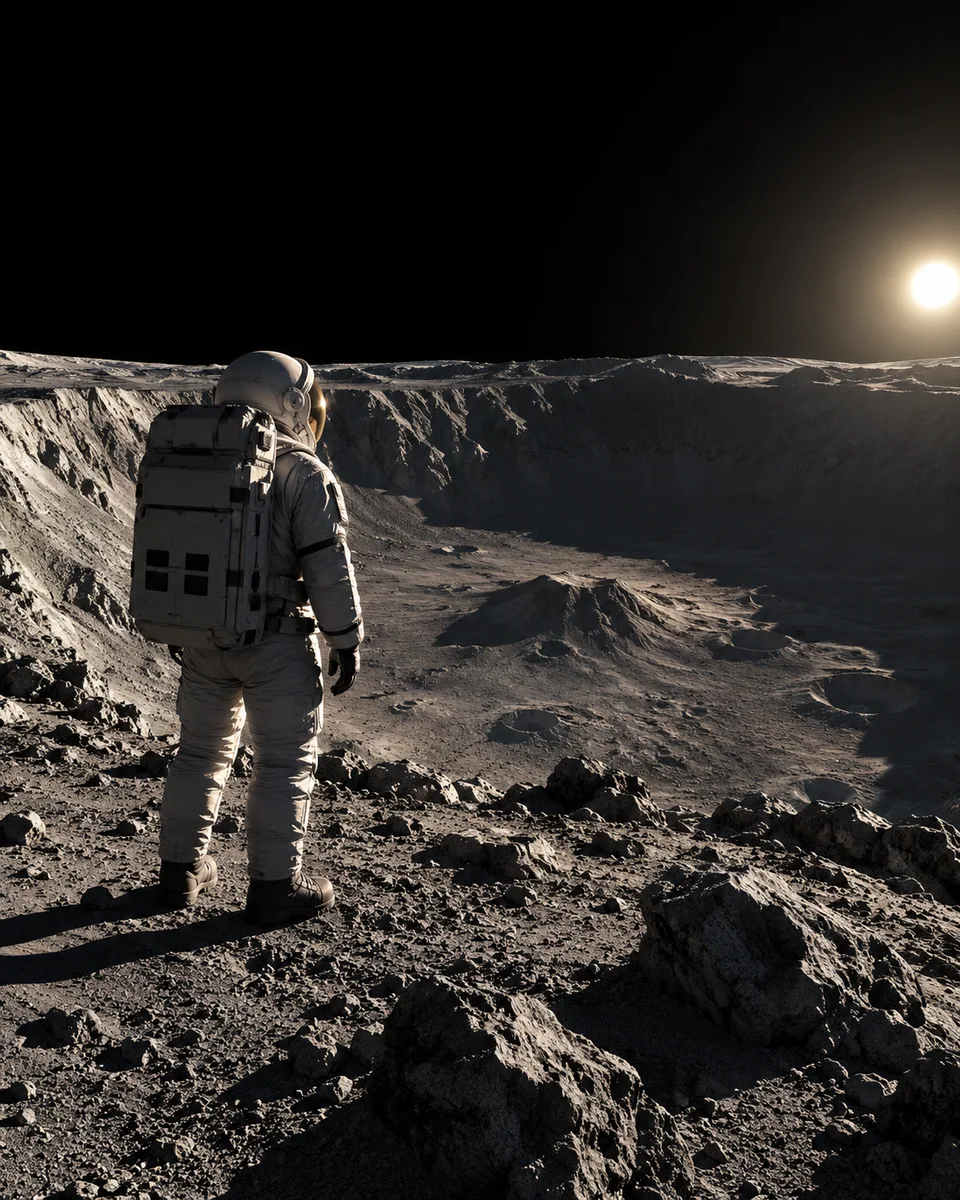
myAudience · AI-generated original illustration · Original AI-generated illustration; not documentary evidence; no third-party artwork reproduced.
A lunar horizon looks unfamiliar partly because the Moon lacks Earth’s substantial atmosphere. There is no blue daytime sky like ours, and the boundary between sunlit ground and shadow can be striking. The apparent light in this illustration is an artistic construction, however; it should not be used to infer a measured temperature, exposure setting or exact location on the Moon.
The phases seen from Earth follow a different idea from the local view of a landscape. Sunlight illuminates roughly half the Moon at any moment. As the Moon orbits Earth, our line of sight includes different fractions of that lit half. An ordinary crescent is not Earth’s shadow covering the Moon. Earth’s shadow is involved in a lunar eclipse, which requires a particular alignment.
Model the distinction with a ball and a fixed lamp in a dim room. Keep the lamp in one place, hold the ball away from your head and change your viewing position. The ball remains partly illuminated while the visible lit fraction changes. Keep yourself from blocking the lamp accidentally, since that would introduce a shadow resembling a different phenomenon. A simple model explains geometry without claiming to reproduce lunar distances or surface conditions.
When reading real lunar images, look for mission name, location if known, capture date and lighting information. A spacecraft image and a painting can both be beautiful, but they answer different questions. The generated crater edge here is useful for imagining a viewpoint; NASA observations are needed for claims about actual terrain. Try naming one thing the artwork suggests and one thing that would require a measured image to establish.
Image: illustration, not a documentary photograph.