Layers at a Martian delta
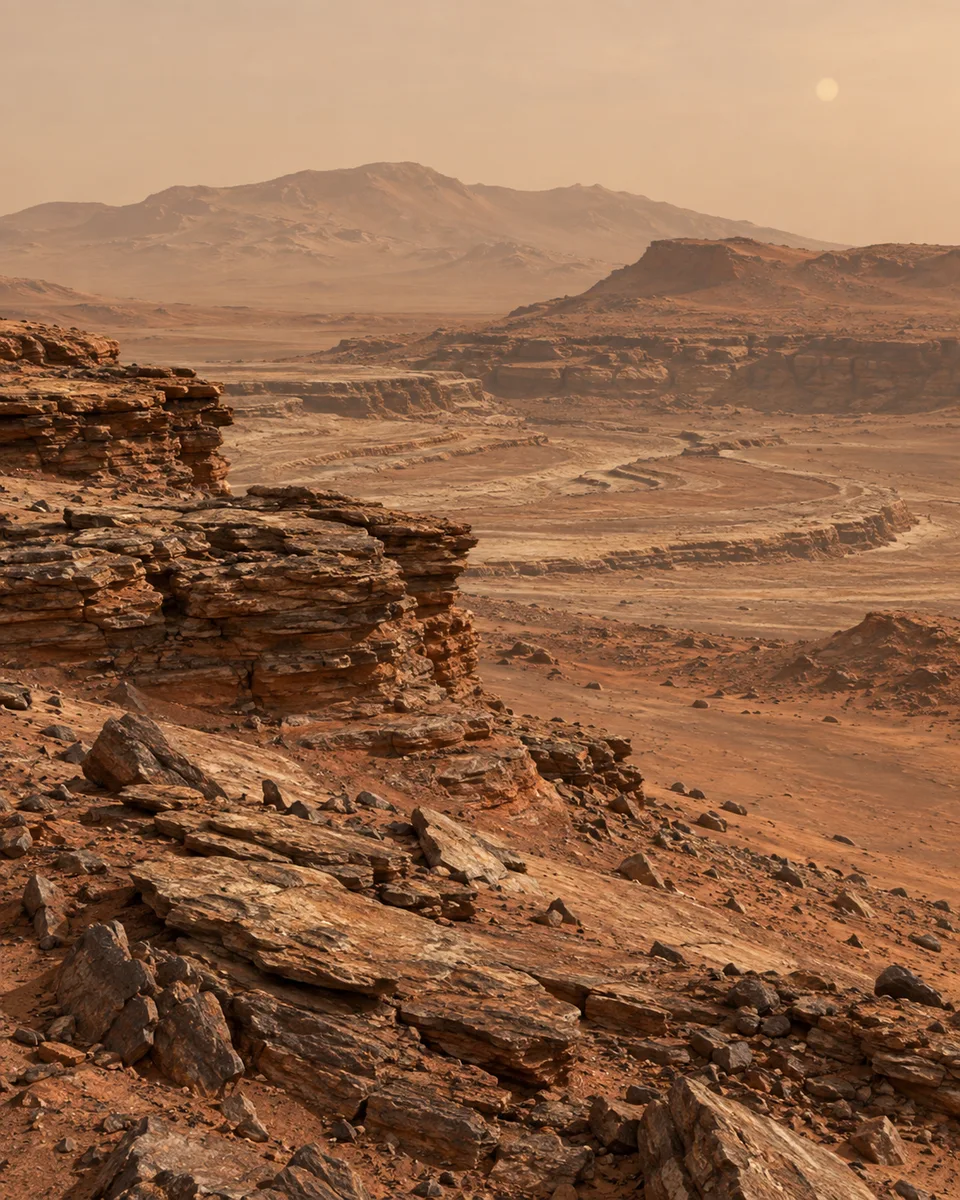
myAudience · AI-generated original illustration · Original AI-generated illustration; not documentary evidence; no third-party artwork reproduced.
A delta forms where sediment carried by flowing water accumulates as the flow slows. Its layers can preserve a record of changing transport and deposition. Jezero Crater on Mars contains a delta that makes it important to Perseverance’s investigation of ancient environments. The presence of a delta supports questions about past water; it does not by itself establish that organisms once lived there.
Sediment is informative because transport sorts and rearranges material. Grain size, layering and the relationships between deposits can help researchers reconstruct how a setting changed. A coarse deposit may tell a different story from a fine one, but interpretations depend on surrounding evidence. The scientific task is to compare plausible explanations, not simply match a rock colour to a single event.
A gentle model can use dry grains of different sizes arranged in layers in a clear container. Draw the sequence before changing it, then ask what a later observer could infer from the surviving layers. Removing one layer demonstrates why an incomplete record can support several histories. This models the problem of interpretation, not Martian chemistry, rover sampling or the actual age of the deposits.
Our orange cliff is an imagined scene. For real evidence, use an identified rover image with its mission context and the accompanying scientific explanation. A sample’s importance comes from what can be measured and how it fits the wider geological record. Keep three claims separate when reading: water existed in some past setting, conditions might have supported life, and evidence of life has been established. They are not interchangeable conclusions.
Image: illustration, not a documentary photograph.