A pattern you can count
By Maths in the wild · myAudience
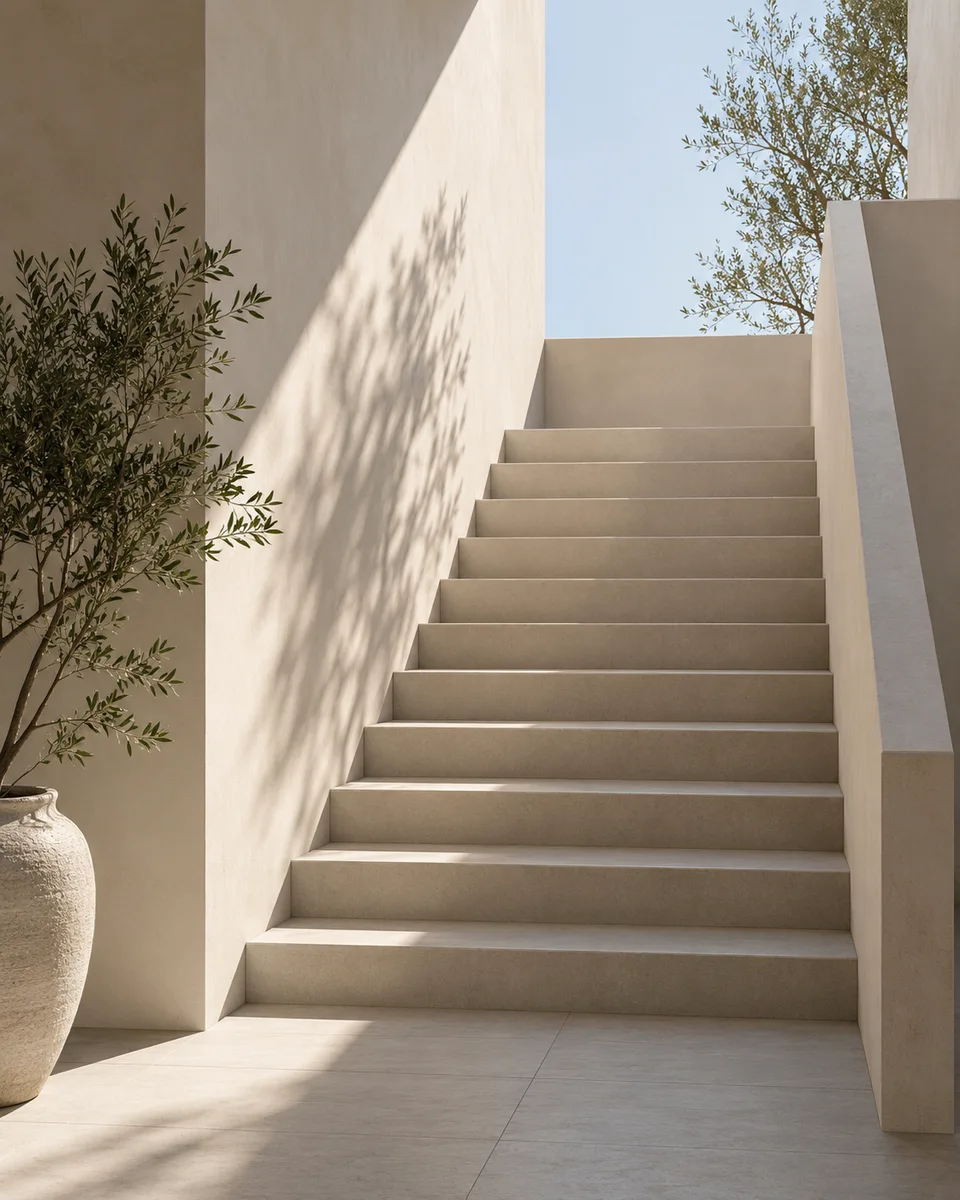
myAudience · AI-generated original illustration · Original AI-generated illustration; not documentary evidence; no third-party artwork reproduced.
A staircase combines repeated vertical rises with horizontal treads. Count the rises carefully: the number of visible treads and the number of height changes need not be identical at the landings. A mathematical model starts by choosing what one repeated unit means, rather than multiplying an appealing number of shapes in a picture.
If every rise has height r, the vertical height after n rises is h = nr. This is direct proportion: doubling n doubles h when r stays constant. Adding a starting height h₀ changes the rule to h = h₀ + nr. The constant difference between consecutive heights remains r, but the graph no longer has to pass through the origin.
Vertical rise, horizontal run and distance traveled are separate quantities. A simplified straight ramp with rise h and run d has length √(h² + d²). Walking on individual stair treads follows a different route; the ramp calculation cannot automatically be presented as the exact walking distance. Consistent units and a clear path are part of the solution.
Worked example: twelve equal rises of 0.15 m produce a height of 12 × 0.15 = 1.80 m. If the horizontal run between landings is 2.40 m, the straight-line diagonal is √(1.80² + 2.40²) = 3.00 m. Check: is 3.00 m the vertical height? No; the vertical height remains 1.80 m.
The generated staircase is a visual starting point, not a construction plan or building-code example. The exercise uses stated dimensions rather than measurements inferred from perspective. When a real pattern is uneven, record individual rises or explain why an average is an acceptable approximation.
Image: illustration, not a documentary photograph.