Symmetry in a tiled floor
By Maths in the wild · myAudience
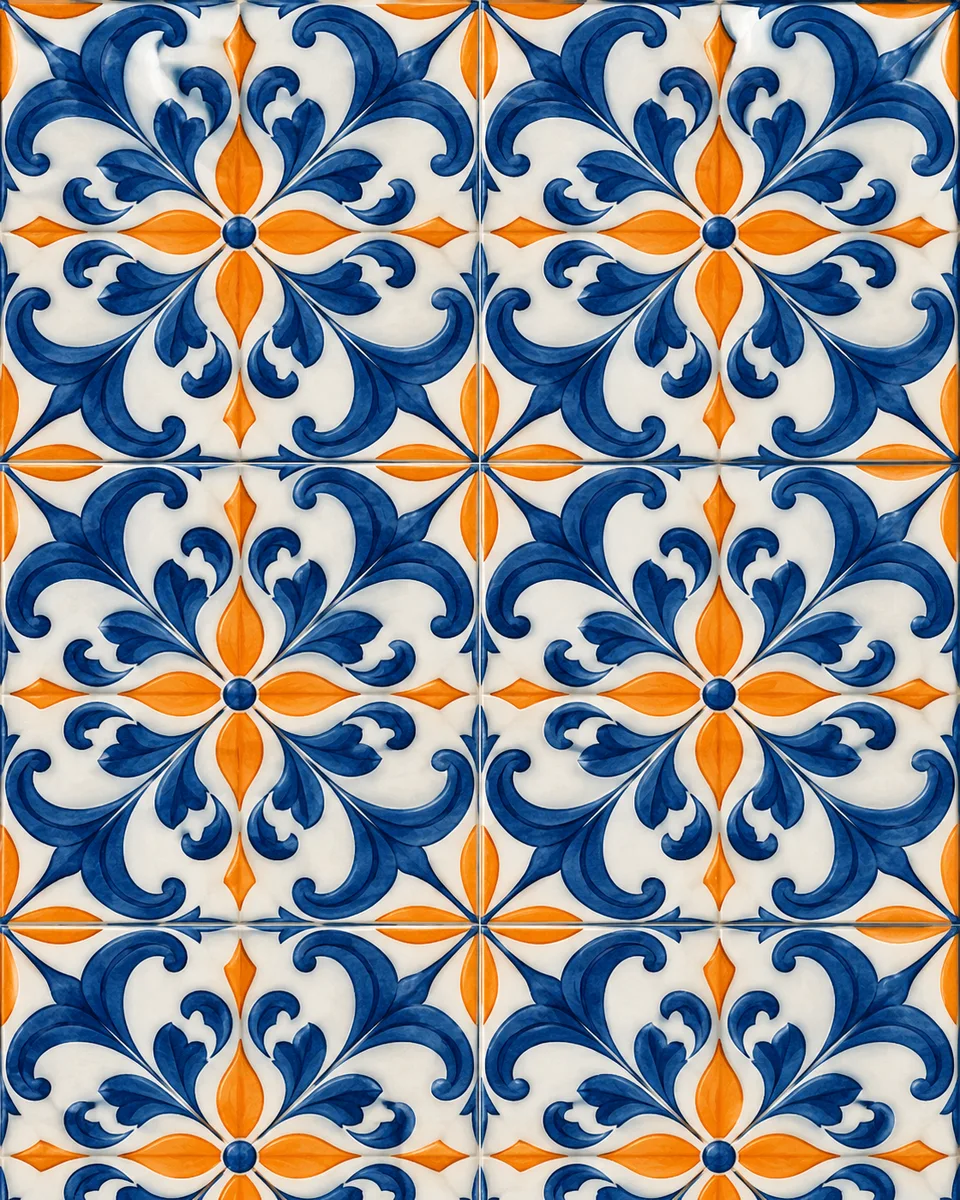
myAudience · AI-generated original illustration · Original AI-generated illustration; not documentary evidence; no third-party artwork reproduced.
A repeating floor pattern can be studied at two scales: the decoration within one tile and the arrangement across several tiles. A symmetry is a transformation that leaves the selected pattern unchanged. It is not simply a statement that the design feels balanced or looks attractive.
Reflection maps each point to an equal distance on the opposite side of a mirror line. Rotation turns a figure about a fixed center. Translation moves every point by the same vector. A decoration might repeat by translation across the floor while having no mirror symmetry inside its own tile; the object being tested must be stated.
The order of rotational symmetry counts how many times the shape matches itself during a full turn, including its starting orientation. A plain square has order 4 because rotations through 90°, 180°, 270° and 360° match it. A colored motif drawn inside that square may reduce this order because the colors and markings also have to match.
Worked example: imagine a square tile with only its top edge marked blue. The square outline still has fourfold rotational symmetry, but the marked design returns to the same position only after 360°, so its rotational order is 1. Check: why is a 180° turn not a symmetry of the marked tile? It moves the blue edge to the bottom.
A useful test is to trace a repeat unit and compare its transformed copy, including the decoration rather than only the border. Our generated artwork may include small inconsistencies, so do not assume that every visible repeat is mathematically exact. A verified diagram or explicit coordinates provide stronger evidence than an ornamental image.
Image: illustration, not a documentary photograph.