A curve worth noticing
By Maths in the wild · myAudience
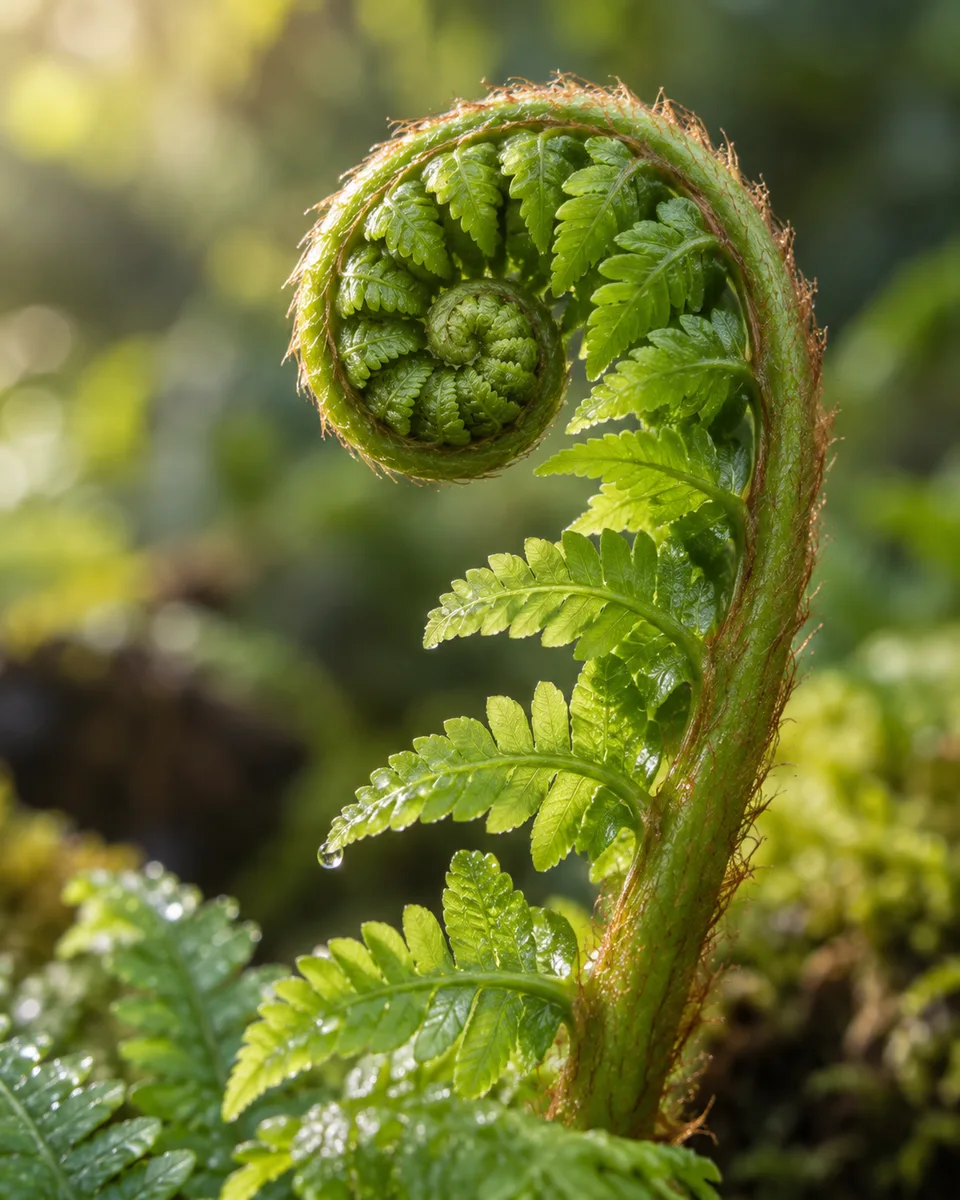
myAudience · AI-generated original illustration · Original AI-generated illustration; not documentary evidence; no third-party artwork reproduced.
An unfurling fern offers a curve worth drawing, but seeing a spiral does not establish one exact equation. Mathematical models simplify a selected feature. First decide whether you are modeling the outer silhouette, the centerline of a stem or the spacing of leaves; those are different data sets.
A circle has a fixed distance from its center. An Archimedean spiral increases its radius by an equal amount for equal changes of angle. A logarithmic spiral multiplies its radius by a constant factor over equal angle intervals. These definitions make testable claims about a curve; a visual resemblance alone does not decide which model fits.
Measurement adds a practical limitation. A photograph projects a three-dimensional plant onto a plane, and perspective can change apparent distances. Repeated measurements should use the same reference point and scale. If a model misses the data, investigate the measurement and assumptions instead of declaring that nature must obey a fashionable ratio.
Worked example: at three equally spaced angles, measured radii are 2 cm, 4 cm and 6 cm. The constant increase of 2 cm is consistent with an Archimedean model over those points. Radii of 2 cm, 4 cm and 8 cm instead have a constant ratio of 2. Check: do three points prove either model over the entire fern? No; more observations could reveal a different pattern.
The picture is generated botanical art, not a specimen measurement. You can still use it to frame a question or compare curve vocabulary. For a quantitative claim, collect a scale-calibrated set of observations and report how closely the model fits rather than claiming an exact golden ratio from appearance.
Image: illustration, not a documentary photograph.