A ripple travels outward
By Physics you can picture · myAudience
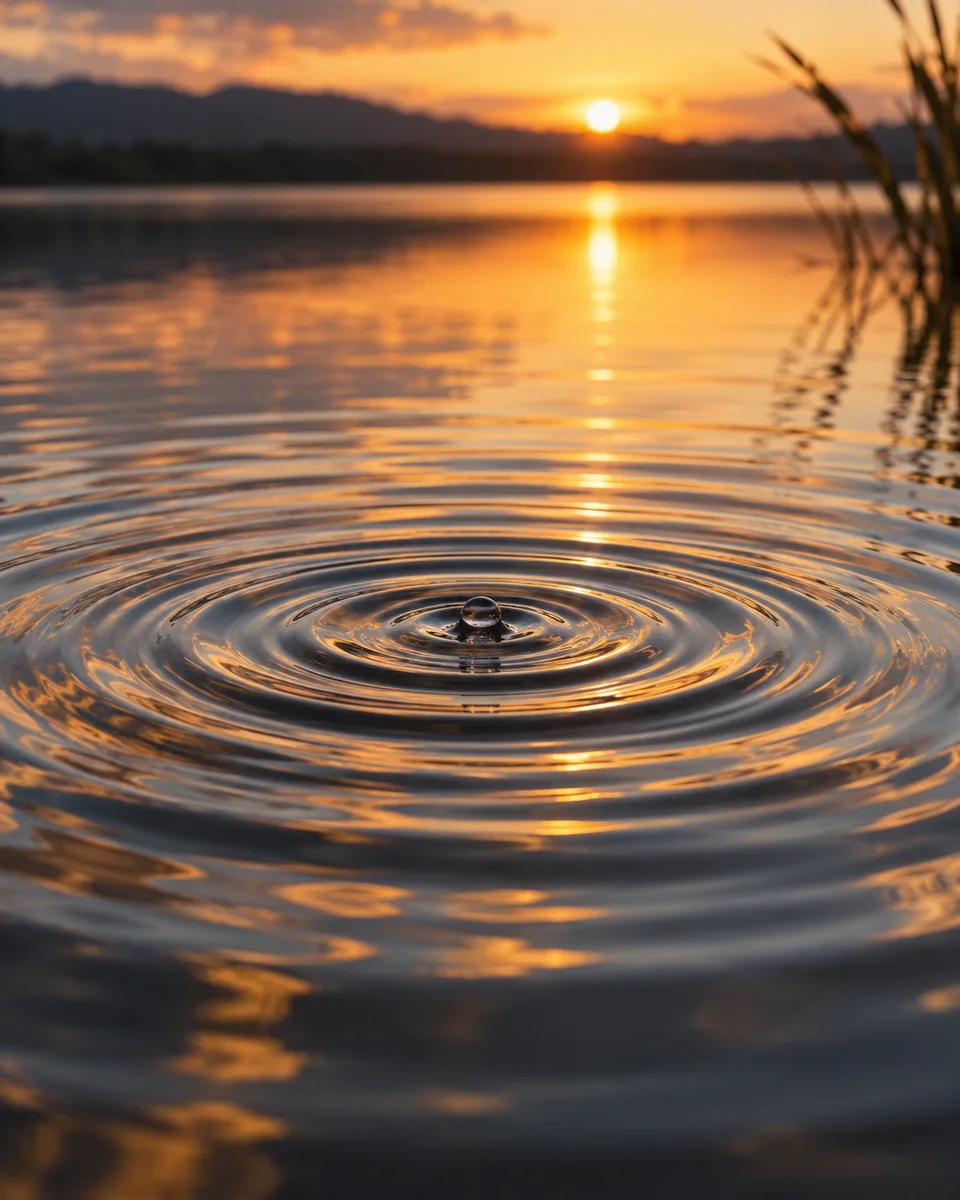
myAudience · AI-generated original illustration · Original AI-generated illustration; not documentary evidence; no third-party artwork reproduced.
A disturbance can carry energy across water while individual parcels of water move locally. A floating marker may rise and fall as a crest passes instead of traveling across the whole surface with that crest. Real surface-water particle motion can include horizontal and vertical components, so a purely up-and-down sketch is a simplified description.
Wavelength λ is the distance between corresponding points on neighboring waves, such as crest to crest. Frequency f counts cycles passing a point each second. Period T is the time for one cycle and equals 1/f. For a regular wave, speed v = fλ relates the motion of the pattern to its spacing and timing.
Amplitude describes the size of the disturbance, not the distance between crests. A taller wave does not automatically have a longer wavelength. Water depth, gravity and surface tension can affect real surface-wave behavior; the conditions determine which physical model is useful.
Worked example: a regular ripple pattern has a measured wavelength of 0.080 m and frequency 5.0 Hz. Its wave speed is 5.0 × 0.080 = 0.40 m/s, and its period is 1/5.0 = 0.20 s. Check: can one untimed photograph establish the frequency? No; it can show spacing if a scale is known, but frequency requires timing information.
The generated image supplies no calibrated ruler or clock. Circular-looking rings need not remain perfect circles when reflected from a boundary or disturbed by wind. Separate what the image shows from what a measurement would need, and explain whether your stated speed refers to the wave pattern or an actual flow of water.
Image: illustration, not a documentary photograph.