White light, many wavelengths
By Physics you can picture · myAudience
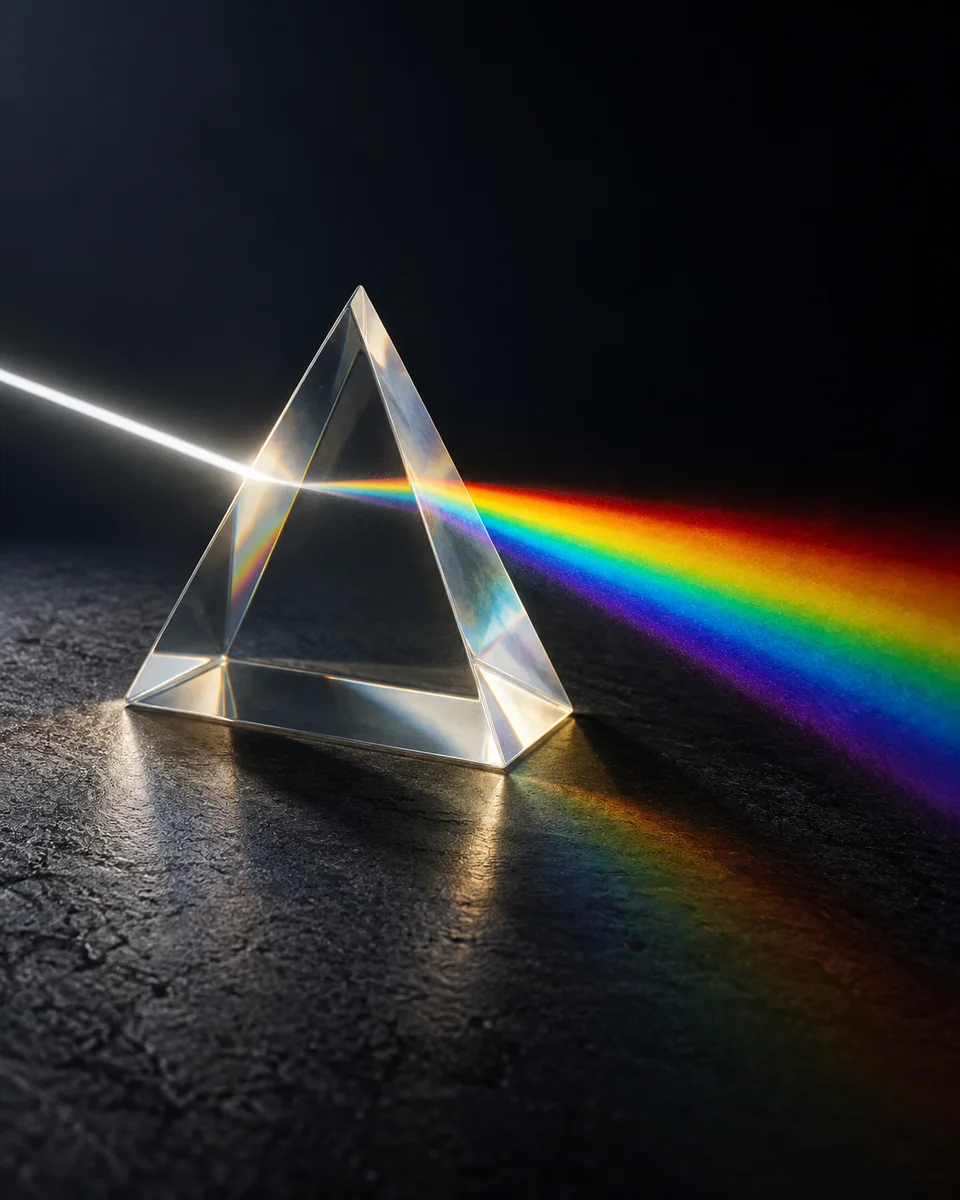
myAudience · AI-generated original illustration · Original AI-generated illustration; not documentary evidence; no third-party artwork reproduced.
White light can contain a range of visible wavelengths. When light enters glass, its speed changes and it usually changes direction unless it meets the surface along the normal. Refraction is described relative to that normal, a line perpendicular to the surface, rather than relative to the prism’s edge.
In ordinary glass, refractive index varies with wavelength. Visible violet light is generally refracted more strongly than visible red light, producing dispersion. The prism separates wavelengths already present in the incident light; it does not manufacture the colors from a colorless substance.
Frequency is measured in hertz, meaning cycles per second. Wavelength and frequency are linked by c = fλ in a vacuum. A shorter vacuum wavelength means a higher frequency. Crossing a stationary boundary changes wavelength and speed while frequency stays the same. It is therefore misleading to say that refraction changes red light into violet by increasing its frequency.
Worked example: use c = 3.00 × 10⁸ m/s and λ = 600 nm = 6.00 × 10⁻⁷ m. The frequency is c/λ = 5.00 × 10¹⁴ Hz. Check: if that same light enters glass, does its frequency change? No; its speed and wavelength change in the medium, while the boundary preserves its frequency.
The artwork simplifies beams, colors and their separation; it is not a measured optical spectrum. A narrow beam, controlled geometry and a suitable screen are needed for a scientific observation. Do not look directly at the Sun or point intense light sources toward eyes when investigating light.
Image: illustration, not a documentary photograph.