A crystal’s repeating order
By Chemistry in small pieces · myAudience
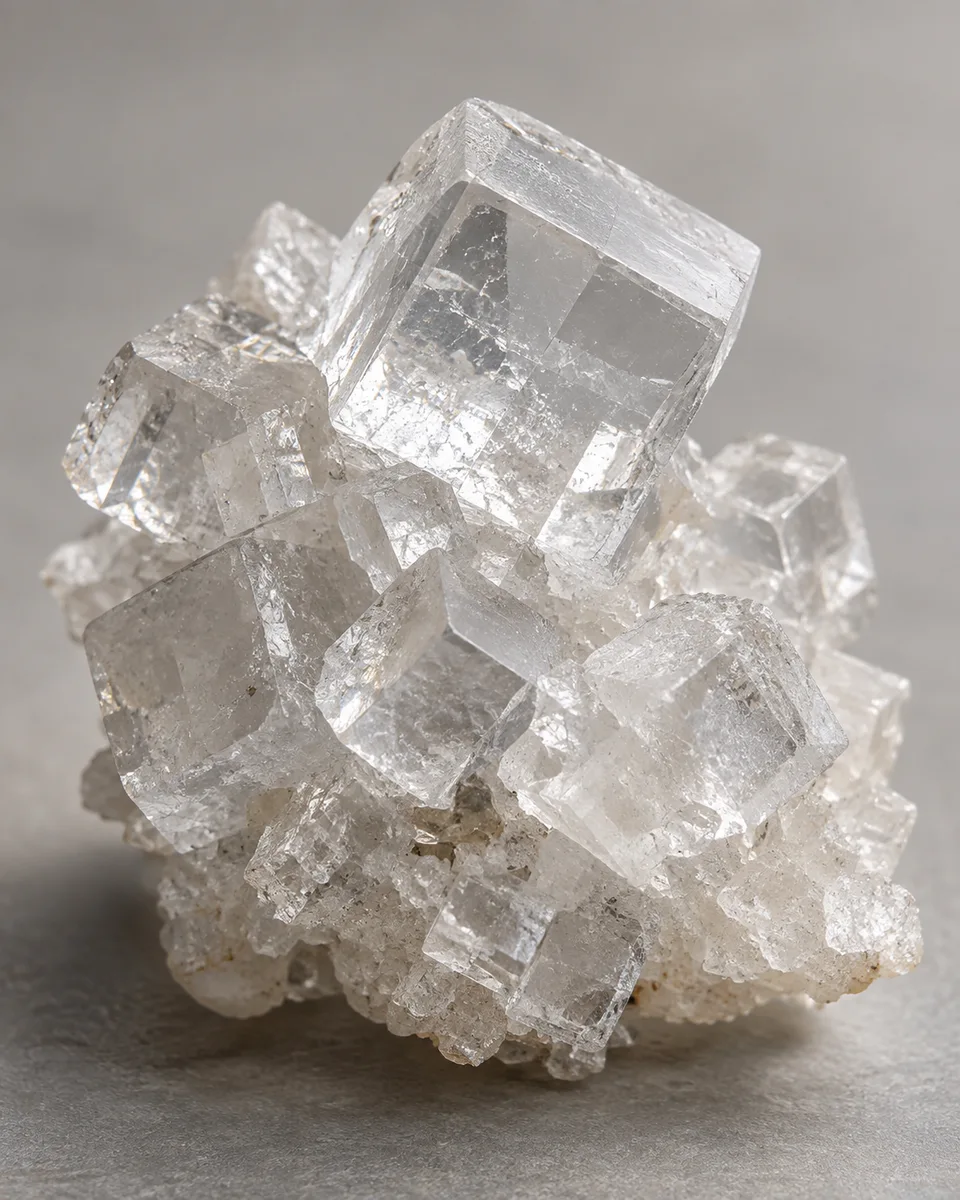
myAudience · AI-generated original illustration · Original AI-generated illustration; not documentary evidence; no third-party artwork reproduced.
A crystalline solid has a repeating arrangement of particles extending through its structure. The repeating pattern is microscopic; a visible face is an outer boundary of a grown specimen, not a giant picture of one atom. Crystal shape can reflect the underlying arrangement, but growth conditions and damage also affect its appearance.
In sodium chloride, sodium and chloride ions form an extended ionic lattice. Oppositely charged ions attract, and each ion interacts with surrounding ions throughout the structure. It is misleading to describe a salt crystal as a collection of isolated NaCl molecules: the formula records the simplest ratio of the ions.
Different solids have different particles and forces. Molecular crystals contain molecules; metallic crystals contain a metallic structure; giant covalent structures have networks of bonded atoms. A repeating arrangement alone does not tell you the bonding type or the material’s melting point, conductivity and hardness.
Worked example: the formula CaCl₂ requires two chloride ions for each calcium ion because Ca²⁺ needs two negative charges to balance its +2 charge. For three calcium ions, six chloride ions give total charge +6 − 6 = 0. Check: does the subscript 2 mean the entire crystal contains only two chloride ions? No; it expresses a ratio repeated across the material.
The generated facets are an imagined specimen, not a chemical identification or microscopic image. A scientific identification combines composition, physical measurements and structure. When studying a diagram, distinguish the real particles from the colors and connecting lines used to represent them.
Image: illustration, not a documentary photograph.