A leaf is a working surface
By Living systems · myAudience
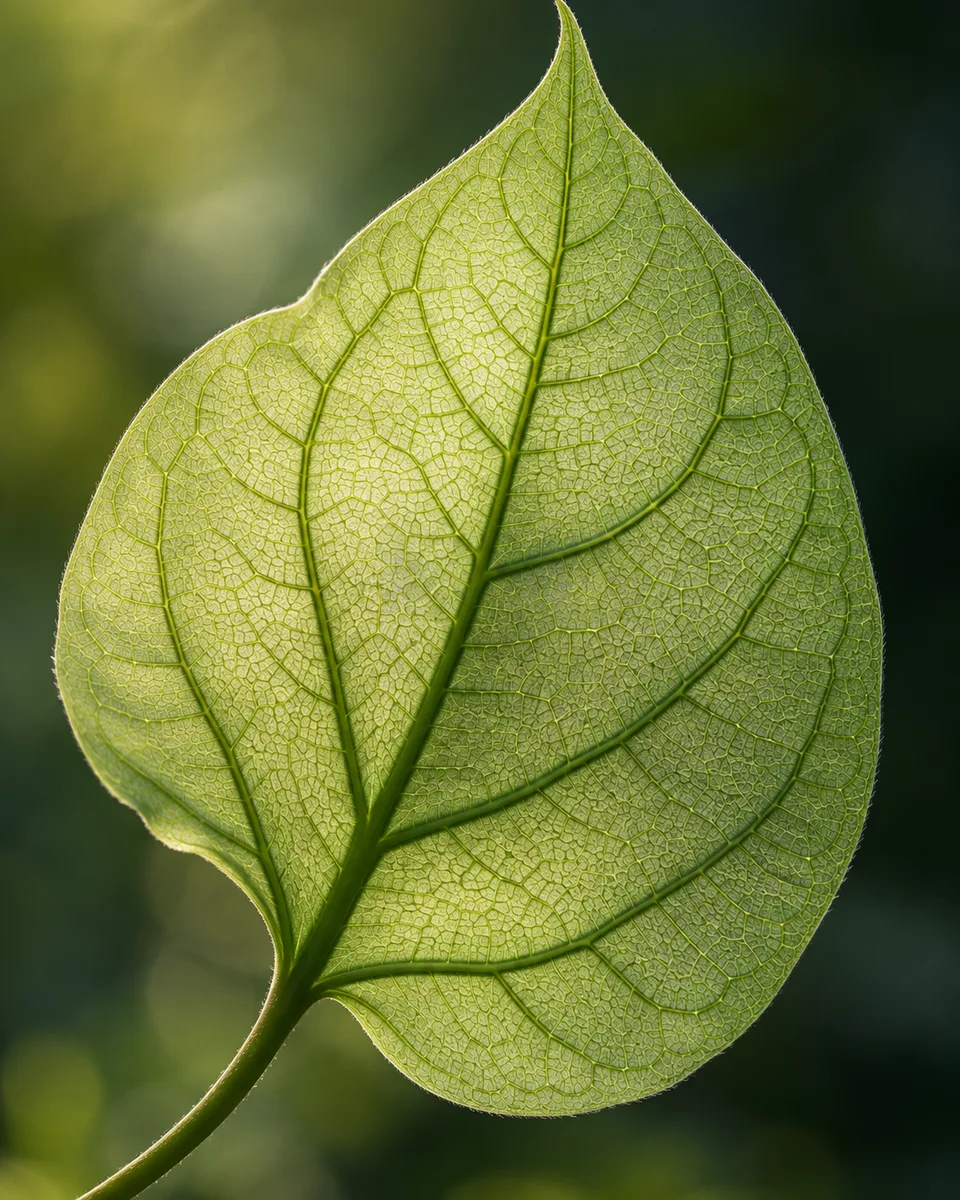
myAudience · AI-generated original illustration · Original AI-generated illustration; not documentary evidence; no third-party artwork reproduced.
A leaf brings together light capture, gas exchange and transport. Its broad surface can intercept light, while a thin structure shortens the route between air and photosynthetic cells. These features vary among plants, so a typical leaf model should not be treated as the design of every species.
Stomata are pores controlled by guard cells. Carbon dioxide can diffuse into a leaf through them when a suitable concentration gradient exists; oxygen and water vapor can diffuse out. Guard-cell changes affect pore opening. Gas exchange and water conservation therefore involve a trade-off rather than two completely independent processes.
Water loss from leaves contributes to transpiration. Water moving through xylem replaces water lost from leaf surfaces, while dissolved mineral ions travel with it. Phloem transports dissolved sugars between sources and sinks; it is a different transport tissue, not simply another pipe carrying the same material as xylem.
Worked reasoning: on a hot, dry, windy day, evaporation and removal of water vapor near the leaf can favor faster water loss if other conditions are comparable. Closing stomata can reduce that loss, but it can also limit carbon dioxide entry and photosynthesis. Check: does a low transpiration rate automatically mean that a plant is photosynthesizing rapidly? No; water conservation and carbon supply must be considered together.
The generated macro-style artwork does not reliably resolve individual cells or identify a particular species. Use a reviewed microscopic diagram for guard-cell structure. A real comparison of transpiration needs controlled leaf area and conditions, and a measurement of water uptake is not always identical to the rate of water loss.
Image: illustration, not a documentary photograph.