A fern unfolds
By Living systems · myAudience
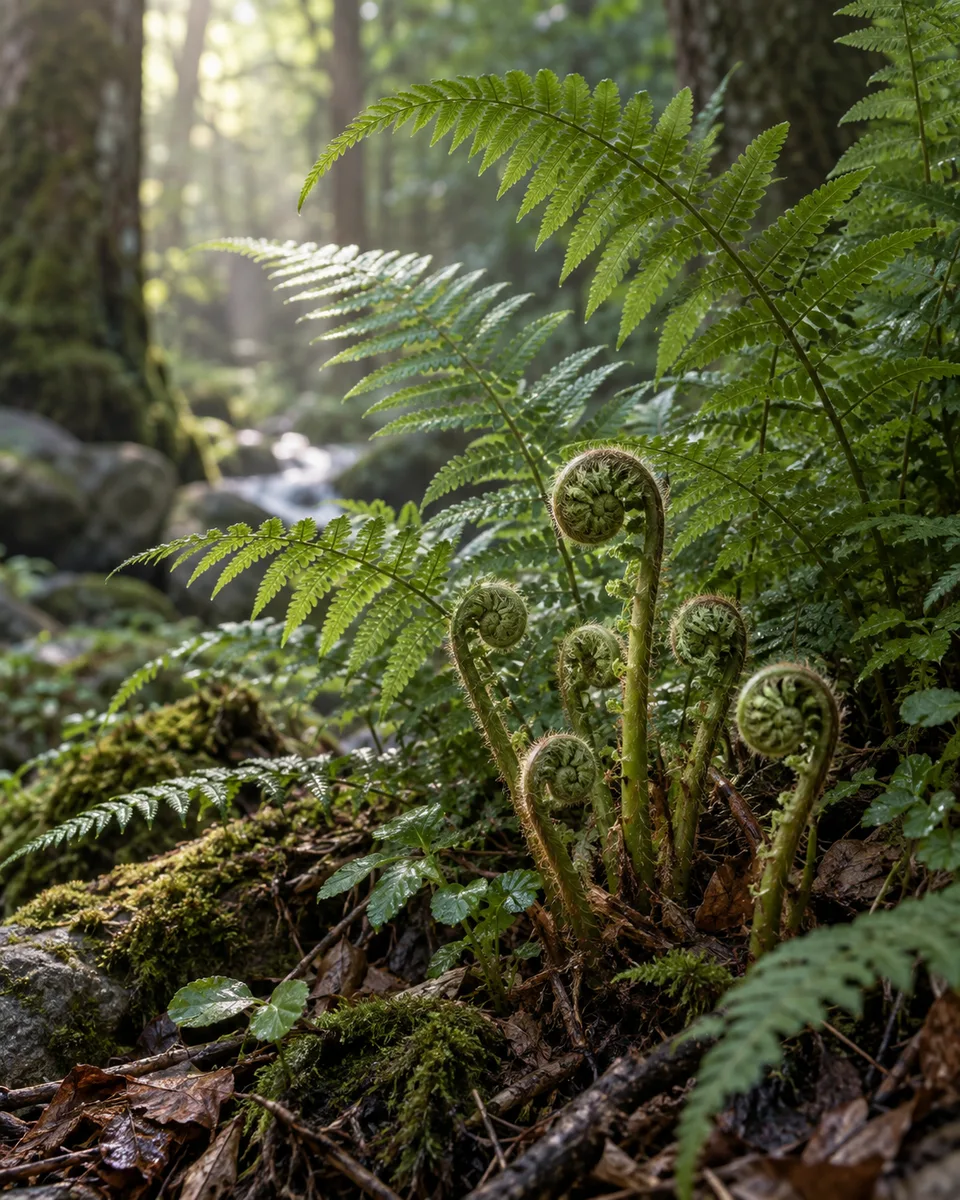
myAudience · AI-generated original illustration · Original AI-generated illustration; not documentary evidence; no third-party artwork reproduced.
The leafy fern most people recognize is one stage in a life cycle with alternating generations. It is a vascular plant, using tissues that move water and other substances. Its reproduction differs from seed plants: ferns produce spores and do not make flowers or seeds.
In the life-cycle model, the leafy sporophyte produces spores by meiosis. A spore can develop into a small gametophyte, which produces eggs and sperm. Fertilization joins gametes and forms a new sporophyte. Calling every small reproductive structure a seed hides important differences in its origin and development.
Many ferns depend on a film of water for motile sperm to reach an egg. This helps explain why reproductive conditions matter as well as the appearance of the mature plant. The curled young frond in the image is a growing leaf, not a spore or the entire gametophyte generation.
Worked reasoning: a fern has many healthy leaves but conditions become very dry. Existing leaves alone do not prove that fertilization can proceed normally, because the gametophyte and movement of sperm may be limited by moisture. Check: is a spore already a miniature embryo enclosed in a seed? No; the spore develops into the gametophyte stage before the fertilization that produces a new sporophyte.
The artwork is a generated botanical scene and should not be used to identify a species or prove a reproductive stage. A reviewed life-cycle diagram needs distinct labels for spores, gametophyte, gametes and sporophyte. This is an interest-page extension beyond the core GCSE plant transport examples, not a claim that every fern detail is assessed in that course.
Image: illustration, not a documentary photograph.