A flower and its visitor
By Living systems · myAudience
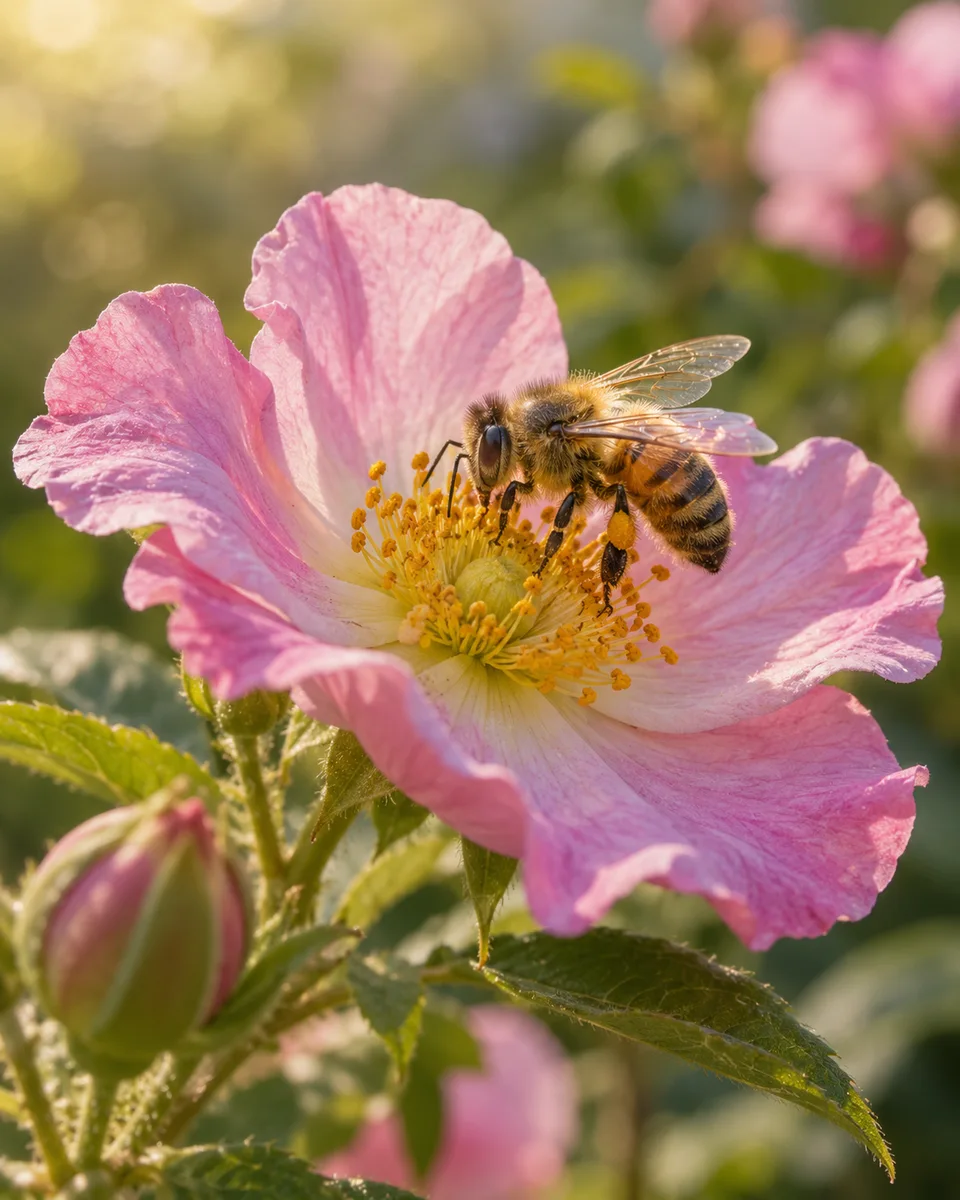
myAudience · AI-generated original illustration · Original AI-generated illustration; not documentary evidence; no third-party artwork reproduced.
Pollination moves pollen to a flower’s receptive surface; fertilization is the later fusion of gamete nuclei. These are different events. A visiting insect can help with the first, but one visit does not establish that fertilization or successful seed development has occurred.
A flower can offer nectar or pollen as food. While feeding, an animal may carry pollen to another flower. Floral shape, scent and timing can affect these encounters. Plants also have other pollination strategies, including wind, so an insect visit is not a universal requirement for all flowering plants.
After suitable pollen reaches a stigma, a pollen tube can grow toward an ovule. Male gametes travel through the tube, allowing fertilization within the flower. The resulting seed includes an embryo; the ovary can develop into a fruit. Follow this sequence instead of jumping straight from an insect landing to a finished seed.
Worked observation: suppose 12 flowers receive insect visits and 9 later produce fruit. The observed fraction producing fruit is 9/12 = 75%, but the result alone does not prove that those visits caused every fruit. A comparison needs appropriate controls and information about other pollen transfer. Check: is a photograph of pollen on an insect proof of seed formation? No; several later steps must succeed.
The generated garden does not reliably identify the plant or insect species. Observe real visitors without disturbing them and distinguish visit count, pollen transfer, fertilization and seed production as separate outcomes. This separates an ecological relationship from a claim that one image has demonstrated its complete mechanism.
Image: illustration, not a documentary photograph.