Life on a fallen branch
By Living systems · myAudience
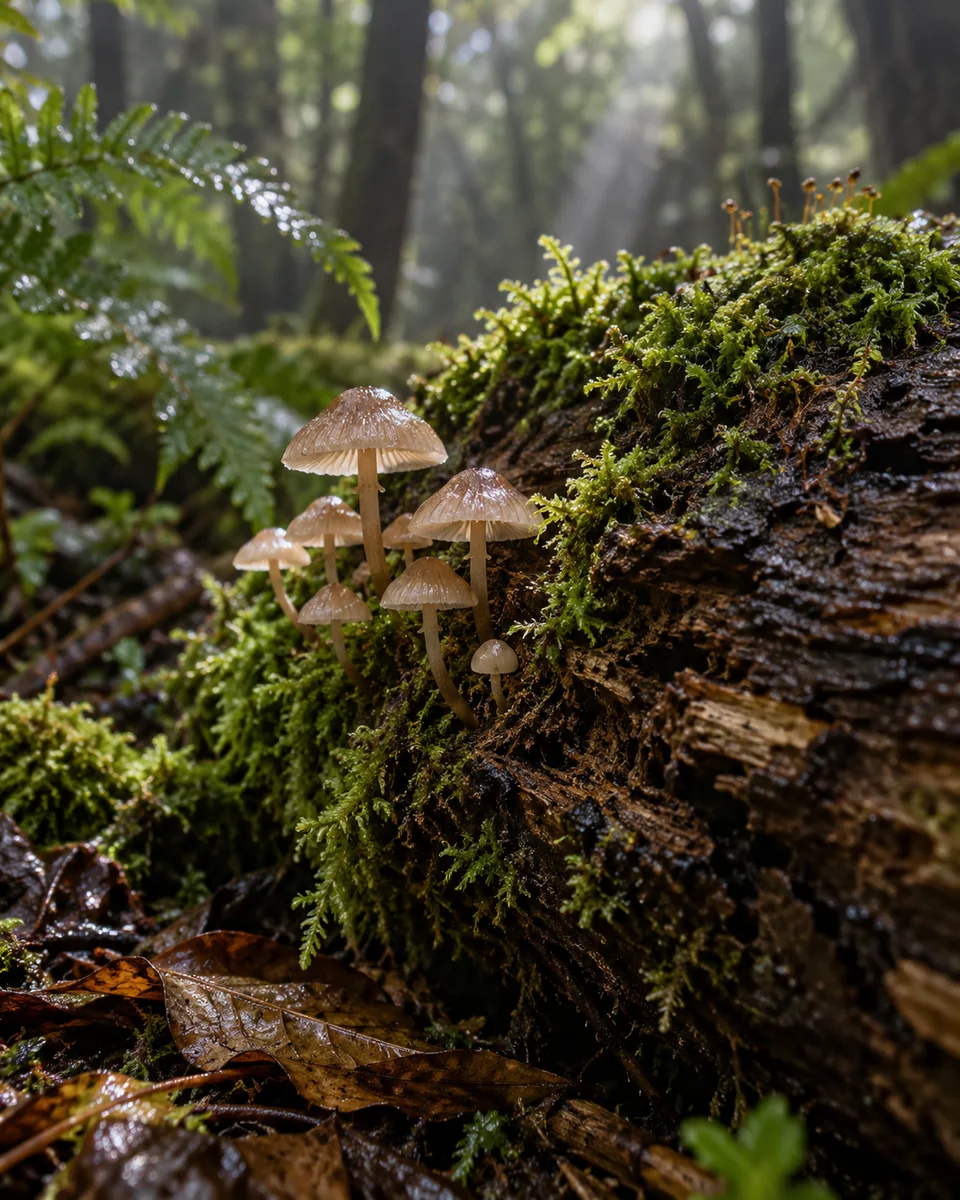
myAudience · AI-generated original illustration · Original AI-generated illustration; not documentary evidence; no third-party artwork reproduced.
A mushroom is a reproductive structure produced by some fungi. Much of the organism can exist as hyphae, fine threads that extend through a substrate. A group of hyphae forms a mycelium. The visible mushroom is therefore only part of the organism, rather than a complete plant growing from a conventional root.
Fungi do not photosynthesize like green plants. Many release enzymes into their surroundings and absorb smaller products of digestion. Decomposing fungi can obtain nutrients from dead material, helping return substances to a form that other organisms can use. Fungi also include parasites and mutualistic partners; not every fungus has the same ecological role.
Respiration transfers energy for fungal growth and other processes. Decomposition changes the location and chemical form of matter; it does not make matter vanish. Warmth, moisture and oxygen can affect the activity of organisms involved, but the appropriate conditions depend on the species and substrate.
Worked explanation: a fallen branch loses mass over time while decomposers grow and carbon dioxide is released. Some carbon moves into decomposer biomass and some enters the atmosphere through respiration. Check: has the branch’s carbon been destroyed? No; it has been redistributed and changed chemical form, so the observation should be explained with material flows.
The mushroom scene is generated art and cannot identify an edible species. Do not eat or cultivate an unknown fungus based on an image. A reviewed diagram can distinguish fruiting body and mycelium, while a supervised decay investigation needs a defined substrate and safe procedures.
Image: illustration, not a documentary photograph.