A machine that meets the wind
By How things are built · myAudience
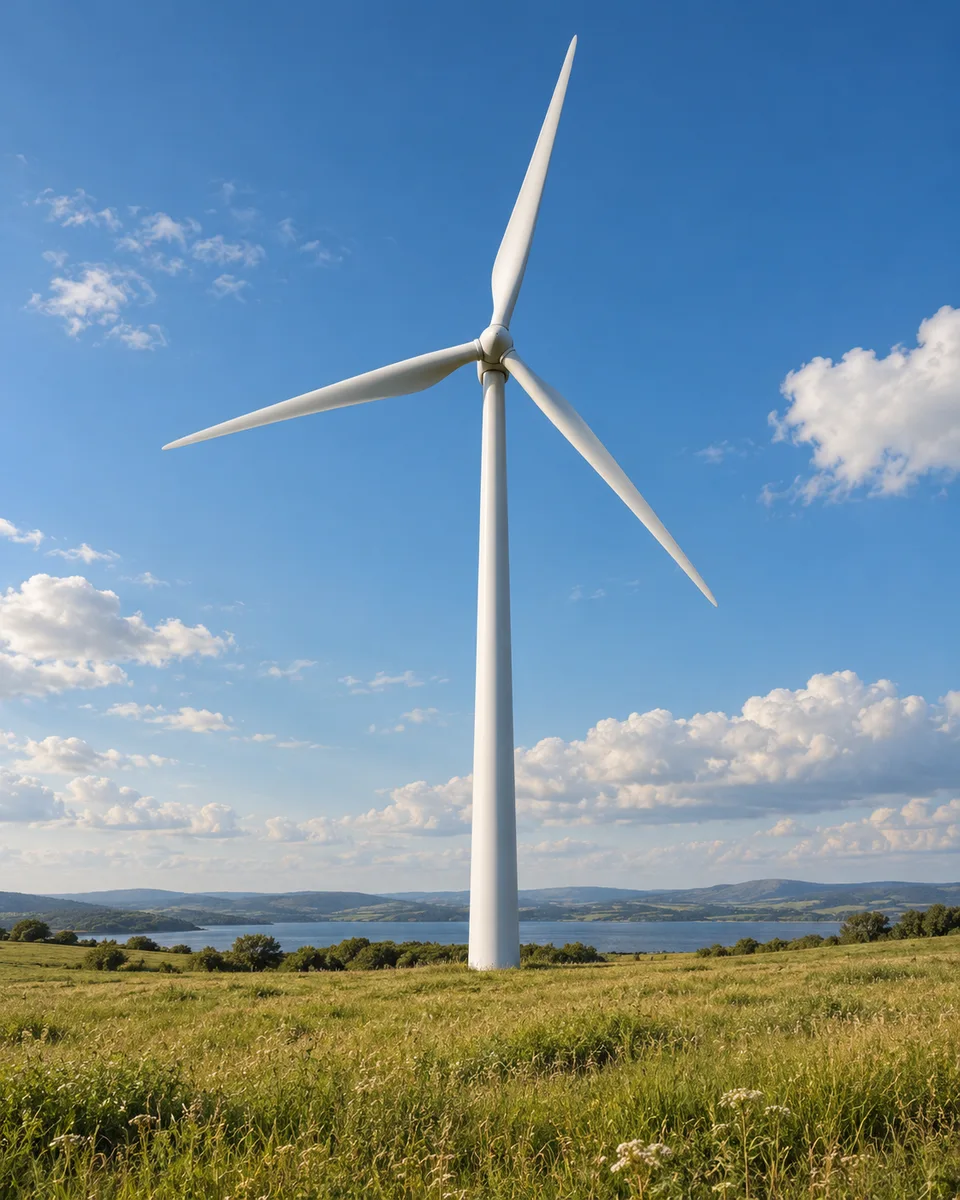
myAudience · AI-generated original illustration · Original AI-generated illustration; not documentary evidence; no third-party artwork reproduced.
A wind turbine transfers some of the wind’s kinetic energy into mechanical rotation and then electrical energy through a generator. The rotor sweeps an area of air. Its operation depends on aerodynamic forces, control systems and the wind conditions; the silhouette alone does not reveal its output.
The kinetic-energy flow through a fixed area varies strongly with wind speed. In an idealized model it is proportional to air density, swept area and the cube of wind speed. The turbine cannot convert all of that flow into electrical output, and real controls impose operating limits, so this relationship is not a complete power prediction.
Design objectives can conflict. A larger rotor may capture energy over a larger area but needs suitable materials, supports, control and maintenance. Noise, access, reliability and local conditions are separate considerations. A requirement should identify what outcome is being assessed rather than treating the tallest machine as automatically the best design.
Worked ratio: keeping air density and swept area fixed, increasing modeled wind speed from 5 m/s to 10 m/s multiplies the incoming kinetic-energy flow by (10/5)³ = 8. Check: does that prove that an actual turbine’s electrical output rises exactly eightfold? No; efficiency, control limits and operating conditions also affect its output.
The generated machine is an imagined scene, not a named installation or performance measurement. A fair comparison uses a stated wind distribution and an appropriate time period, not one favorable gust. Distinguish available wind energy, converted electrical energy and equipment reliability when evaluating a proposal.
Image: illustration, not a documentary photograph.