Stone shaped by cooling
By Our changing Earth · myAudience
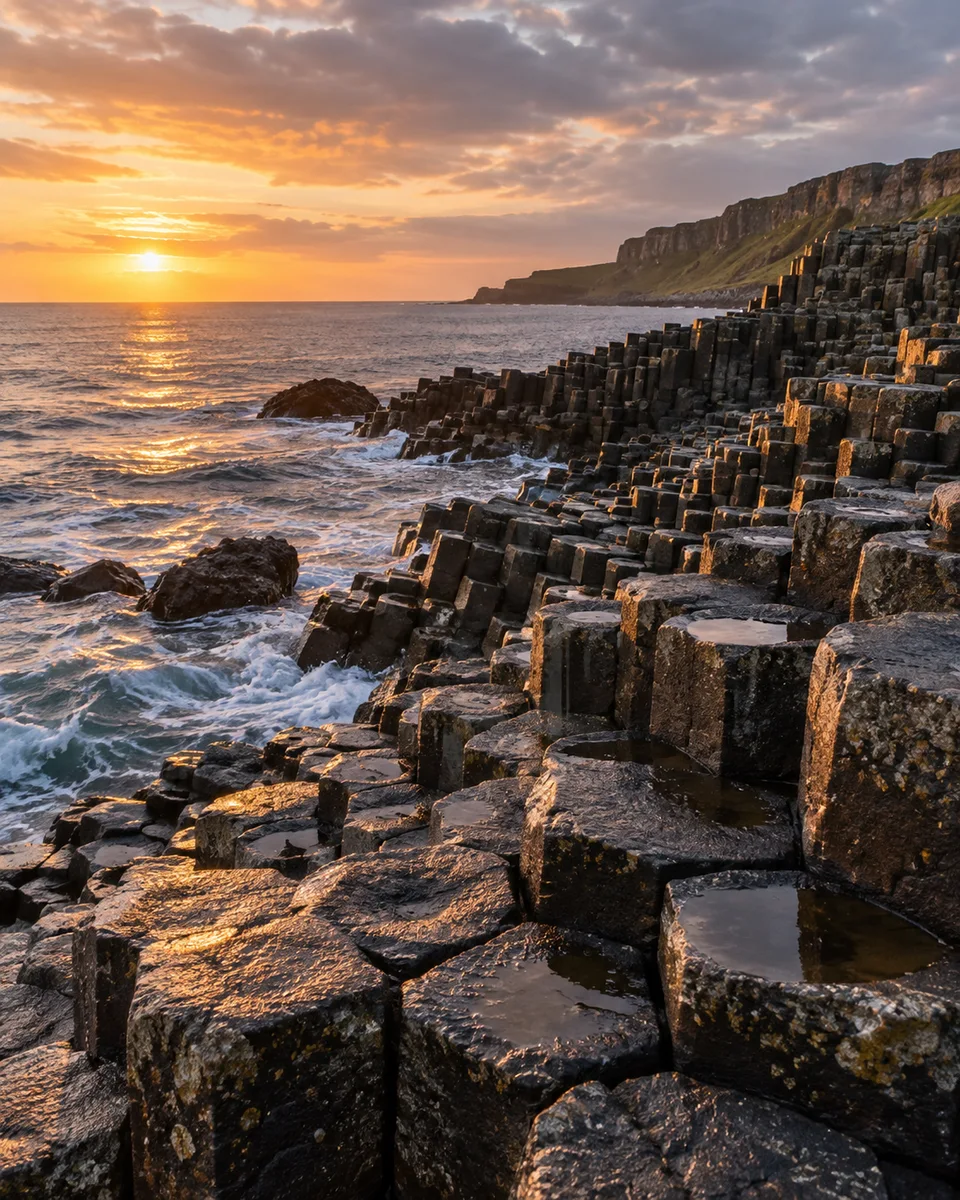
myAudience · AI-generated original illustration · Original AI-generated illustration; not documentary evidence; no third-party artwork reproduced.
Columnar joints can form when a body of lava or other suitable igneous material cools and contracts. The rock cannot shrink freely everywhere, so fractures develop. A field of polygonal columns is therefore a consequence of physical change in cooling rock, rather than a set of blocks assembled by people.
Fractures often create a network of roughly polygonal shapes, including many hexagons, but a real formation need not consist of perfect identical six-sided columns. Their geometry depends on how the material cooled and cracked. Columns commonly extend approximately perpendicular to the cooling surface, which connects visible form with the direction of cooling.
Rock identification requires more than a silhouette. Texture, mineral composition and geological setting help distinguish a rock and explain its formation. A dark columnar coast can suggest a question about cooling lava, but a generated picture cannot prove its composition, age or connection to a named volcanic event.
Worked geometric example: a regular hexagonal cross-section has six sides and can be divided into six equilateral triangles from its center. That is a mathematical ideal, not a requirement imposed on every real column. Check: would finding a five-sided column disprove cooling contraction as an explanation? No; natural fracture networks contain variation.
The coast in the artwork is imaginary, not a photograph of a specific protected site. A useful field record would include scale, the orientation of the columns and nearby rock units. Treat the shape as evidence to combine with geological observations, and avoid claiming an exact age or location from its appearance alone.
Image: illustration, not a documentary photograph.