A valley holds a glacier
By Our changing Earth · myAudience
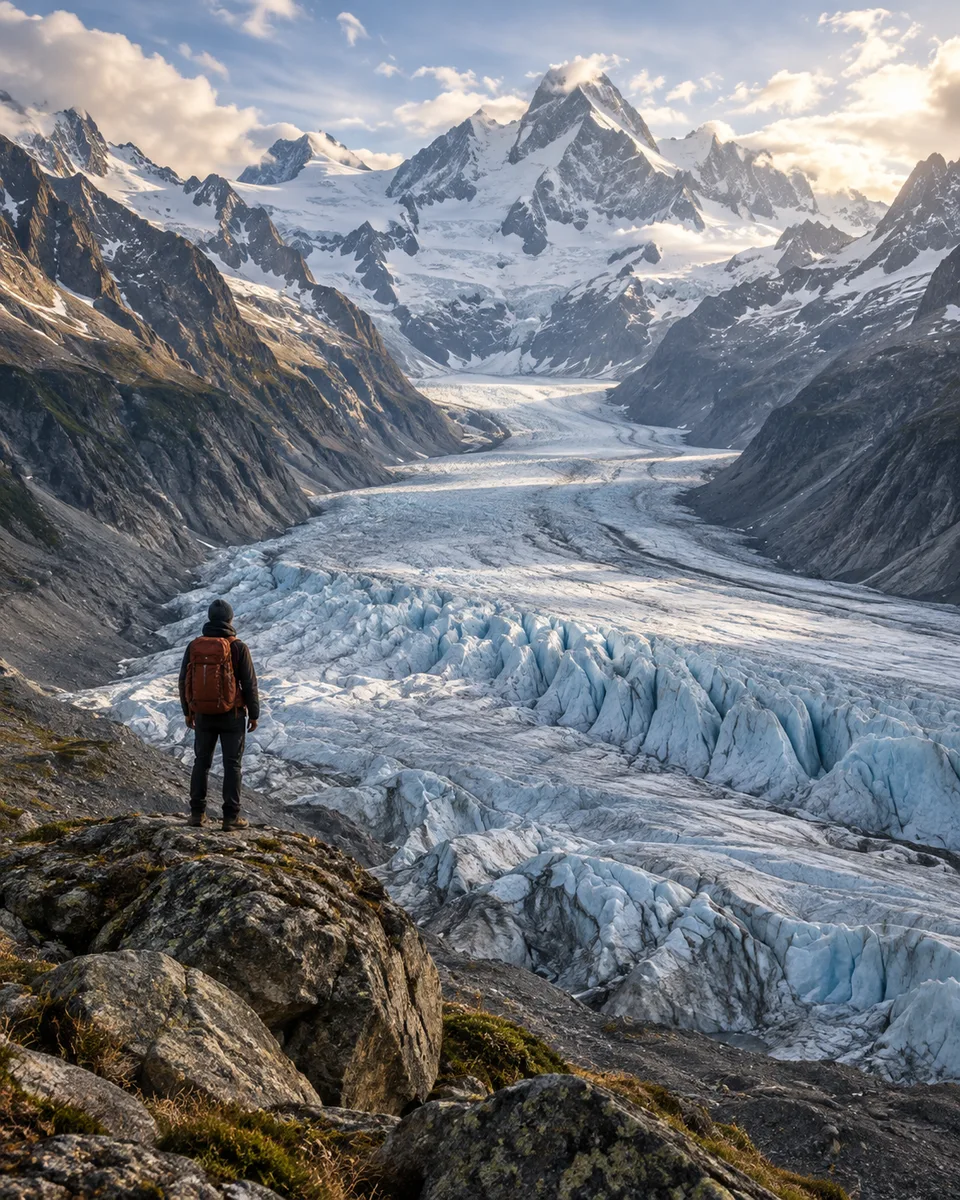
myAudience · AI-generated original illustration · Original AI-generated illustration; not documentary evidence; no third-party artwork reproduced.
A glacier is a mass of ice that moves under its own weight. Snow can accumulate, compact and become ice where conditions allow it to persist. Flow includes deformation within the ice, and some glaciers can slide at their base when conditions permit. A glacier is therefore a changing body, not simply snow sitting in a valley.
Moving ice can erode rock through processes including abrasion by material carried at its base and removal of loosened blocks. It can transport and later deposit sediment. Broad valley shape, polished surfaces and deposits can contribute evidence of past glaciation, but each feature must be interpreted in its geological context.
A glacier’s front can retreat even while ice still flows forward, if melting and other losses exceed the supply of ice reaching the front. Distinguish motion of ice from change in the glacier’s boundary. Assessing climate-related change needs repeated measurements, not a comparison between two unrelated scenic images.
Worked record: a surveyed glacier front moves from 1,200 m to 1,050 m along a fixed reference line over five years. The observed retreat is 150 m, averaging 30 m per year along that line. Check: does that establish that every ice particle moved backward? No; the boundary change and the direction of ice flow are different quantities.
The generated valley is not a monitoring photograph or a named glacier. Real measurements need consistent reference points, dates and methods, and an average boundary rate does not by itself give ice volume lost. Combine surface position, thickness and other observations before making a quantitative mass-change claim.
Image: illustration, not a documentary photograph.