Water between sky and land
By Our changing Earth · myAudience
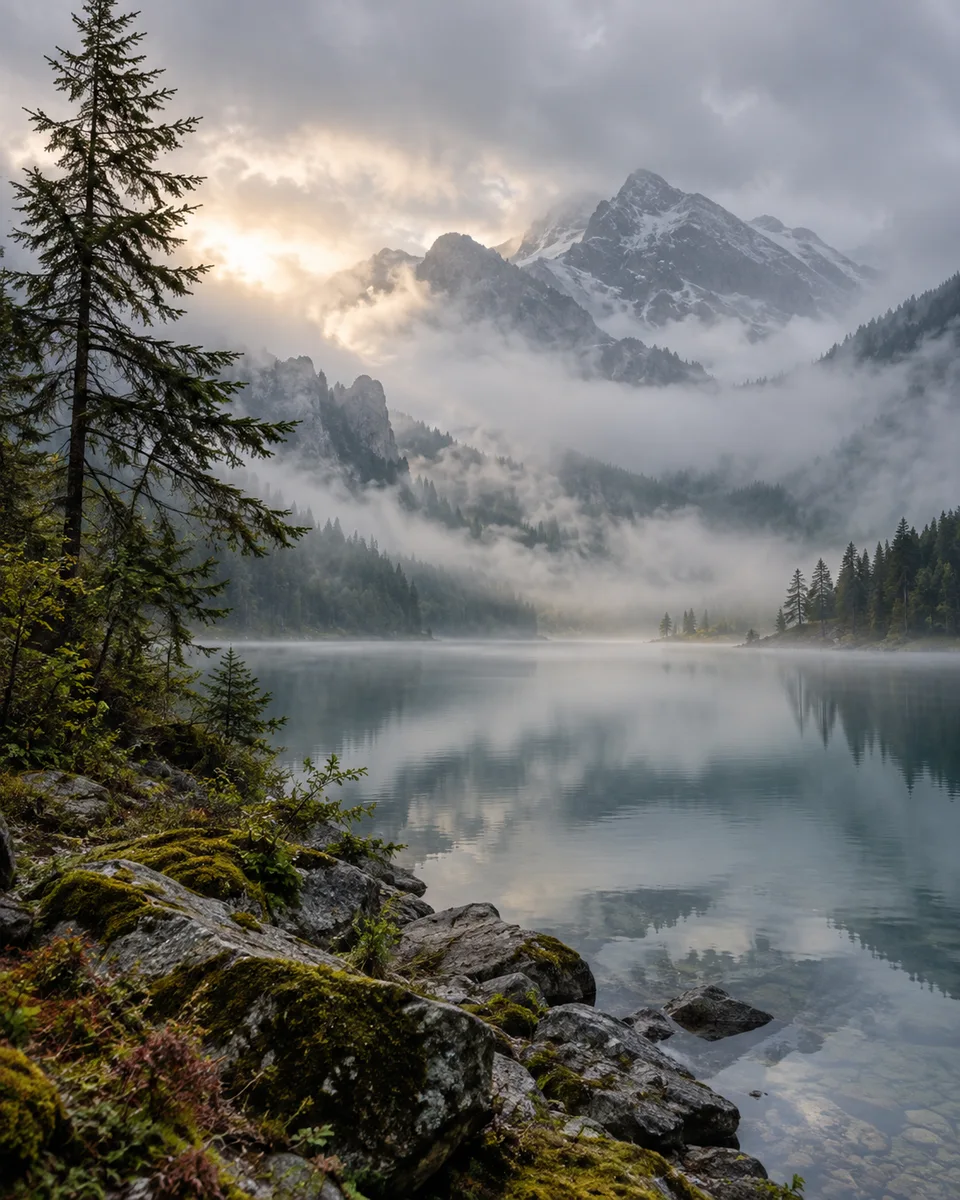
myAudience · AI-generated original illustration · Original AI-generated illustration; not documentary evidence; no third-party artwork reproduced.
Water moves through many connected stores, including oceans, lakes, rivers, soils, groundwater, ice and the atmosphere. Evaporation transfers liquid water into vapor; condensation forms liquid droplets when conditions allow. Precipitation returns water to the surface in forms such as rain and snow. There is no single route that every water molecule must follow.
After reaching land, water can flow over the surface, enter soil through infiltration or move into longer-term groundwater storage. Plants take up water and release vapor through transpiration. Different pathways have different timescales, so a fast-changing stream and a deep groundwater store do not respond to rainfall in the same way.
A water budget compares changes in storage with incoming and outgoing flows over a defined time and area. The units must agree: a depth of rainfall can be converted to a volume using area, but it is not automatically the volume collected in a stream. Evaporation, infiltration and storage can affect how much becomes runoff.
Worked example: 10 mm of rain falls uniformly over 100 m². Convert 10 mm to 0.010 m, then calculate volume = 0.010 × 100 = 1.0 m³, or 1,000 liters. Check: does that mean a tank connected to the site receives 1,000 liters? No; the collection area, losses and drainage route determine the amount actually captured.
The artwork is an imagined lake and cloud scene, not a local weather measurement. A useful diagram labels processes and stores separately, rather than drawing one arrow around a perfect loop. For a real water-budget claim, state the observation period, boundaries and which flows have actually been measured.
Image: illustration, not a documentary photograph.