A walk through a Roman forum
By Rome beyond the arena · myAudience
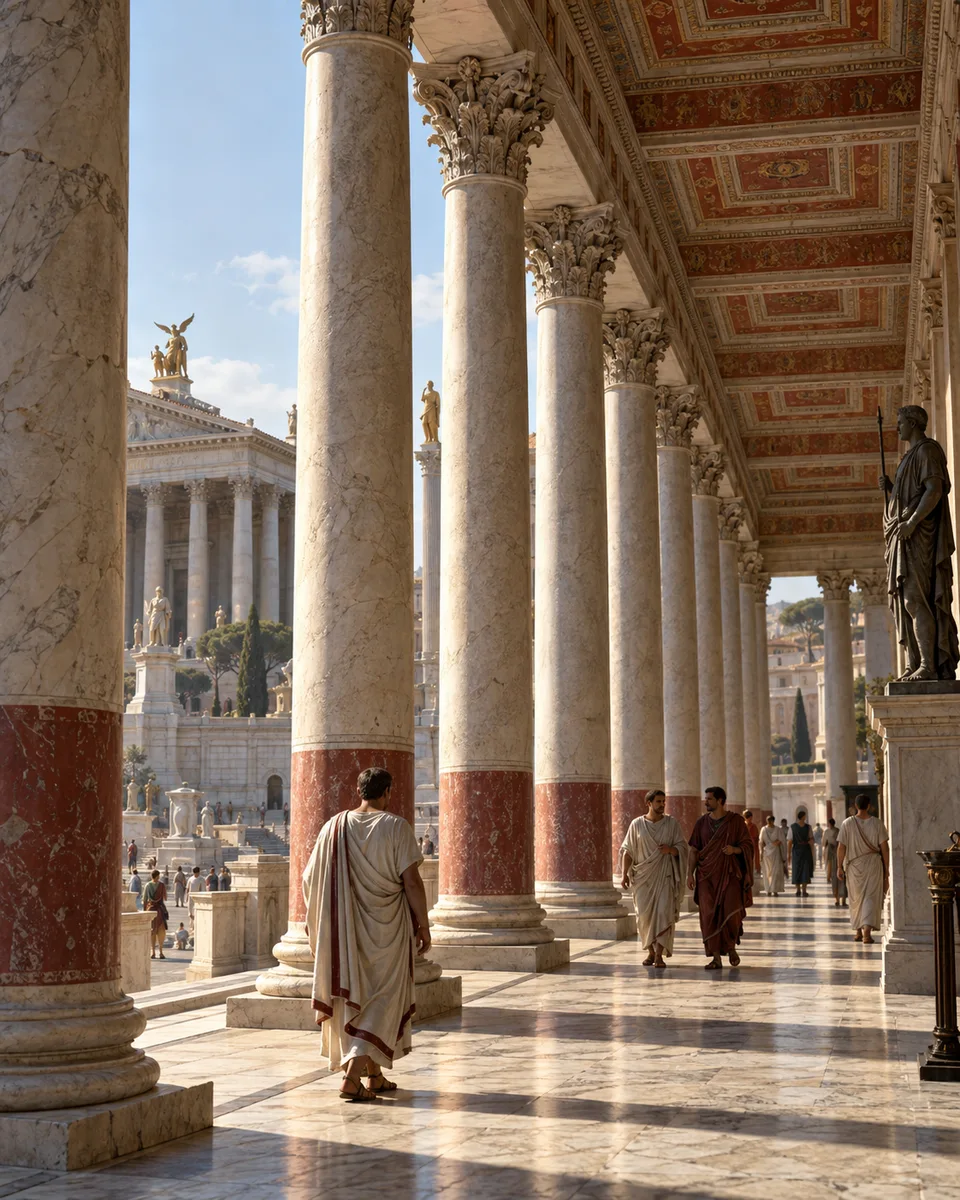
myAudience · AI-generated original illustration · Original AI-generated illustration; not documentary evidence; no third-party artwork reproduced.
A Roman forum was a junction of city life: public business, worship, trade and social encounters could occupy neighboring spaces. It was not simply an ancient shopping square. A basilica offered covered space for business and legal proceedings, while a temple made religion physically prominent. Different towns arranged these elements differently; Rome’s own forum was only one, exceptionally famous example.
Columns created sheltered edges around open ground. Building that edge required foundations, supports and a roof or upper structure, rather than a row of decorative posts alone. Stone, brick and concrete belonged to a wider Roman building repertoire. Read the illustrated colonnade as a structural question: where would a load travel, and where could rainwater and pedestrians pass?
The empire stretched across communities with different languages, traditions and local histories. A common-looking building did not erase those differences. Nor did a public space guarantee equal political power. Wealth, legal status and exclusion shaped participation. An attractive civic center can therefore tell two stories at once: the resources gathered to construct it and the unequal society that used it.
Our image invents a particular town, its occupants and its moment of light. The reliable comparison is a surveyed plan or excavated building, where a doorway, foundation or inscription can test a claim. Try tracing a route from an entrance to the square. Which activities could share that route, and which would need quieter, restricted or sheltered rooms? That is a better starting point than treating every Roman city as identical.
Image: speculative AI reconstruction; uncertain details.