Water above a valley
By Rome beyond the arena · myAudience
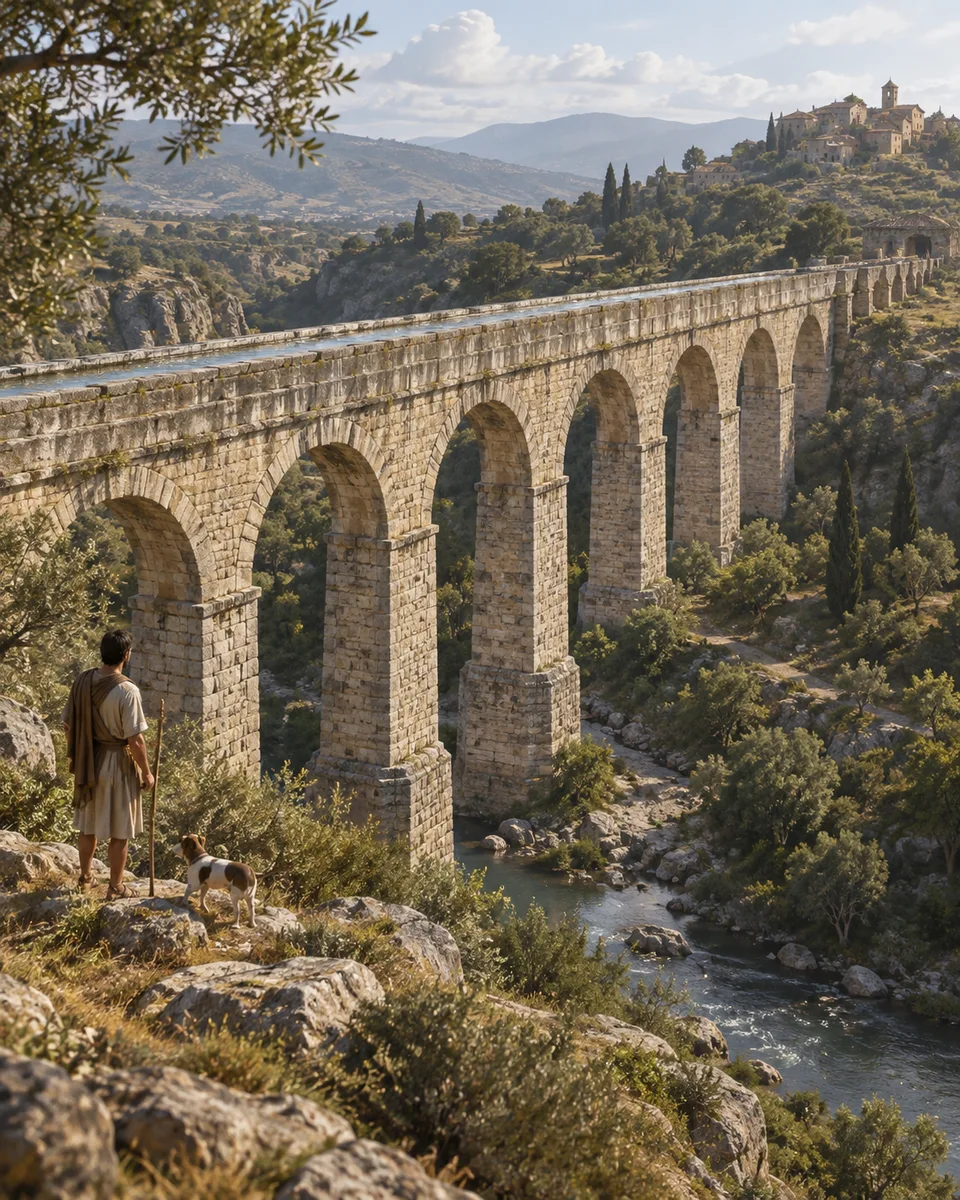
myAudience · AI-generated original illustration · Original AI-generated illustration; not documentary evidence; no third-party artwork reproduced.
The spectacular arches of an aqueduct were only part of a water route. Roman engineers also used buried channels, tunnels and stretches close to the ground. The basic challenge was to bring water from a suitable source to its destination with enough height remaining for distribution. A valley was an obstacle in that route, not a reason to build arches everywhere.
In an open channel, gravity moves water down a controlled gradient. Surveying mattered: a channel that lost height too early could not serve a higher destination. Bridges kept the channel near the needed elevation; some crossings instead used pressure pipes arranged as an inverted siphon. Those systems had different construction and maintenance demands. The illustrated arcade should not be mistaken for the only Roman solution.
An aqueduct also needed access for repairs and removal of deposits. Water infrastructure continued after the opening ceremony: channels, basins and distribution points had to be inspected, cleared and maintained. Funding and public authority mattered alongside masonry. A successful supply was an organized service supported by labor, not merely a monument left to work forever.
The Penn Museum essay provides a detailed historical account of surveying and construction, but it was published in 1970; treat its broader judgments about Roman knowledge as historical interpretation. Our valley, finish and exact pier spacing are invented. Follow the top channel with your eye, then imagine the unseen source and outlet. Where could the route lose elevation, collect sediment or become difficult to repair?
Image: speculative AI reconstruction; uncertain details.