A potter’s day in a Roman town
By Rome beyond the arena · myAudience
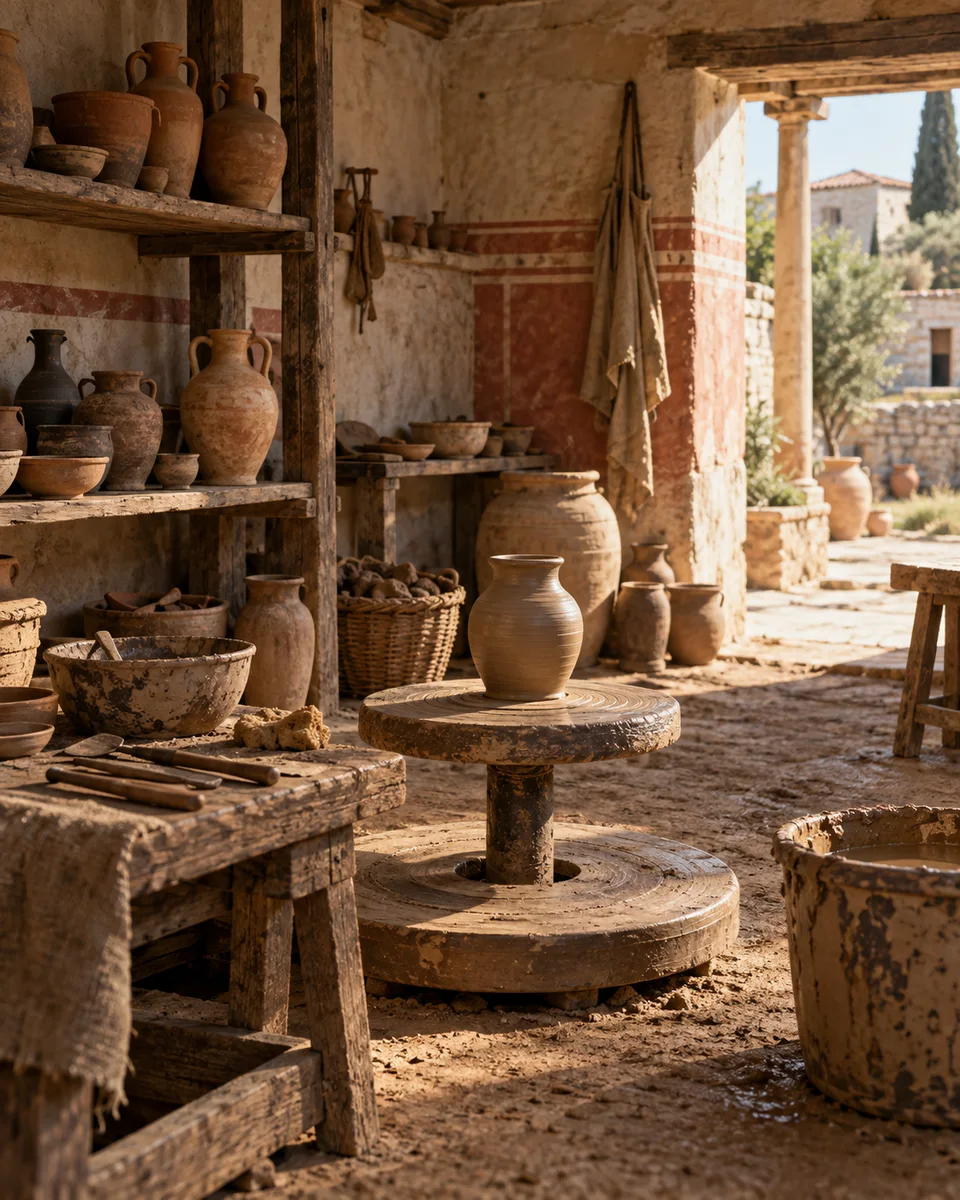
myAudience · AI-generated original illustration · Original AI-generated illustration; not documentary evidence; no third-party artwork reproduced.
Roman pottery ranged from cooking and storage vessels to carefully finished tableware. A useful distinction is between the object’s shape, the clay body and the surface treatment. They answer different questions: what a vessel could hold, how it was made and how its maker wanted it to look. The same empire contained many local traditions and workshops.
Making a vessel required suitable clay, preparation, shaping, drying and firing. Drying mattered because wet clay shrinks; firing changed the material more permanently. Wheel-thrown vessels and molds supported different forms of production. A smooth bowl did not appear from a lump of earth in one operation: each stage constrained the next, including how thin the wall could be and how safely it could be handled.
Fine red tablewares and transport amphorae traveled through trade networks. A stamped maker’s mark, a distinctive fabric or a recognizable rim can help researchers compare production centers and circulation. Yet one fragment rarely reveals a whole journey. Sherds are most informative when their findspot, associated objects and archaeological layer are recorded, rather than when they are admired in isolation.
This workshop is an illustration, not an excavated room or an identified potter. Its tools, working arrangements and vessel combination should not be used as an exact recipe. Look at the mouth, base and handles of one pot: how would it be filled, lifted and cleaned? Then ask what evidence would distinguish that proposed use from another. Ordinary objects can connect household routines with distant exchange without inventing a biography for their maker.
Image: speculative AI reconstruction; uncertain details.