Giza before the casing was lost
By Egypt along the Nile · myAudience
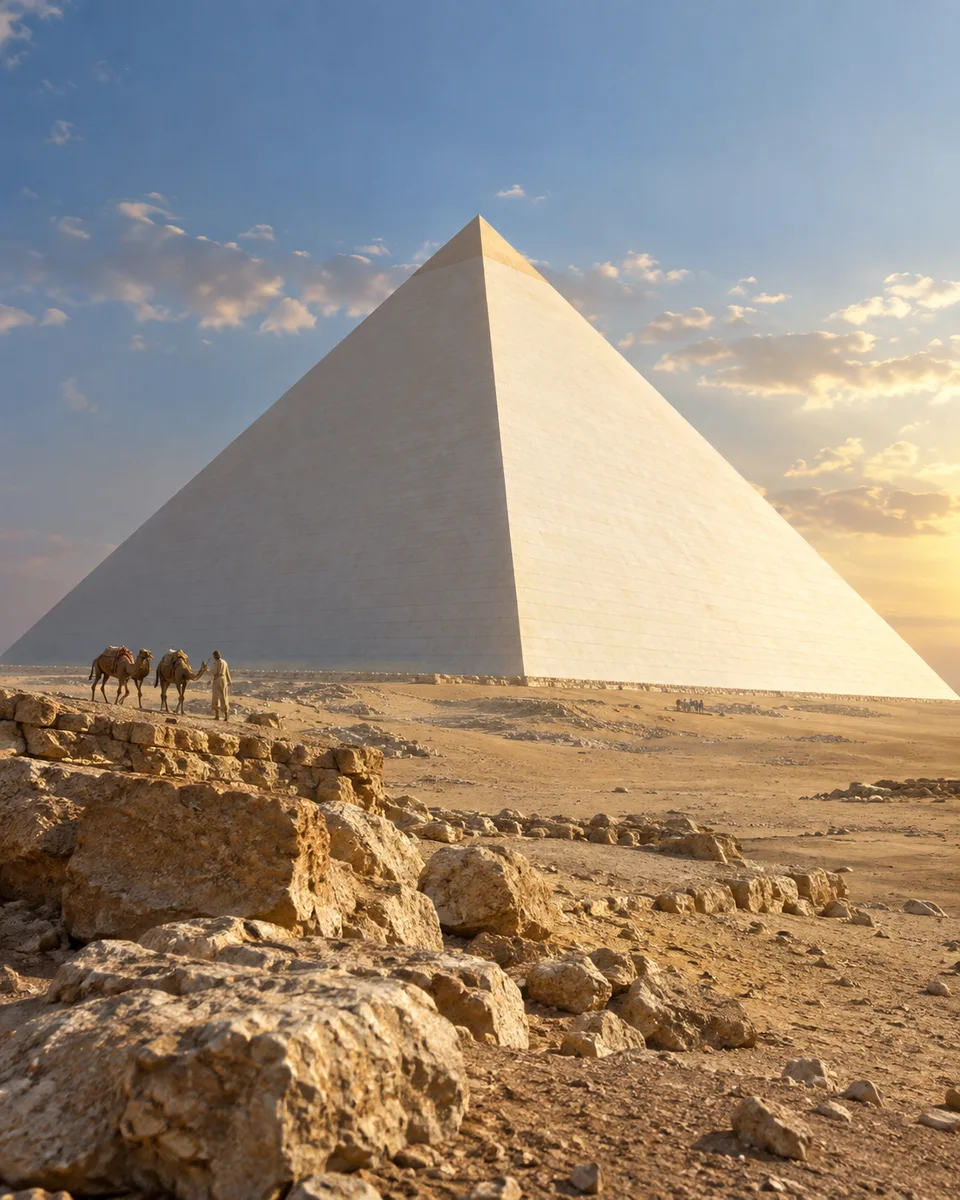
myAudience · AI-generated original illustration · Original AI-generated illustration; not documentary evidence; no third-party artwork reproduced.
The Great Pyramid was built for King Khufu during Egypt’s Old Kingdom. Its present rough outline is not the whole original surface. Much of the core used locally available limestone, while finer limestone from Tura formed an exterior casing. The distinction matters: a durable mass of stone and a carefully finished outer skin solved different construction problems.
In its original form the pyramid had smooth sides rather than the exposed steps now visible. The surviving monument lets researchers measure masonry and passages, but missing casing prevents us from seeing every finish directly. Imagining a pale exterior is reasonable; asserting an exact pristine appearance, every joint or a particular decorative treatment would go beyond the surviving evidence.
Building the monument joined quarrying, transport, stone dressing, setting-out and labor organization. A large royal project also needed food, tools and routes for materials. Those connections make the pyramid a record of institutions and craft as well as a tomb. It was not an isolated geometrical object dropped onto an empty desert.
The image restores an illustrative pale casing; it is not a documentary photograph of the pyramid at completion. Keep three kinds of claim separate: stone that survives, evidence for material that was removed, and an artist’s choice about missing details. Notice how a smooth face changes your reading of the same underlying shape. Then ask what a surviving casing block can establish that an impressive reconstruction cannot.
Image: speculative AI reconstruction; uncertain details.