Stone and the work beside it
By Egypt along the Nile · myAudience
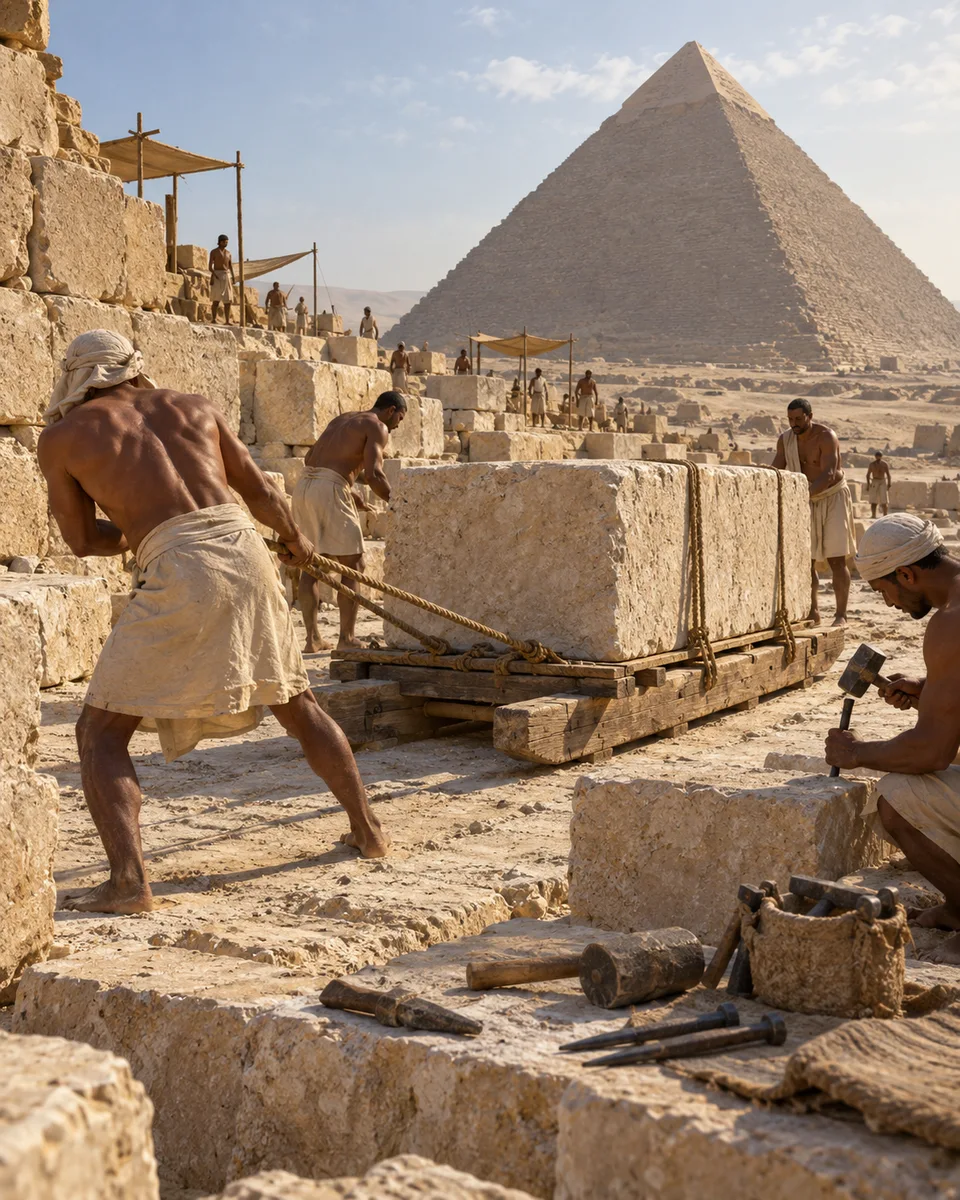
myAudience · AI-generated original illustration · Original AI-generated illustration; not documentary evidence; no third-party artwork reproduced.
A pyramid’s construction can be broken into repeated tasks: extract stone, shape a usable block, move it, place it and check its position. Different stones and locations called for different tools and handling. Limestone, granite and a finished casing block should not be treated as interchangeable materials. A general account of pyramid building must also allow methods to change across periods.
Quarries, tool traces, workers’ settlements and written records provide evidence for parts of this process. Ramps, sledges and other proposed lifting arrangements address real mechanical problems, but no single surviving manual explains every stage of Khufu’s pyramid. A plausible experiment demonstrates that something can work; it does not automatically prove that the builders used that exact arrangement.
The Harvard Giza Project emphasizes the organization and provisioning of the workforce. Evidence for settlements and food supply challenges the simple picture of an anonymous, unsupported crowd. At the same time, we should not replace one stereotype with a claim that every worker had the same status or employment terms. Large projects depended on both skilled activity and powerful institutions.
Our work area and the workers’ individual actions are imagined. Treat the scene as a way to inspect a sequence, not as evidence for a specific machine. Which task needs a cutting edge, which needs a route and which needs measurement? Explaining those separate demands makes construction understandable without pretending that all archaeological debates have been settled. The remaining uncertainty concerns details of human methods, not a need for supernatural engineering.
Image: speculative AI reconstruction; uncertain details.