Cargo on the Nile
By Egypt along the Nile · myAudience
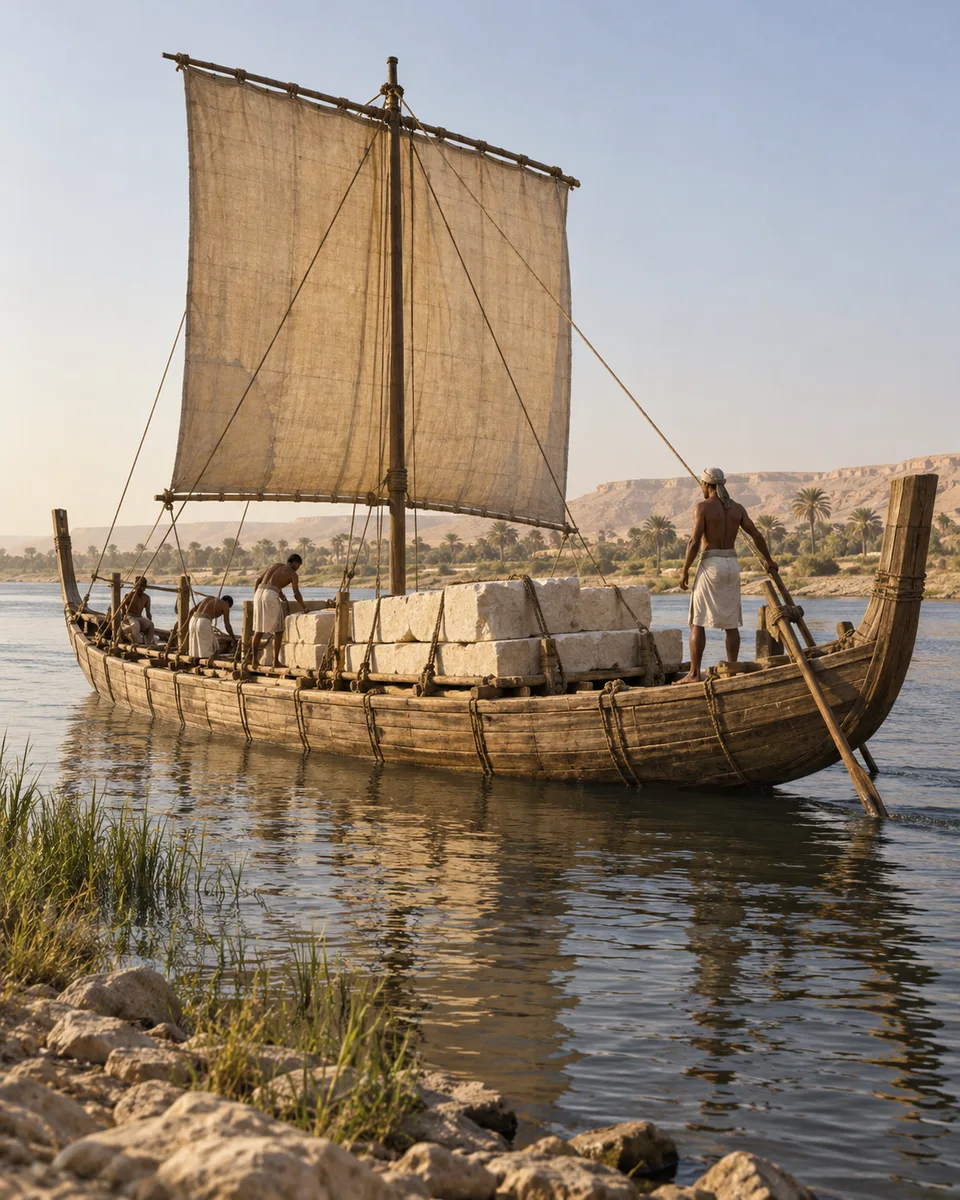
myAudience · AI-generated original illustration · Original AI-generated illustration; not documentary evidence; no third-party artwork reproduced.
The Nile was a route connecting settlements, fields and building projects. A cargo’s journey began before a boat reached a royal site: material had to be quarried or produced, brought to a loading place and handled at its destination. River transport made large movements possible, but boats were one component of a coordinated supply chain.
A particularly important source is the journal associated with Merer, discovered among the Wadi al-Jarf papyri. It records activities of a work crew in Khufu’s reign, including journeys involving limestone from Tura toward the royal construction area. That is direct evidence for an organized transport operation; it is not a complete explanation of how blocks were raised into the pyramid.
The Old Kingdom joined agricultural resources, royal authority and specialized work. Time spent on the water had to fit with other tasks and with conditions along the route. When reading an administrative document, attend to what it actually records: deliveries, movements and organization can be highly informative even when the writer offers no dramatic account of monument building.
The illustrated boat, crew and load are invented, not a vessel copied from Merer’s journal. Follow the cargo rather than only the sail: where would it come from, where could it be unloaded and what would happen next? Separating river movement from final stone placement prevents a common mistake—treating evidence for one link in a construction chain as proof of every link. Practical records can be more revealing than spectacular later legends.
Image: speculative AI reconstruction; uncertain details.