A morning in the agora
By Greece in the making · myAudience
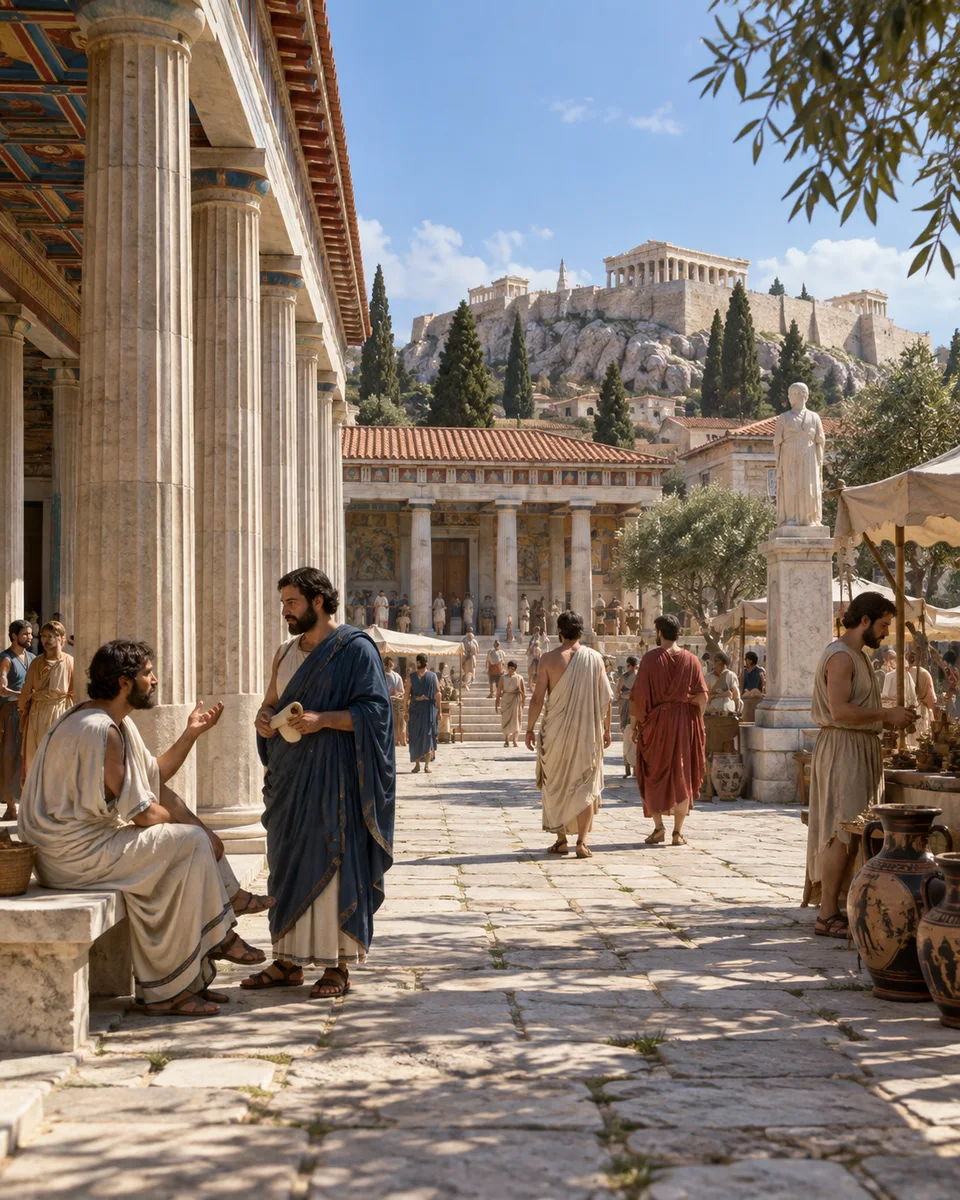
myAudience · AI-generated original illustration · Original AI-generated illustration; not documentary evidence; no third-party artwork reproduced.
An agora was a public gathering place in a Greek city, with activities that could include exchange, worship and civic business. Ancient Greece consisted of distinct communities whose institutions and spaces changed over time. Athens offers famous surviving evidence, but its agora should not be used as a universal plan for every Greek settlement.
Covered colonnades, or stoas, offered a sheltered boundary between open space and rooms or shops. Building such a space meant coordinating a roof, supports, paving and access. Its value was practical as well as visual: shelter could change where people paused and how they moved. A row of columns is better understood as part of a usable architectural system than as ornament detached from its surroundings.
Public participation also had limits. Athenian democracy did not grant the same political role to women, enslaved people and resident foreigners as to male citizens. The appearance of an open square therefore cannot establish equal access to power. Read civic architecture together with the rules of the particular community, rather than assuming that “public” meant the same thing as it does today.
This image invents a morning and its occupants. It is not a survey of the Athenian Agora or a record of a historical assembly. Trace where a pedestrian could seek shade, approach a building or cross the open ground. Which choices come from a known plan and which come from the artist? That comparison makes the city more interesting: streets and buildings become evidence to investigate, not a backdrop for a single idealized story.
Image: speculative AI reconstruction; uncertain details.