A theater uses the hillside
By Greece in the making · myAudience
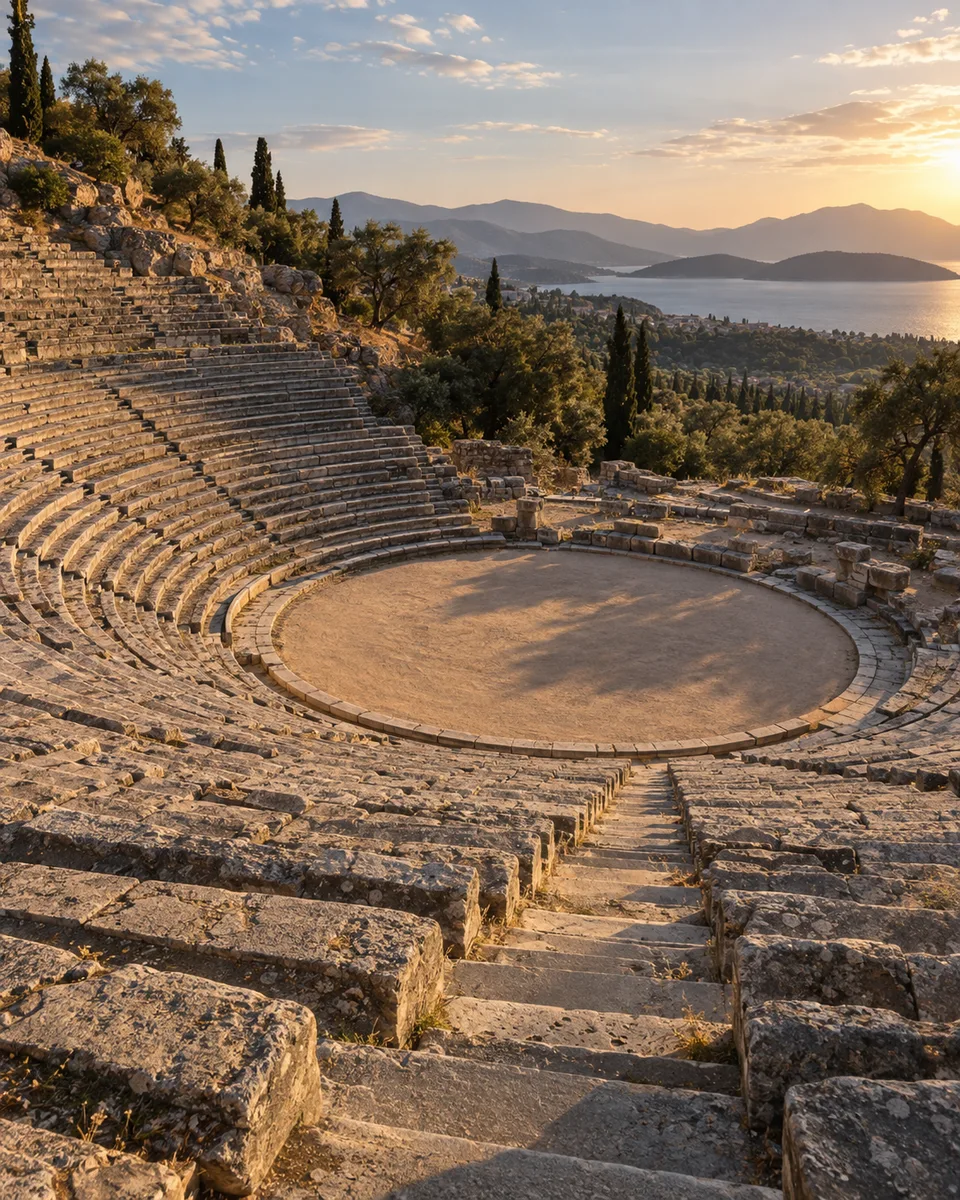
myAudience · AI-generated original illustration · Original AI-generated illustration; not documentary evidence; no third-party artwork reproduced.
An ancient Greek theater placed spectators around a performance area, often making use of a hillside. The orchestra, seating and stage-related structures were distinct parts of the arrangement. Their forms changed over time and from site to site. Greek theaters also should not be confused with Roman amphitheaters, whose surrounding seating served a different building type.
A slope could support ascending rows and help arrange sightlines, but terrain did not do all the work. Paths, entrances, drainage and prepared seating were construction choices. A performance space had to be reached and used by a crowd, not only viewed from above. Reading the plan means following arrival and departure as well as the direction in which spectators faced.
Theater in Greek communities was connected with festivals and public life. A dramatic performance was therefore more than a modern entertainment event transported into antiquity. Yet surviving buildings do not tell us every detail of acting, audience response or access. Texts, architectural remains and later reconstructions provide different kinds of evidence.
This hillside is invented and the image makes no acoustic measurement. Do not turn an attractive layout into a claim that every spectator could hear every quiet word. Instead, choose a documented theater and compare its entrances, orchestra and rows with this illustration. Where does the terrain help, and where must masonry or circulation solve another problem? The achievement becomes clearer when several practical requirements are considered together.
Image: speculative AI reconstruction; uncertain details.