Brick rises in terraces
By Between two rivers · myAudience
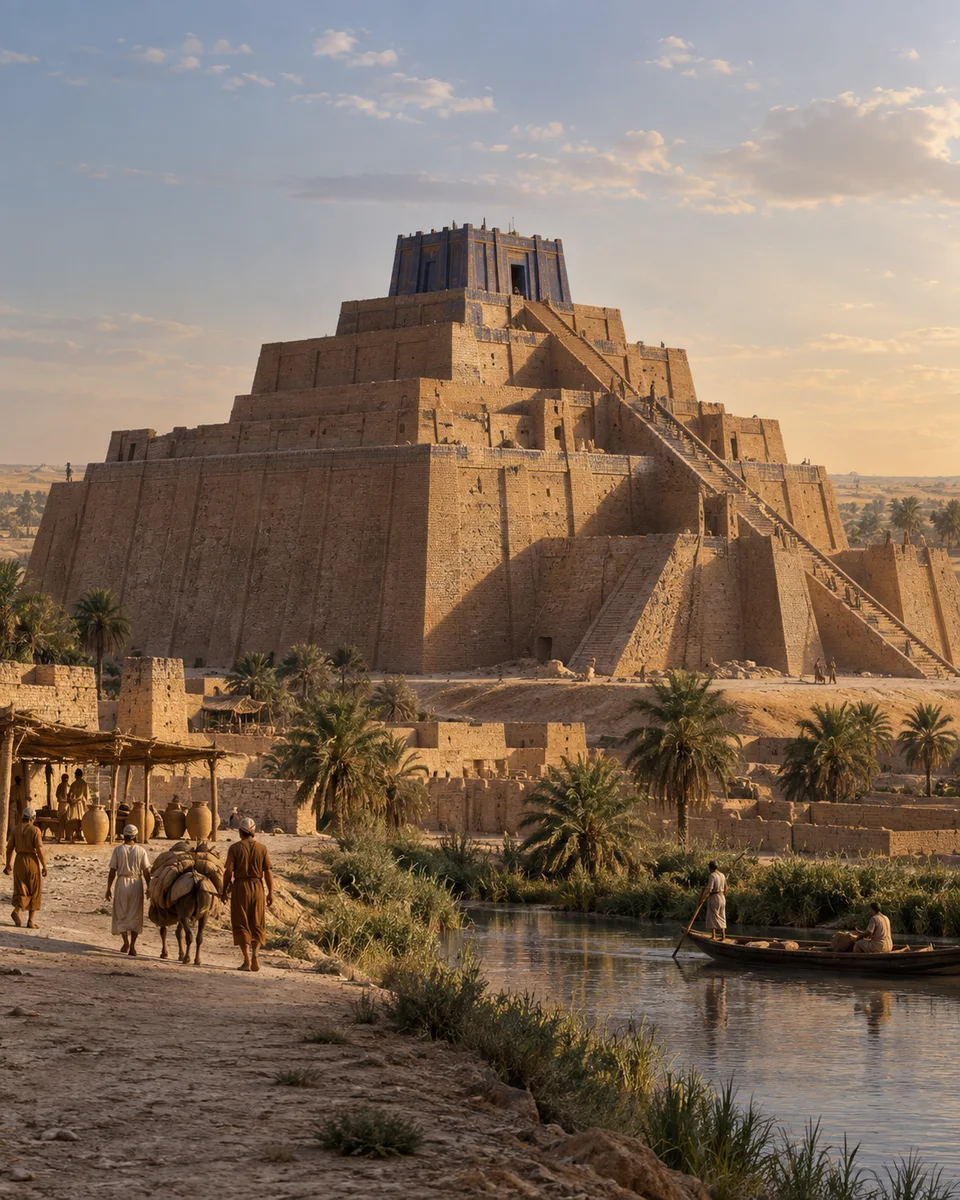
myAudience · AI-generated original illustration · Original AI-generated illustration; not documentary evidence; no third-party artwork reproduced.
A ziggurat was a monumental raised structure associated with a religious complex in ancient Mesopotamia. Its terraced form lifted part of the sanctuary above the surrounding settlement. It was not an Egyptian-style royal pyramid tomb. That distinction matters because similar silhouettes can disguise different institutions, materials and uses.
Brick made large construction possible in a landscape where clay was a major resource. Sun-dried brick could form a substantial core, while fired brick could protect exposed surfaces. Building required repeated molding, drying, transport and laying, with careful attention to the stability of a rising mass. The supply of materials and labor was an engineering problem alongside the shape itself.
Babylon preserves remains of monumental urban and religious architecture, but present-day ruins and later reconstructions must be distinguished. A low foundation can constrain a plan without determining every lost upper stage. The full height, surface and access arrangements of any named structure require their own evidence, rather than being supplied by a general picture of what ziggurats looked like.
This stepped monument is invented and is not a measured reconstruction of Etemenanki or Ur. Read its terraces as a question about loads and routes: how would people and materials reach a higher level, and which surfaces would face weather? Then compare an excavated plan. The most useful reconstruction makes the distinction between evidence and completion visible instead of letting a persuasive skyline conceal missing information.
Image: speculative AI reconstruction; uncertain details.