An account in clay
By Between two rivers · myAudience
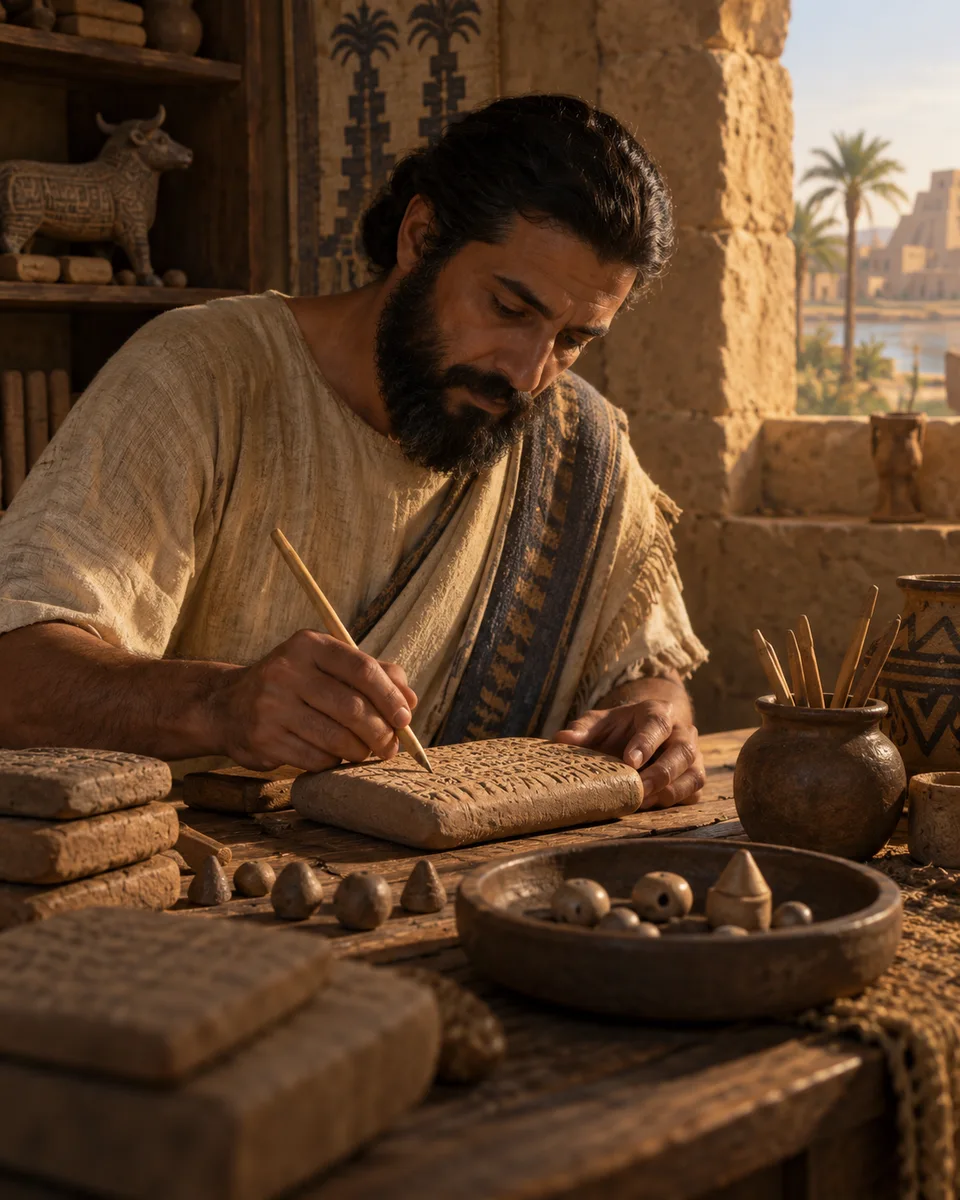
myAudience · AI-generated original illustration · Original AI-generated illustration; not documentary evidence; no third-party artwork reproduced.
A clay tablet could record a delivery, a list, a calculation or a literary work. Writing in Mesopotamia served practical administration as well as storytelling and scholarship. The Metropolitan Museum’s documented administrative tablet offers a concrete reminder that an account can be a historical object: routine organization left marks that survived long after the transaction.
Cuneiform signs were formed by pressing a stylus into prepared clay. The wedge-shaped marks belonged to a writing system used for more than one language across a long history. A sign is therefore not simply a little drawing with an obvious English meaning. Correct reading depends on the language, period, conventions and state of the particular tablet.
The making of the record also matters. Someone prepared a surface, arranged information and entered marks that others could interpret. Accounting can connect goods, measures and institutions; it does not reveal an entire society from one list. A tablet’s provenance and archaeological context help establish what kind of record it is and how it relates to other evidence.
Our image contains no authoritative readable ancient message. Do not translate generated marks or invent a person’s transaction from them. Compare a documented photograph and scholarly reading, then ask what the tablet confirms and what remains unknown. The value of this small object is its specificity: it can make an ordinary act of administration tangible without requiring a grand, fictional story about its writer.
Image: speculative AI reconstruction; uncertain details.