Water reaches a field
By Between two rivers · myAudience
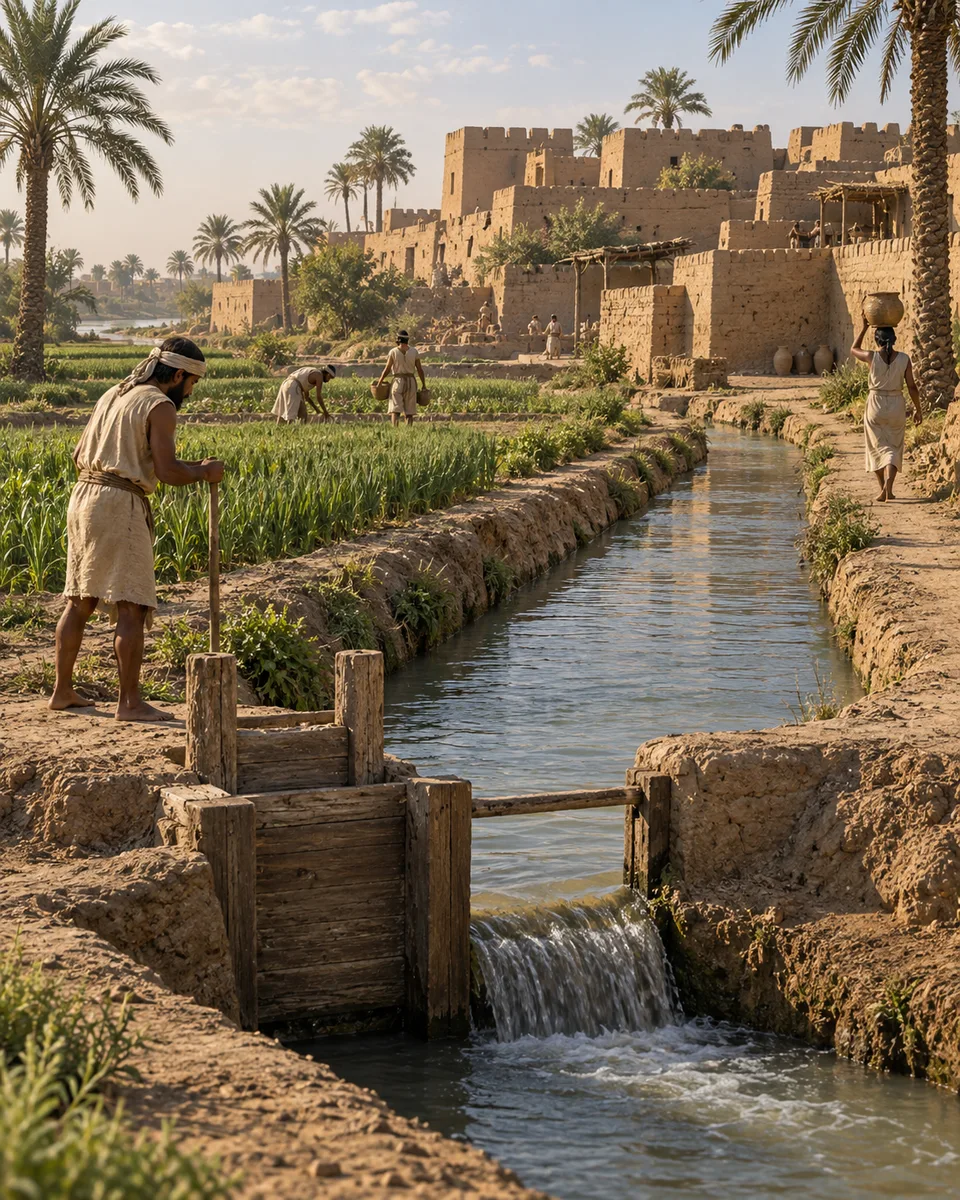
myAudience · AI-generated original illustration · Original AI-generated illustration; not documentary evidence; no third-party artwork reproduced.
In southern Mesopotamia, communities depended on managing water as well as cultivating crops. Channels connected parts of a river landscape with fields and settlements. Rainfall, river behavior and local conditions varied, so “the canal system” should not be imagined as a single unchanged arrangement spanning every city and century.
A canal required more than an initial excavation. Water had to reach the intended area, banks and access points needed attention, and sediment could reduce a channel’s capacity. Those practical demands make maintenance central to the history. An impressive new route that was not kept usable would not accomplish the same work as a functioning system.
Babylon’s World Heritage property includes agricultural areas as well as urban monuments. That helps correct a view of the ancient city as only temples and palaces. Food production, movement and political institutions were connected, even though the exact arrangements must be established for a particular place and period. Cooperation and authority can both matter without being reduced to a simple story of harmonious shared labor.
The illustrated field and channel are not an excavated route. Treat the water’s path as a problem to inspect: where does it enter, where could it spread and what happens when a bank fails or a channel silts up? Then ask which remains or administrative texts could test your interpretation. Landscape history is strongest when a plausible practical explanation is kept distinct from a claim that this particular system has been proved.
Image: speculative AI reconstruction; uncertain details.