A street in an Indus city
By Ancient South Asian cities · myAudience
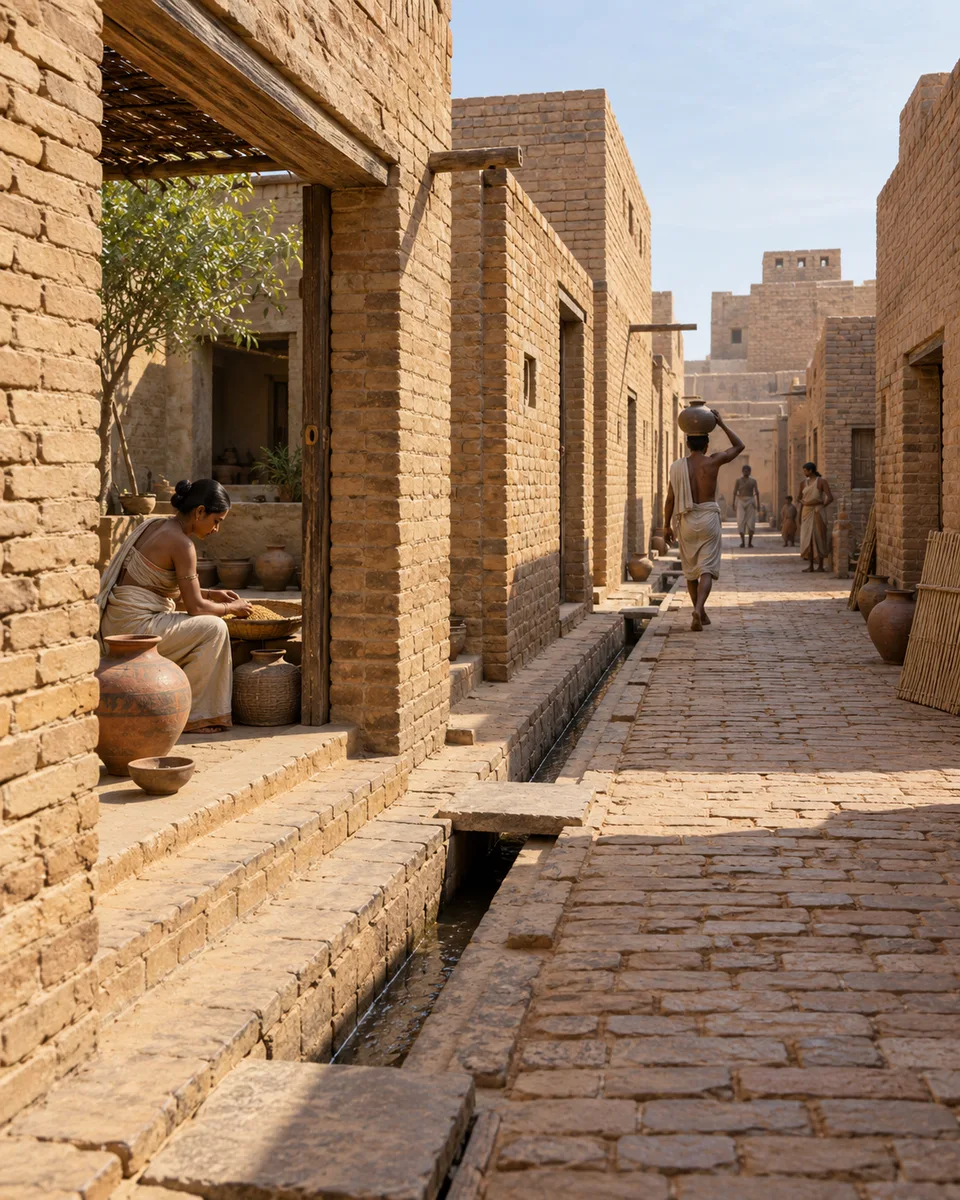
myAudience · AI-generated original illustration · Original AI-generated illustration; not documentary evidence; no third-party artwork reproduced.
Mohenjo-daro was a major urban settlement of the Indus civilization, in present-day Pakistan. Its surviving streets and buildings show that city-making involved deliberate organization. This is a Bronze Age South Asian setting, not a scene from a later Indian empire. Keeping place and period distinct prevents several thousand years of history from becoming one imagined “ancient” city.
Brick construction allowed repeated units to form walls, platforms, wells and other features. Planning still required decisions about access, levels and relationships between neighboring buildings. A regular material did not automatically create a regular city: builders and inhabitants had to organize space around practical needs. Excavated plans reveal arrangements more reliably than a completed illustration does.
The Indus script has not been securely deciphered, and many questions about political organization remain open. Researchers cannot simply read a surviving royal chronicle to identify the ruler or explain every institution. Streets, objects and buildings provide evidence, but names such as “citadel” do not prove the precise political function of an elevated area.
Our street restores imagined height, roofs and everyday activity. It does not establish the clothing or appearance of particular inhabitants. Compare the reconstruction with a surveyed plan, tracing an entrance and a route between buildings. Which relationships survive in the archaeology, and which depend on the artist? An organized settlement is impressive without inventing either a named king or a claim that everybody shared the same way of life.
Image: speculative AI reconstruction; uncertain details.