Threads become a cloth
By China through objects · myAudience
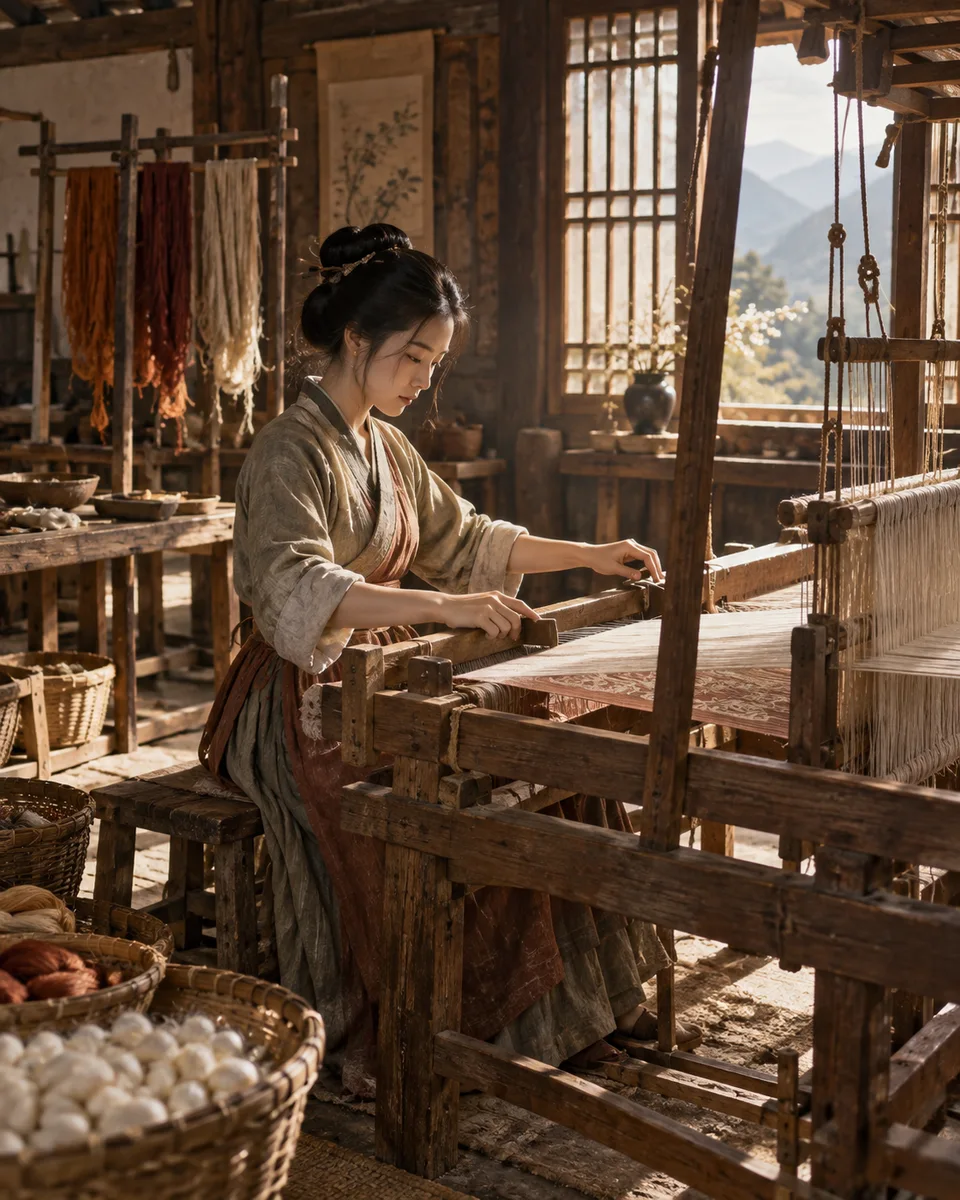
myAudience · AI-generated original illustration · Original AI-generated illustration; not documentary evidence; no third-party artwork reproduced.
Silk cloth begins with a biological material and ends with an organized textile. Fibers associated with silkworm cocoons have to be prepared into usable thread before weaving can create a surface. The distinction between producing fiber, preparing yarn and making cloth matters: “silk manufacture” is a chain of skilled operations rather than a single action at a loom.
A loom organizes lengthwise threads while another thread passes across them. Different arrangements and techniques can create different structures and patterns, but the tools in our image should not be treated as a technical diagram of an identified Han loom. A finished textile, a surviving tool and a depiction of weaving answer related but different questions about production.
Silk was part of Han material culture and exchange with regions beyond the empire. Trade involved networks and intermediaries, not one uninterrupted road traveled by every piece of cloth. The Metropolitan Museum’s Han overview places silk within a wider movement of goods. Luxury at a destination depended on work performed in several places long before a purchaser saw the finished textile.
Our workshop’s people, equipment and working sequence are imagined. Compare the illustration with a documented textile and its provenance, then ask what can be learned from the fibers, weave and pattern separately. Which parts reveal a manufacturing choice, and which parts depend on a later interpretation? Seeing the cloth as a product of repeated work offers more depth than presenting it only as a shimmering emblem of distant trade.
Image: speculative AI reconstruction; uncertain details.