A model of a daily world
By China through objects · myAudience
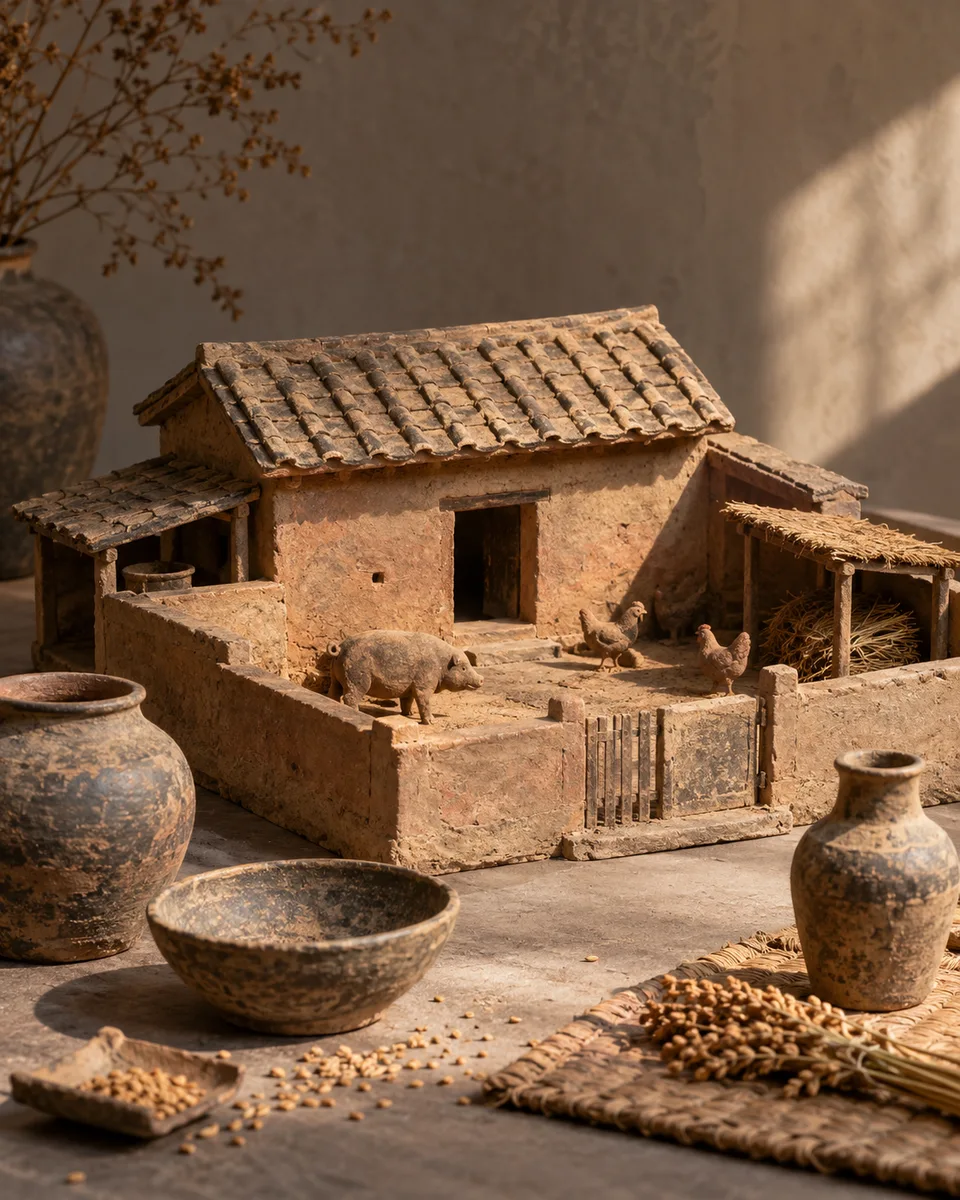
myAudience · AI-generated original illustration · Original AI-generated illustration; not documentary evidence; no third-party artwork reproduced.
Objects placed in tombs could represent buildings, attendants, animals and useful goods. These funerary objects are often discussed under the term mingqi. They belonged to practices of burial and commemoration rather than serving simply as toys or neutral architectural records. Their meaning begins with the context in which they were made and deposited.
A clay model had to be shaped, joined and fired, with details selected to make its subject recognizable. Scale could simplify a building or emphasize a feature that mattered to the object’s purpose. That makes it possible to study representation and craft without assuming that every proportion records the dimensions of a real structure.
Han-period models provide valuable evidence for how buildings and daily activities were represented. They can be compared with excavated remains and other objects, but surviving tomb assemblages also reflect wealth, belief and preservation. They do not offer an equal sample of every household’s possessions or every person’s daily experience.
This illustrated grouping does not reproduce a museum collection. The combination, placement and individual objects are invented. Choose one documented model and inspect what the maker emphasized: an entrance, raised floor, roof or animal pen might be more carefully described than another part. What does that choice help you understand, and what does it leave unknown? Treating the model as a purposeful object preserves its historical interest without turning it into an unquestioned miniature photograph.
Image: speculative AI reconstruction; uncertain details.