Stone records a ruler’s story
By Maya cities and living heritage · myAudience
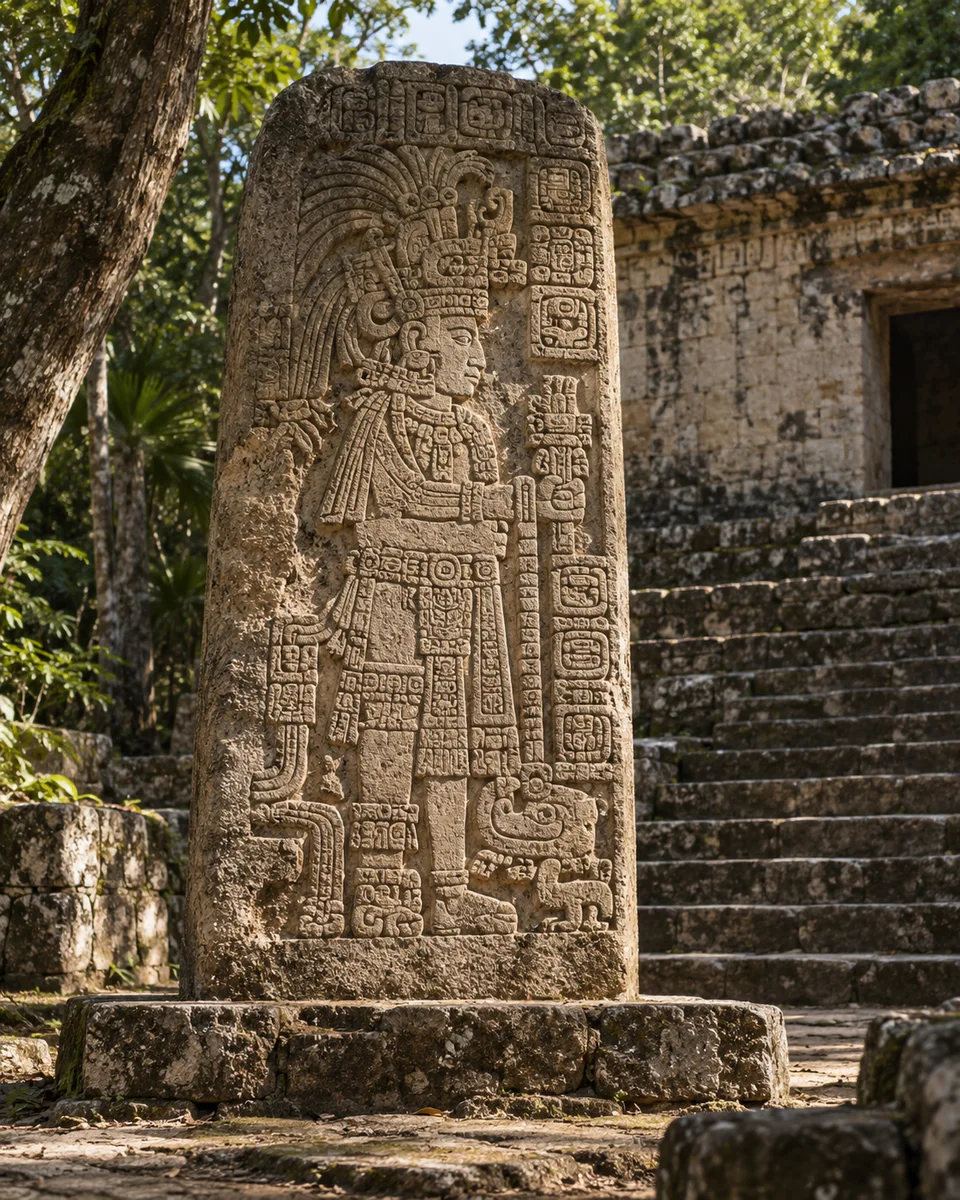
myAudience · AI-generated original illustration · Original AI-generated illustration; not documentary evidence; no third-party artwork reproduced.
A Maya stela is a carved standing stone monument. Many display rulers together with inscriptions that commemorate events and dates. These are not interchangeable decorative panels: a specific monument has a particular place, historical setting and text. Their study depends on archaeology and specialist interpretation, including the reading of Maya writing.
The object joins several kinds of work. Stone had to be selected and moved, a surface prepared, and images and signs arranged and carved. A relief can lead the eye toward a figure while an inscription organizes another form of information. The composition is therefore part of how an authority or event was presented, not merely embellishment added after the history was recorded.
Royal monuments are powerful sources, but their purpose can shape their message. A ruler’s commemoration is not automatically an impartial account of all members of a society. Researchers compare inscriptions with other texts and material evidence. The fact that a stone is ancient does not remove the need to consider whose viewpoint it presents.
Our stela is invented and contains no authoritative readable account of a named ruler or event. Do not treat generated marks as translatable historical writing. Compare a documented monument and an identified reading, distinguishing the figure, date and interpretation. That practice lets a carved stone become a historical source while preventing an attractive reconstruction from supplying a false ancient quotation.
Image: speculative AI reconstruction; uncertain details.