Water beside a Maya city
By Maya cities and living heritage · myAudience
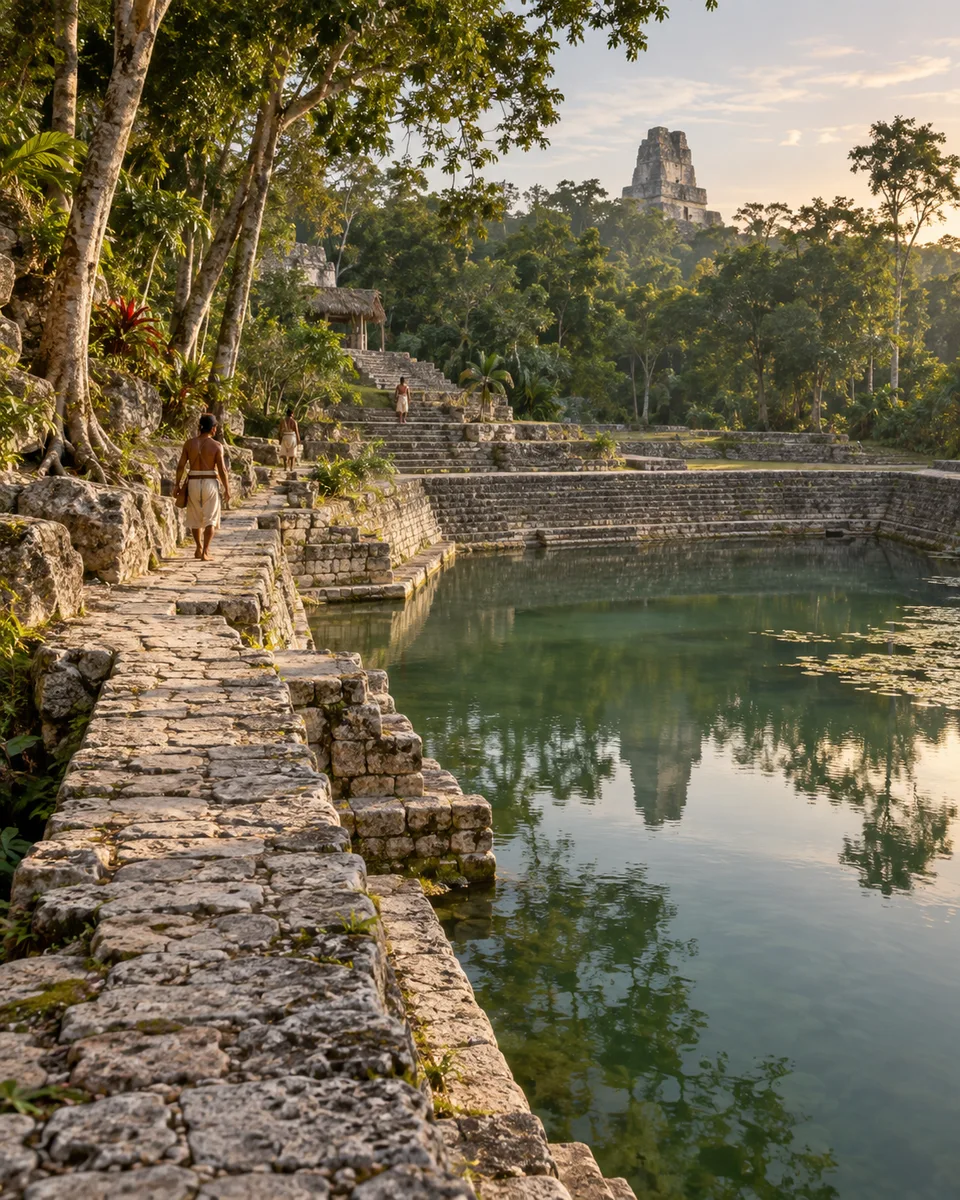
myAudience · AI-generated original illustration · Original AI-generated illustration; not documentary evidence; no third-party artwork reproduced.
Tikal’s water needs extended beyond its monumental buildings. Reservoirs stored water for use during dry conditions, connecting settlement design with seasonal supplies. A city could not depend only on the visual success of its temples: water collection, storage and access were continuing practical requirements for the people living there.
Water management could involve the shape of the ground and built surfaces that directed runoff. A reservoir also raised a second problem after collection: keeping stored water usable. Research at Tikal’s Corriental reservoir identified quartz and zeolite in a context interpreted as evidence for filtration. This is a specific archaeological finding, not proof that every Maya reservoir used the same system.
The evidence comes from sampled material and its context, compared with geological sources and known material properties. That supports a reasoned interpretation of an engineering practice. It does not reveal every maintenance routine, the exact appearance of a working filter or what each resident knew about the process. A scientific conclusion can be strong while leaving those details unresolved.
Our water scene is illustrative and does not locate a named reservoir or reproduce a tested filter design. Trace where rainwater might enter and where a person could draw from storage; then compare the documented research. Separating collection, storage and water quality makes the achievement clearer. It also prevents a newly interesting discovery from being expanded into a claim that an entire civilization had one identical, perfectly functioning water technology.
Image: speculative AI reconstruction; uncertain details.