Craft in a courtyard
By Maya cities and living heritage · myAudience
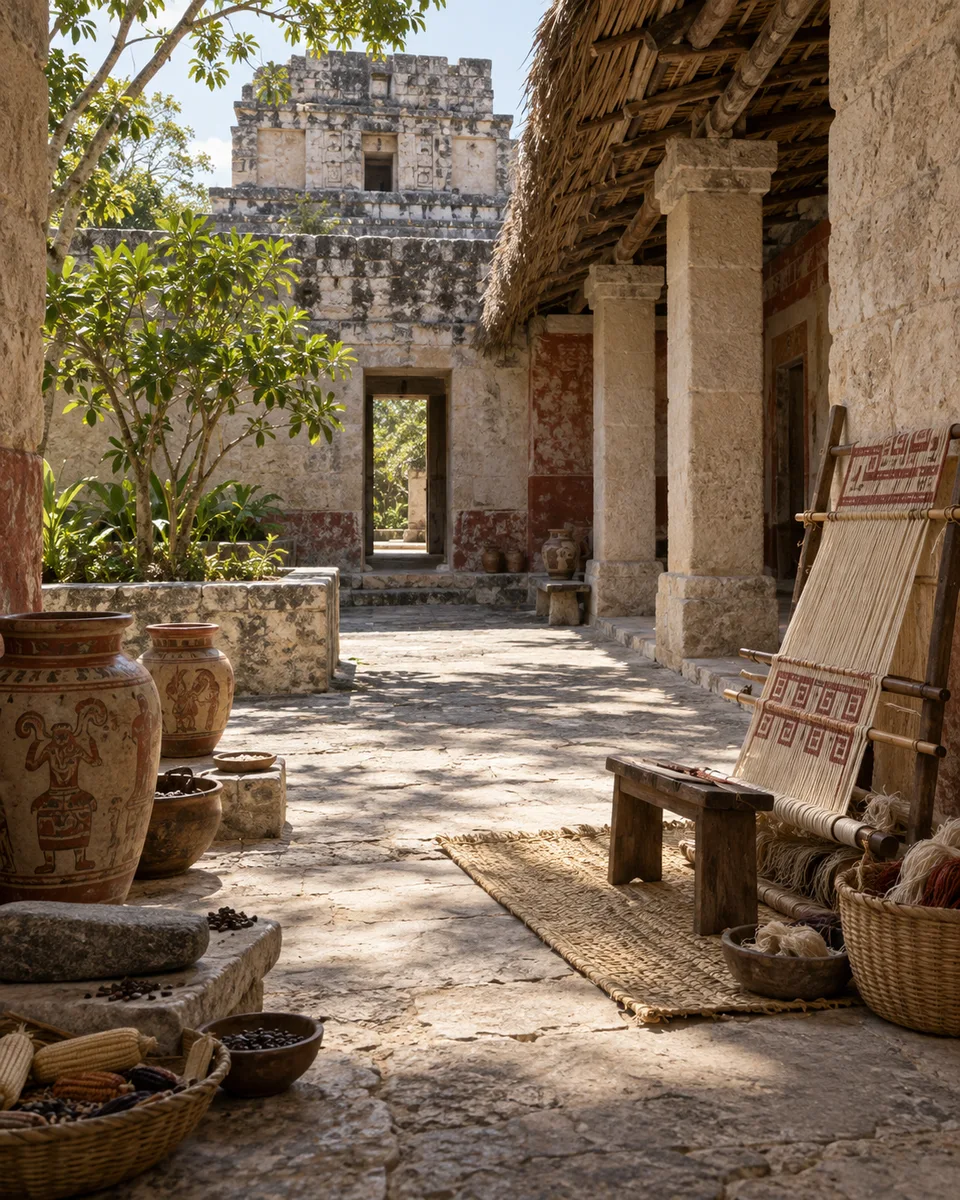
myAudience · AI-generated original illustration · Original AI-generated illustration; not documentary evidence; no third-party artwork reproduced.
Maya cities included homes and working spaces as well as temples and royal monuments. A courtyard shifts attention toward the movement of materials and the tasks that sustained everyday life. That change of viewpoint matters: a ceremonial skyline is not a complete description of a city’s economy or of the experience of all its inhabitants.
Ceramic manufacture offers one example of practical skill. Clay had to be prepared and shaped, vessels dried and fired, and surfaces finished for particular uses or displays. Forms could be built by hand, with different techniques suited to different objects. A painted vessel and a cooking pot need not demand the same finish or circulate in the same social setting.
Surviving ceramics can be compared by material, shape and decoration, while excavated context helps distinguish workshop activity, household use and deposition. An image on an elaborate vessel is also a designed representation, not a direct window into every ordinary meal. Objects become more informative when making, use and later survival are treated as separate stages.
The people and activities in our courtyard are imagined. The picture does not prove an identified Tikal workshop or the exact task performed in a particular building. Look for the relationship between shade, space and materials, then ask what tools or production waste would test the proposed activity. Ordinary work deserves a careful explanation without needing a fabricated diary or a crowd of invented comments to make it feel alive.
Image: speculative AI reconstruction; uncertain details.