The Pharos beside its harbor
By Wonders, built by people · myAudience
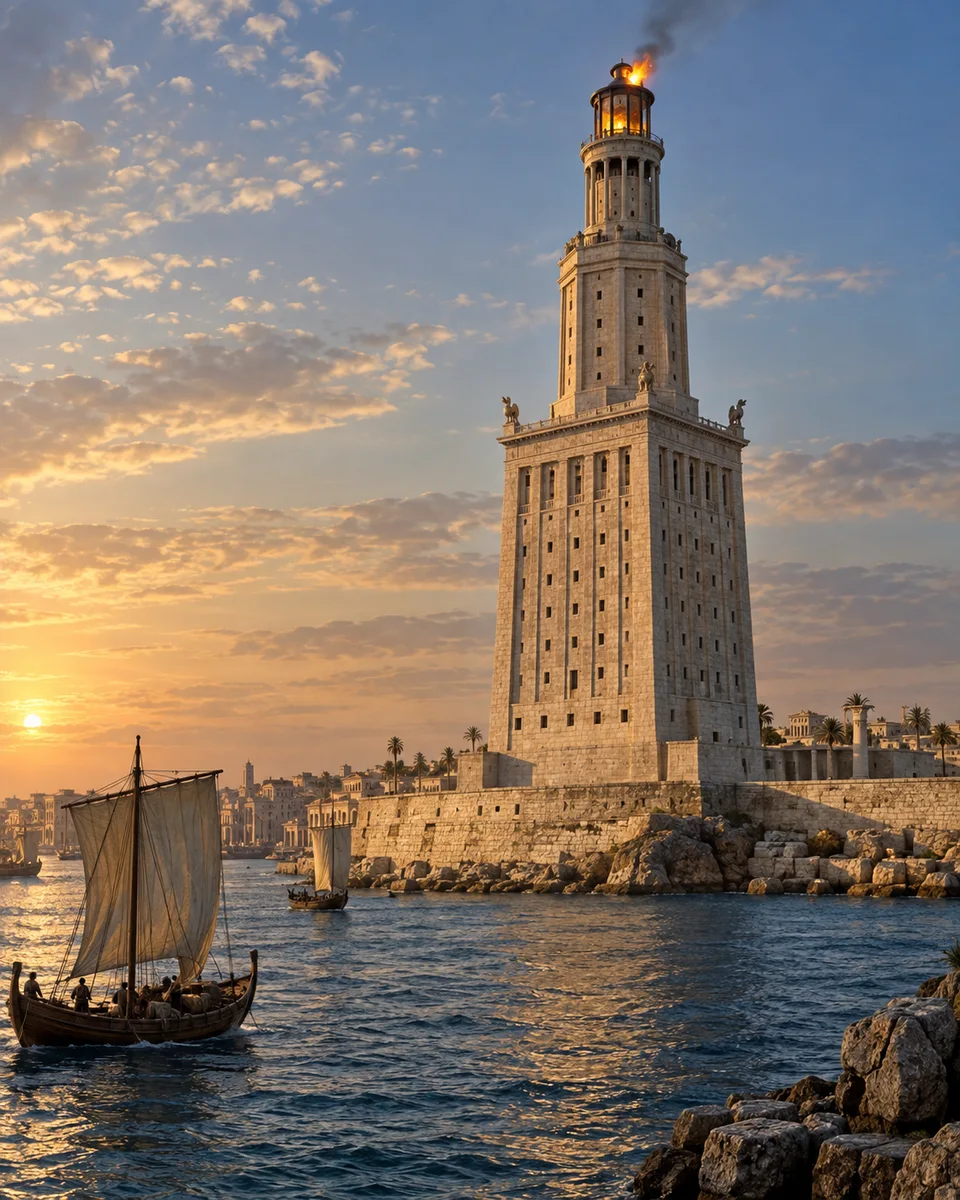
myAudience · AI-generated original illustration · Original AI-generated illustration; not documentary evidence; no third-party artwork reproduced.
The Pharos of Alexandria was a lighthouse built in the Ptolemaic period and associated with the traditional Seven Wonders. It served a maritime city in which approach and orientation mattered. A landmark beside a harbor offered more than a dramatic skyline: its purpose depended on the relationship between ships, water and the coast.
Egypt’s UNESCO Tentative List submission describes a tower with square, octagonal and circular stages. Those descriptions help explain common reconstructions, but a Tentative List submission is not the same as an inscription on the World Heritage List or a complete surviving building survey. The lost tower’s dimensions and details must be judged against the particular textual and archaeological evidence.
Construction required a large stable base and a rising masonry structure, with access and continued operation to consider. The lighthouse also changed through damage and repair over a long history. Earthquakes contributed to its destruction. A reconstruction that freezes one ideal form can conceal that changing life of maintenance, alteration and eventual loss.
Our harbor, vessel traffic and surface finish are invented. The image does not demonstrate a particular optical mechanism or prove every upper-level feature. Start with the practical task of recognizing a coast, then ask what evidence supports the tower’s form and how that evidence was produced. Treat later descriptions, underwater remains and an artist’s reconstruction as distinct kinds of information rather than letting their combined impression become a false photograph.
Image: speculative AI reconstruction; uncertain details.