The telescope waits for dark
By A sky worth slowing for · myAudience
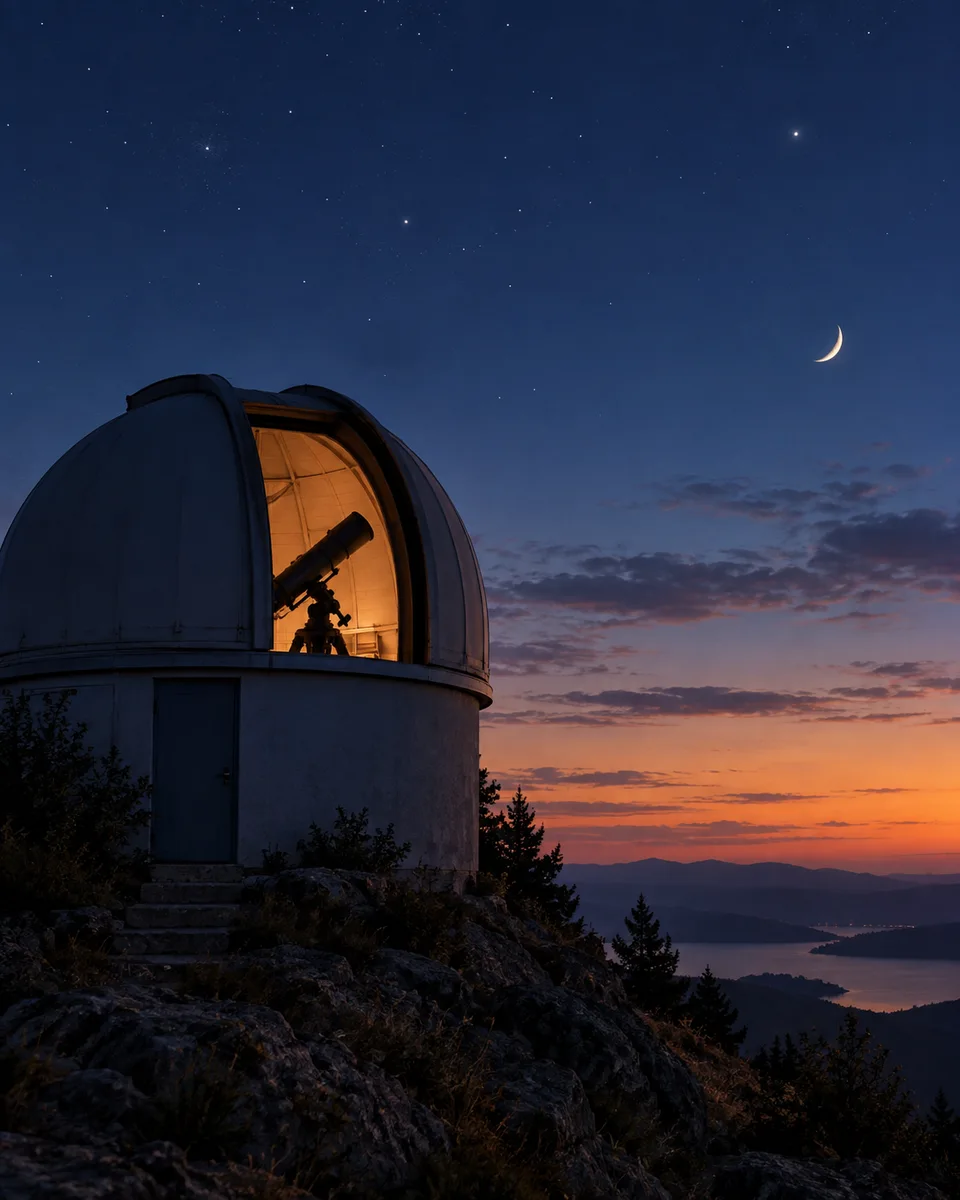
myAudience · AI-generated original illustration · Original AI-generated illustration; not documentary evidence; no third-party artwork reproduced.
A telescope gathers light and forms an image or supplies it to another instrument. Its value depends on the question, not just how large it looks. Aperture, optical design, detector sensitivity, wavelength range and observing conditions all affect the information available. An instrument suited to a bright planet is not automatically the best way to investigate a very faint, distant galaxy.
Astronomers also measure spectra: how light is distributed across wavelengths. Patterns can provide clues about physical conditions and motion when interpreted with suitable models. A visually striking photograph is therefore only one kind of result an observatory can produce. A modest-looking set of measurements may answer a question that a much prettier image cannot resolve.
For a beginner’s planning exercise, select one target type—Moon, planet or star field—and write the feature you want to observe. Next list what would interfere: clouds, a bright sky, vibration or an unsuitable field of view. This changes the task from buy the strongest telescope to choose a method for a defined observation. Binoculars or unaided viewing can be appropriate for some questions; never point ordinary optics at the Sun.
The dome here is fictional, not a visitor recommendation or a promise of public access. Read a real observatory’s description for its actual instrument and programme. Hubble’s official observatory material offers an example of matching a designed instrument to scientific work, though an orbiting observatory has different constraints from one on the ground. A useful follow-up is to ask what its designers chose to measure and what they deliberately left to other instruments.
Image: illustration, not a documentary photograph.