A planet crosses its star
By A sky worth slowing for · myAudience
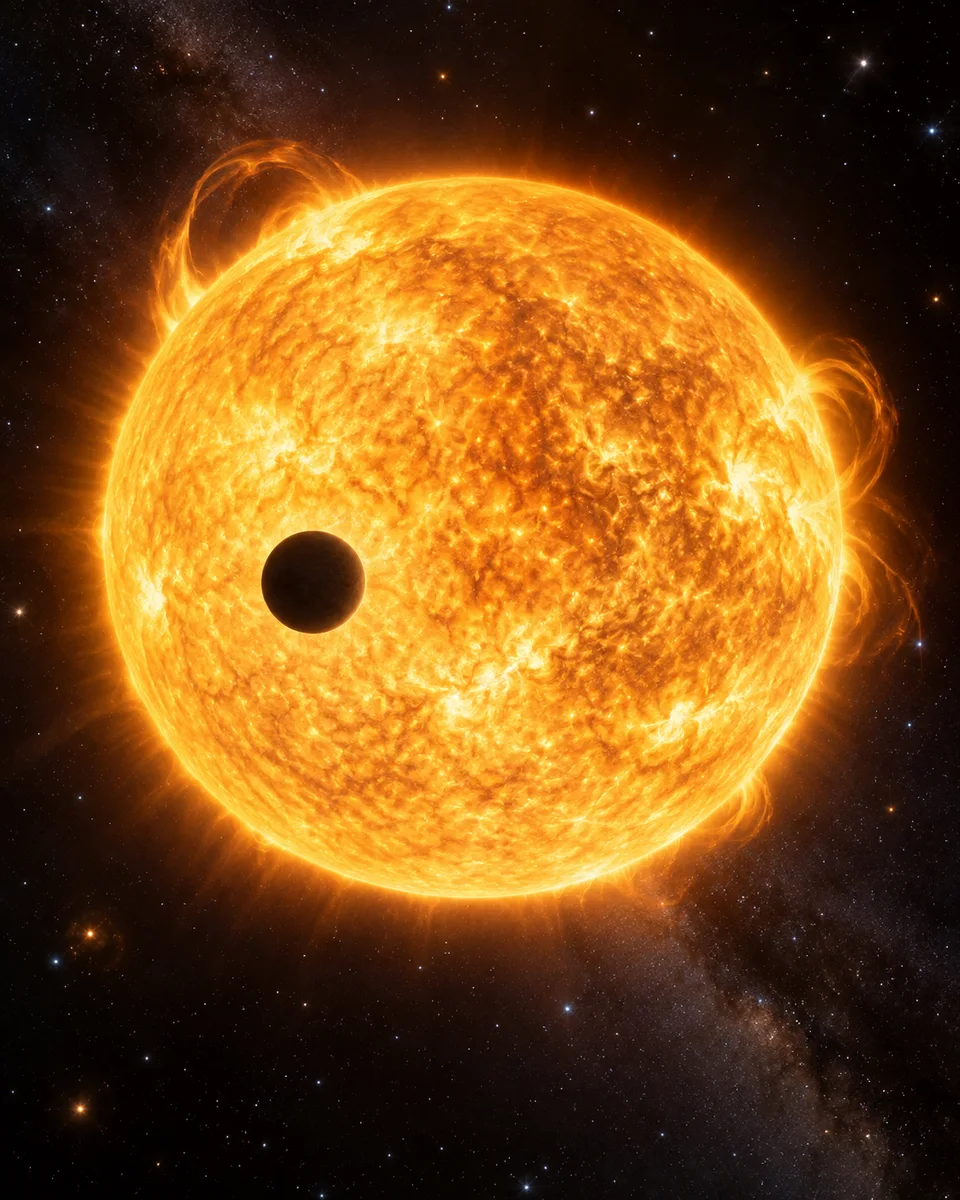
myAudience · AI-generated original illustration · Original AI-generated illustration; not documentary evidence; no third-party artwork reproduced.
A transit happens when an object crosses in front of another from our viewpoint. For an exoplanet, astronomers can measure a repeated reduction in a star’s received light. Most distant planets are not resolved as the large dark discs shown in illustrations. The light curve—the measured brightness over time—is often the main evidence being examined.
In a simplified case with an evenly bright star and a small opaque planet, transit depth is approximately the ratio of their projected areas. Doubling a planet’s radius makes its area four times larger, not twice. Real stars and observations add complications, including limb darkening, noise and the path of the transit. A tidy formula is a model with conditions, not a complete description of every signal.
Imagine a star’s usual brightness is normalised to 1.000 and a dip reaches 0.990. The depth is about one percent. In the simplified area model, the planet-to-star radius ratio is the square root of 0.01, or 0.1. This does not independently reveal the planet’s mass, atmosphere or surface. Identifying the star and validating the signal are essential before interpreting the numbers.
Repeated dips help establish a period, but other phenomena can mimic a planet signal. Astronomers compare evidence and may use additional methods to test the explanation. Our glowing star and oversized crossing disc teach the viewing geometry; they are not a direct observation of a named system. When reading a discovery story, ask which quantities were measured, which were inferred and which attractive details remain unknown.
Image: illustration, not a documentary photograph.