A night under the Milky Way
By A sky worth slowing for · myAudience
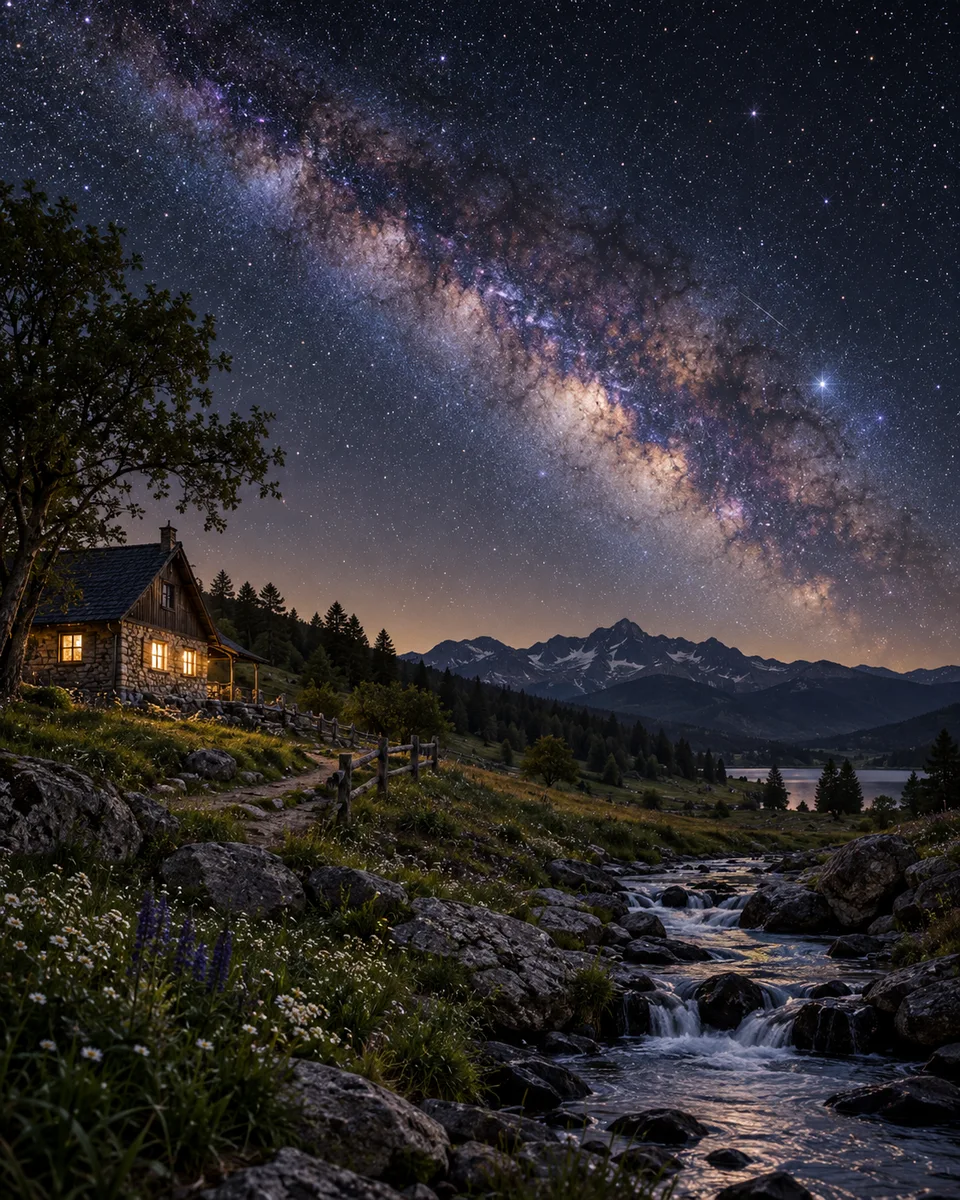
myAudience · AI-generated original illustration · Original AI-generated illustration; not documentary evidence; no third-party artwork reproduced.
The Milky Way’s luminous band is a view through parts of our own galaxy from inside it. Many stars are too faint to distinguish individually, so their combined light contributes to the band. Dark features are not necessarily empty spaces: dust can block some visible light from stars behind it. A sky photograph therefore mixes luminous sources with material that changes what reaches us.
What you can see depends on season, location, weather, Moon brightness and surrounding light. A camera may record faint structure through an exposure that your eyes do not experience in the same way. Saturation and contrast changes also affect the final appearance. Compare the image’s exposure and processing notes before assuming that a colourful photograph promises an identical naked-eye scene.
Plan a short observation from a permitted, safe location with a clear return route. Allow time for your eyes to adjust to the dark and avoid repeatedly looking at bright screens. Rather than trying to name every star, draw the horizon and record one broad pattern. A date, direction and description of conditions turn a pleasant evening into a usable observation, even when clouds prevent the hoped-for view.
The landscape and bright band in this illustration are invented. NASA’s galaxy explanations provide the scientific context; an actual sky chart must match your place and time. A productive question is why a band appears when we are embedded in a much larger structure. Thinking about the direction of your line of sight helps connect a familiar night view with a three-dimensional galaxy without pretending that one scene shows its entire shape.
Image: illustration, not a documentary photograph.