Qin Shi Huang: a life in context
By China through objects · myAudience
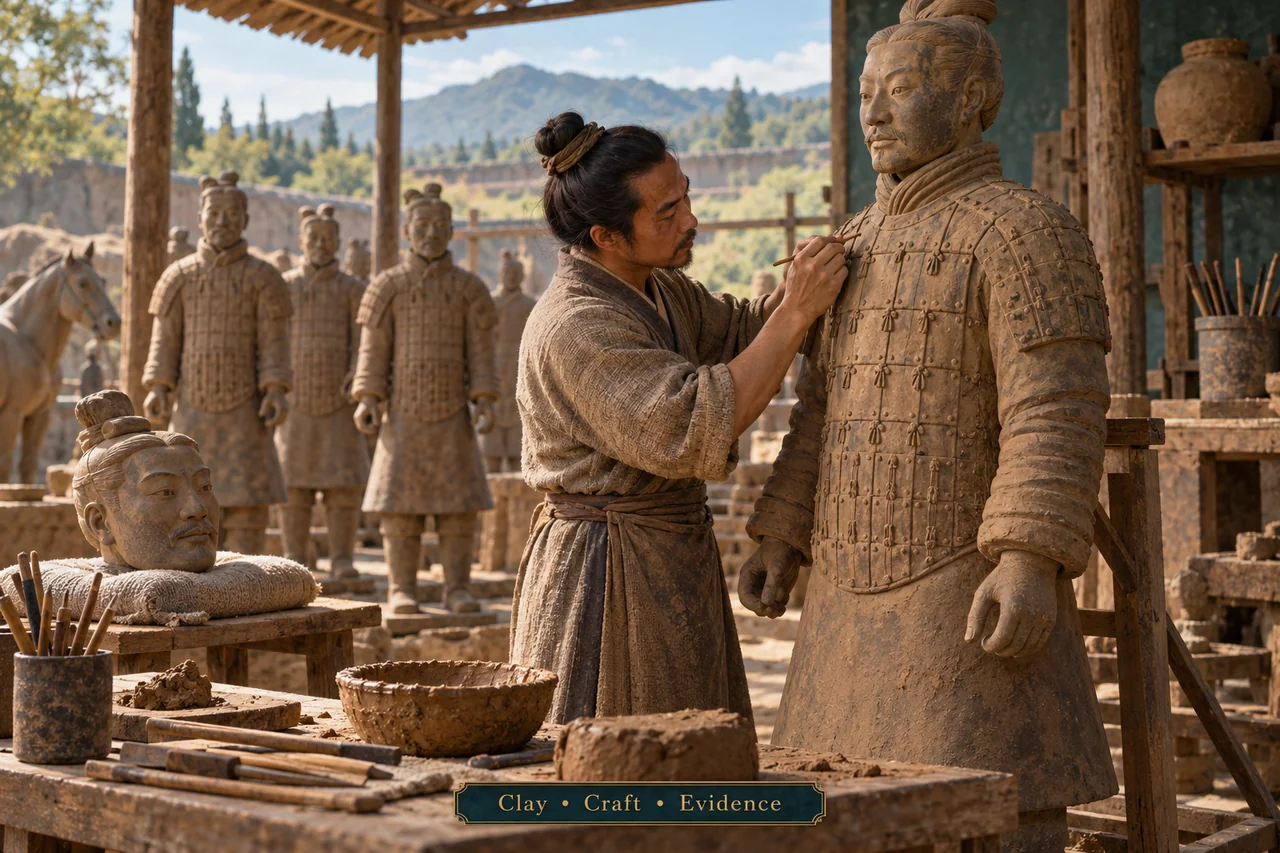
Image: illustration, not a documentary photograph. Imagined workshop; this illustration does not establish how every warrior was made. · Original myAudience teaching illustration
Qin Shi Huang became ruler of Qin and, after conquering rival states in 221 BCE, adopted the title of First Emperor. His reign transformed the organisation of a large territory, but the dynasty's existence was short rather than an uninterrupted beginning of one timeless state.
Standardisation and central administration supported imperial authority. Extensive building and military projects mobilised people and resources, with severe burdens on subjects. Administrative achievement and coercion belong in the same account rather than cancelling one another out.
His tomb complex includes the terracotta army, produced through coordinated craft labour. The surviving figures reveal funerary ambition and production practices, not a photograph of an actual battle formation or a complete inventory of everyday Qin life.
Standardisation can make an extensive administration more workable by reducing differences officials encounter, but it also changes who decides what counts as legitimate practice. The educational question is to examine both coordination and compulsion. A legal document may show an intended rule, while an excavated object can reveal how a material standard was actually produced or used. Neither alone establishes uniform implementation. Linking evidence from an administrative centre with evidence from another locality would test the reach of imperial policy more carefully than assuming every decree transformed the entire territory immediately.
His reforms included common standards for weights, measures, currency and writing. These were practical instruments for administration and exchange, alongside the more conspicuous tomb and military projects. Their range helps explain why Qin’s influence extended beyond the brief life of its dynasty.
Further reading
An army made from earth is also evidence of organisation. Qin Shi Huang died in 210 BCE; the sculptures near his mausoleum were created for an imperial funerary setting, rather than as a public monument to a modern nation. UNESCO describes an extensive complex of pits, buildings and burial remains. Looking only at the familiar rows of soldiers misses the wider question: how were materials, skilled people and repeated tasks brought together?
The clay figures and the bronze equipment ask different questions. A ceramic body had to be shaped and fired; a bronze component required metalworking. Wood, lacquer and pigments belonged to the same larger material system, although they survive differently. The UCL–mausoleum museum Imperial Logistics project studies this combination through objects, measurements and spatial evidence. A grand commission can therefore be examined from the workshop outward, rather than only through the ruler’s ambition.
Repetition does not mean that every object was made in exactly the same way. The Met’s discussion of terracotta production sets out competing interpretations: separately prepared parts, different degrees of moulding, and experiments with a largely continuous clay body. It does not supply a single universally settled sequence. An original-looking modern reconstruction demonstrates that a method can work; matching a finished shape alone cannot prove that ancient workers used that method.
That distinction changes what we can learn from a seam. A join, tool trace or material boundary is evidence to record before explaining it. Ask whether it occurs in many objects, whether later repair could account for it, and whether an experimental method predicts the same trace. These are questions for investigation, not claims that every warrior preserves every kind of mark. A proposed manufacturing model becomes stronger when it explains several independent observations instead of just producing a convincing silhouette.
The bronze weapons offer a particularly clear example of revising a familiar story. Research reported by UCL in April 2019 found that surface chromium was associated with nearby lacquered organic parts, while many well-preserved bronzes had no chromium. That evidence undermined the claim that an intentional ancient chromium coating explained their survival. Soil conditions and the metal itself are relevant to preservation; the result should not be turned into an equally sweeping claim that one factor explains every object.
Consider an invented classroom sample of twenty bronze fragments. Suppose twelve have a chromium signal, but both groups contain well-preserved pieces. The signal occurs in 12 ÷ 20 = 0.60, or 60% of the sample. It does not follow that 60% were deliberately treated: detection and intention are different variables. We would need evidence about where the signal occurs, contamination pathways, manufacture and comparable untreated material. These numbers are a learning model, not measurements from the Qin excavation.
Now change the evidence: a second invented sample contains ten well-preserved pieces, eight without detectable chromium. Can a chromium coating be necessary for preservation in that sample? No. Eight counterexamples show that good preservation occurred without the measured signal. This does not prove that chromium could never influence corrosion under any conditions, nor establish why each object survived. A necessary-condition claim is narrower than a claim about every possible cause.
The illustration brings clay shaping and the workshop scale into view, but it cannot settle the disputed production sequence or identify a real artisan. Its faces are imagined, and the arrangement is a teaching scene. Read the material evidence and the uncertainty together: technical achievement matters, while the people who made it should not disappear behind the emperor’s name. Further questions about labour, coercion and daily experience require additional historical evidence rather than an invented story about the particular worker shown.