Kublai Khan: a life in context
By China through objects · myAudience
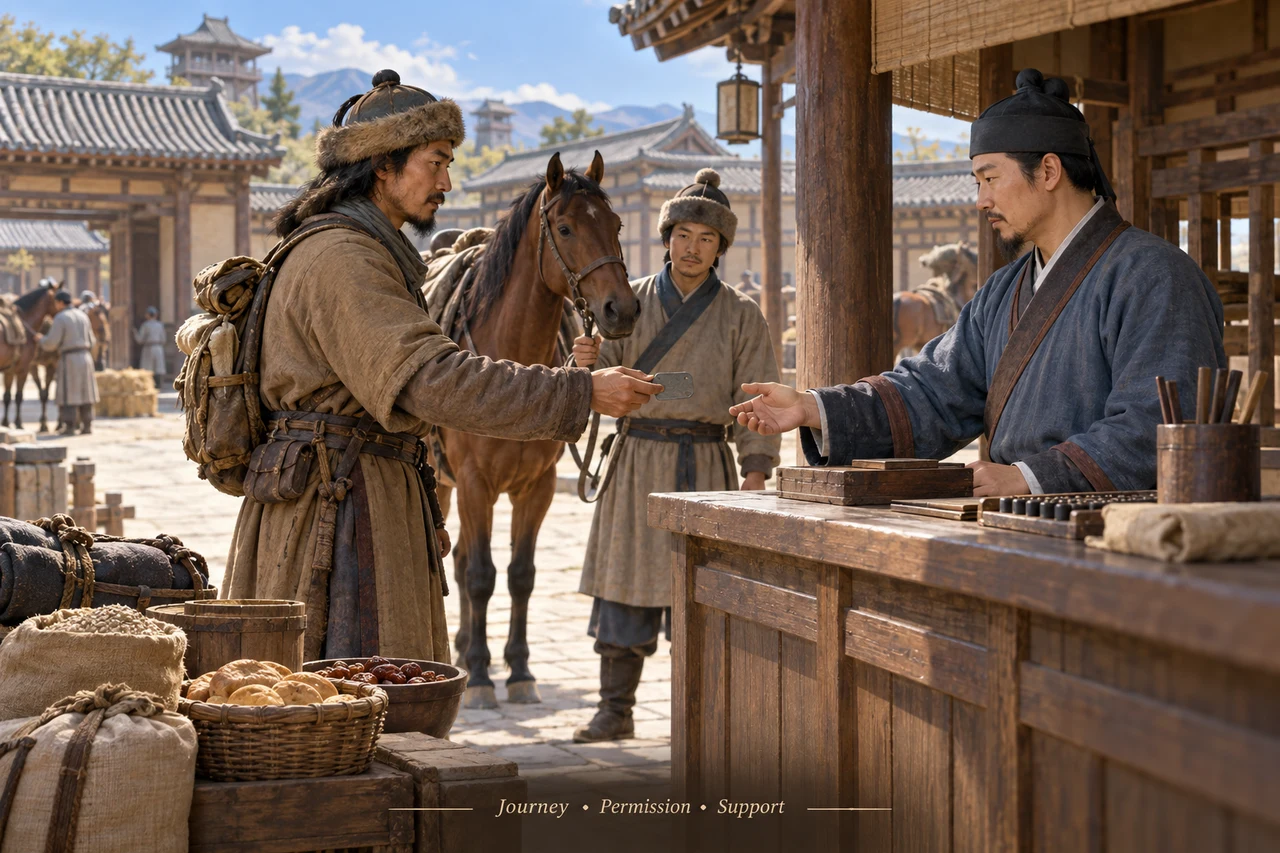
Image: illustration, not a documentary photograph. Imagined relay courtyard; not a surveyed station, authenticated Kublai portrait, exact historical pass or measured route. Actual160 is recognition only; the full explanation defines all model assumptions. · Original myAudience teaching illustration
Kublai Khan was a grandson of Genghis Khan and founded the Yuan dynasty in China in 1271. His authority linked Mongolian and Chinese political worlds, but his rule did not mean every part of the wider Mongol Empire remained governed as one united system.
The conquest of the Southern Song was completed in 1279. Governing required adaptation of institutions, resources and relationships with diverse populations. Imperial rule involved hierarchy and coercion alongside the movement of knowledge and people.
Campaigns beyond the core territories met limits, including unsuccessful invasions of Japan. Organisation and maritime logistics mattered as well as storms. A celebrated imperial court should not make those costs or failures disappear.
A ruler linking several political worlds did not make their institutions identical. The Yuan court had to govern through relationships shaped by conquest and existing administrative practice, while other Mongol centres pursued their own interests. This gives readers a way to ask what the title of great khan meant in practical terms at a particular date, rather than assuming it signified uniform control everywhere. Campaign failures also reveal limits that a courtly display of wealth can conceal. Compare representation with a dated political or military record to separate claims of authority from demonstrated ability to act.
The dynastic name Great Yuan was proclaimed in 1271, before the conquest of the Southern Song was completed in 1279. Those distinct dates connect political claims with an unfinished military process. Accounts by visitors such as Marco Polo supply another perspective on the court, but their narratives still require source comparison rather than acting as an unrestricted record of every reported detail.
Further reading
A ruler can announce a capital, but people and information still have to reach it. The Met’s account of Yuan material culture describes Dadu, now Beijing, as Kublai Khan’s great capital and explains a network of relay stations with food, lodging and supplies. A traveller needed an authorised pass to use those facilities. Start with that small object: it connects a journey to resources, official permission and the work of people along the road.
Permission and movement are different parts of the same system. A pass could identify an entitled traveller, while a station supplied practical support; neither alone ensured a completed journey. The museum notes that passes were often metal, with material varying according to rank and urgency. An impressive metal object therefore needs its administrative context. Its survival is not a count of everyone who travelled, and possessing a particular type does not tell us the exact journey its owner completed.
Objects also reveal connections between workshops. The Met’s account of cross-Asian imagery describes motifs carried through luxury textiles and linked artistic traditions. A pattern could be adapted to express power in a new setting. This is evidence of connected skills and patronage, not a reason to assume that every artisan moved willingly or benefited equally. A textile’s style, the movement of a maker and the terms under which the maker worked are three questions; one attractive pattern does not answer all three.
Political connections could be unequal. The Met’s Yuan painting account describes southern scholars facing a restrictive hierarchy and the disruption of routes into government service. Some made art that communicated loyalties or withdrawal from politics. This helps keep two observations together: the period produced striking cultural exchange, and participation in imperial power was not equally open. A useful history explains both institutions and the people whose choices were constrained by them.
Imagine a classroom route with four legs of 30 kilometres each. Suppose its traveller averages 6 kilometres per hour on every leg and pauses for half an hour at each of the three intermediate stations. Distance is 4 × 30 = 120 kilometres; travelling takes 120 ÷ 6 = 20 hours, and pauses add 3 × 0.5 = 1.5 hours. Total elapsed time is 21.5 hours. These are invented inputs, not measured Yuan travel speeds or proof that actual roads were evenly spaced.
Worked question: Under the explicitly invented four-leg assumptions, what is the elapsed time including only intermediate pauses?
Full answer: 120 km divided by 6 km/h is 20 h travelling; three intermediate pauses add 1.5 h, so 21.5 h. There is no extra pause at the starting point or destination in this model.
Now change two legs so their average speed is only 3 kilometres per hour, leaving the other two at 6 and retaining the same three pauses. The slower legs take 2 × 30 ÷ 3 = 20 hours; the faster legs take 2 × 30 ÷ 6 = 10. Adding 1.5 hours gives 31.5 hours. Is the existence of stations enough to guarantee the earlier arrival time? No. The support network is unchanged, but slower movement adds ten hours. Weather, terrain, animals and availability would require their own real evidence.
Changed question: Two legs slow to 3 km/h. Can the unchanged station network guarantee 21.5 h, and what is the new elapsed time?
Full answer: No. Two slow 30 km legs take 20 h, two fast 30 km legs take 10 h, and three pauses add 1.5 h. Total 31.5 h, ten more than before. Historical travel time cannot be inferred from invented rates.
A second evidence question concerns what survives. Suppose an invented collection contains eight decorated court objects and two plain household objects. Can their 80% share establish that 80% of Yuan households owned luxury objects? No. A selected collection is not a random household survey, and an object is not a household. Acquisition, survival and excavation each affect the sample. This is why the museum’s particular objects should inform specific questions rather than become a simple census of an empire.
Further evidence answer: Eight luxury objects out of ten collected objects is 80% of this collection, not 80% of households; the sampling unit and selection process differ.
The illustration shows an imagined relay courtyard: a traveller presents an uninscribed pass while other people attend to horses and supplies. It is a conceptual scene, not a surveyed station, an authenticated likeness of Kublai or evidence of an exact pass design. Read it alongside the material and administrative questions. The network’s usefulness does not excuse conquest or erase the labour behind it; its organisation can be studied without treating imperial authority as a benefit shared by everyone.