Eleanor of Aquitaine: a life in context
By England and Britain · myAudience
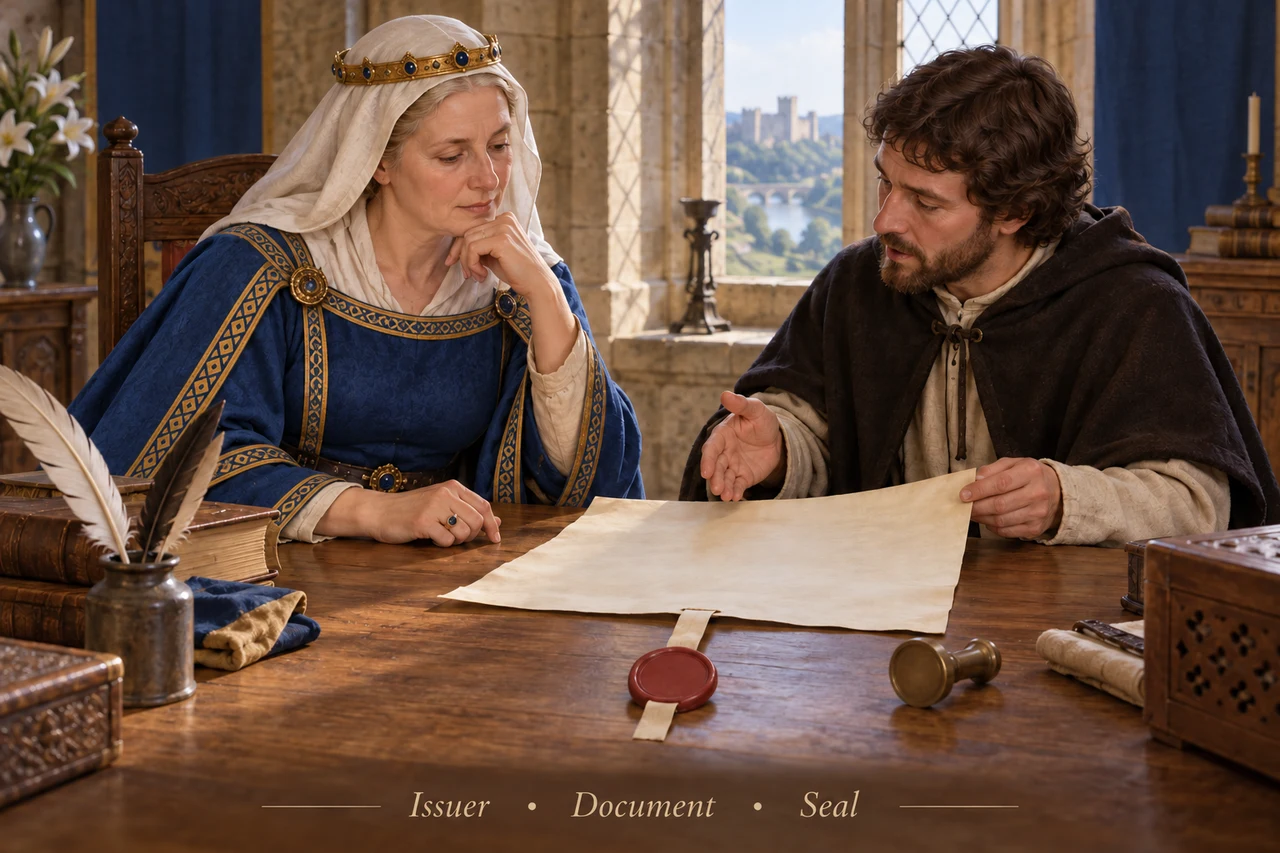
Image: illustration, not a documentary photograph. Imagined scene; not Eleanor’s authenticated appearance, handwriting, room, specific charter, heraldry or surviving seal. Actual160 is recognition only; no modern translated sentence or facsimile reproduced. · Original myAudience teaching illustration
Eleanor of Aquitaine held a major inheritance and became queen of France and later queen of England through two marriages. Her political importance involved land, dynasty and personal action. Modern national boundaries cannot explain the overlapping territories and claims of her world.
Marriage to Louis VII placed her within Capetian royal politics; the annulment and later marriage to Henry II connected Aquitaine to another dynasty. These changes affected power without making her merely a passive object moved between kings. Her own status and resources mattered.
She participated in political conflicts involving Henry and their sons and endured imprisonment. Later she exercised important authority within the dynasty. Precise motives must be reconstructed cautiously from sources, rather than supplied through invented private conversations.
Her inheritance illustrates why marriage was a political relationship involving rights and territory, not only a private romance. A change in dynastic connection could alter claims over land while leaving local institutions and loyalties to be negotiated. Tracing a charter or act of patronage can reveal where Eleanor exercised authority more precisely than a general assertion that she controlled two kingdoms. It also avoids reducing her to the men around her. Personal action mattered within structures of inheritance and rule, and the surviving documents should define its scope rather than a later ideal of the perfectly independent heroine.
The annulment of her marriage to Louis VII came in 1152; she married Henry that same year, before he became king of England in 1154. After his death in 1189 she acted as regent during Richard’s absences. These dates reveal several phases of authority, rather than a static role as the wife of one king or two fictional national versions of the same person.
Further reading
A charter can reveal political work that a dramatic royal portrait misses. Columbia’s Epistolae presents a Latin document of 1199 in which Eleanor of Aquitaine confirms privileges for the people of Oléron. It concerns matters including marriage arrangements, saleable goods and the disposition of possessions. The document addresses a range of officials and invokes Eleanor’s authority. Rather than using it as a complete life story, ask what this particular act was intended to establish, for whom, and through which public language.
The document’s stated purpose is not the same as a record of every outcome. Its wording announces grants and confirmations, names witnesses and refers to sealing. Those elements help explain how a claim could be formalised and communicated. They do not prove that every official obeyed it or that all residents experienced the same freedom. A legal statement and evidence of its enforcement belong together, but they answer different questions.
Another 1199 text in the same university collection comes from John, addressed to Eleanor. It describes her holding Poitou during her life, and a mutual-consent arrangement concerning gifts from the specified lands, with a stated exception for a suitable benefice for the salvation of souls. That is a conditional agreement, not unlimited independent power. Read the territory, duration and exception separately: removing any one of them would change what the document can support.
A seal adds another kind of evidence. The National Archives explains that a seal is commonly an impression made from a matrix and could authenticate a document; it could also close one. Its image and surrounding inscription can express the owner’s status and preferred public identity. That general account helps us ask about Eleanor’s document, but it does not identify the precise surviving seal for this act. A conventional ruler image on a seal should not automatically be treated as a realistic portrait.
Try an invented reading exercise based on the distinction between duration and conditions. Four propositions are offered: the text names Poitou; Eleanor’s tenure is described for her lifetime or while she chooses; each party’s gifts from the specified lands require the other’s consent, subject to an exception; every inhabitant may decide all land matters without either ruler. The first three have support in the described agreement. The fourth does not. Three supported propositions out of four is 75% of this exercise, not a score for Eleanor’s power or a historical population statistic.
Worked question: Which of the four invented propositions does the selected agreement support, and what does the fraction mean?
Full answer: The territory, life/choice duration and mutual-consent-with-exception propositions are supported. The unrestricted resident-control proposition is not. 3/4 = 75% concerns only this exercise’s selected propositions, not historical households or a measure of royal power.
Now change the proposed conclusion to: because consent is required, neither party can ever make any gift. Is it supported? No. It turns a conditional rule into an absolute prohibition and drops the stated exception. A better conclusion preserves the named scope and condition: the agreement limits specified gifts through mutual consent while allowing the described exception. This exercise is original practice in reading a primary record, not a translation of an official examination answer.
Changed question: Does the mutual-consent provision prove neither party may ever give anything away?
Full answer: No. That removes the conditional scope and the expressed benefice exception. A supported interpretation must preserve specified lands, consent and exception rather than replace them with an absolute ban.
We should also distinguish the issuing authority from the hand that wrote the surviving words. A charter in Eleanor’s name does not, by itself, prove that she personally penned every line. The university page gives a printed-source reference to Rymer’s Foedera and supplies both Latin and a modern translation; that transmission matters. Here the facts and reasoning are paraphrased independently. No modern translated sentence or facsimile is reproduced, and a copied edition should not silently be described as the original physical parchment.
The illustration brings a woman of high status, a clerk, a plain parchment and a generic wax seal into one imagined scene. It does not show Eleanor’s authenticated appearance, handwriting or a particular surviving seal, and it does not reproduce the 1199 charter. Its purpose is to make issuer, document and authentication distinct. Close reading gives Eleanor a role in political decisions without turning one elite document into the experience of all medieval women or claiming that the agreement’s promises were always fulfilled.