Gelati: royal patronage and a place of learning
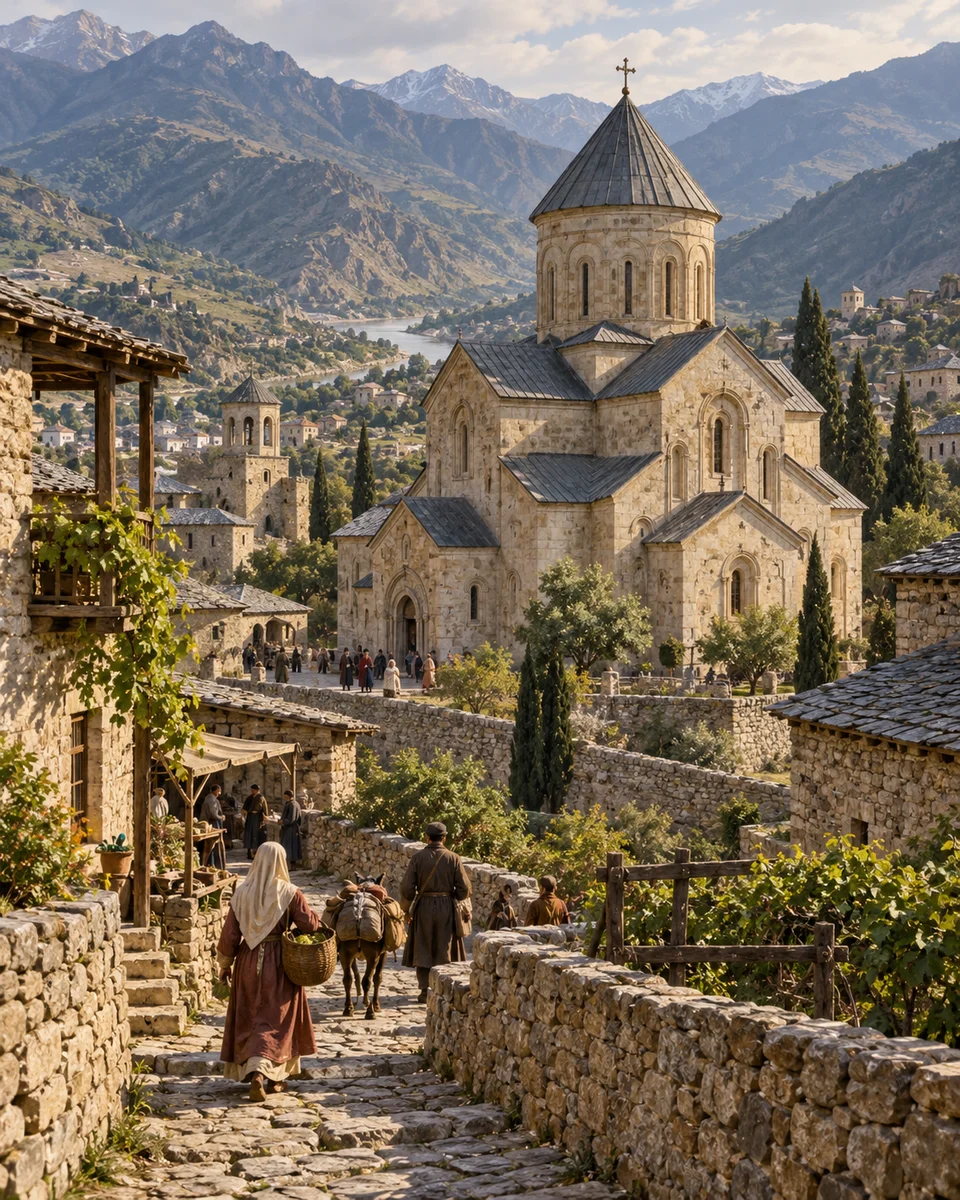
myAudience · AI-generated original illustration · Original generated artwork; not documentary evidence or a grant of landmark/cultural rights. No third-party image reproduced.
David IV began Gelati Monastery in 1106 near Kutaisi. The main church was completed in 1130 during the reign of his successor Demetre. This sequence matters: a royal foundation was a continuing project, not a finished monument that appeared at the instant of its commissioning.
Gelati combined worship with education and manuscript work. UNESCO identifies an academy, scholars associated with translation, and a scriptorium whose precise location is unknown. Later churches, paintings and a surviving twelfth-century mosaic belong to different phases. The ensemble therefore records both an initial foundation and subsequent investment.
A monastery could gather resources, learning and skilled production in one setting. Ask how a translation, a painted image and a fitted stone block each contributed to that institution. This comparison is an educational interpretation of the evidence; it is not proof that every craftsperson or student shared an identical view of royal authority.
Gelati helps illuminate medieval Georgian patronage without representing every community in the kingdom. Distinguish a surviving object from an inferred activity: manuscripts support the presence of copying, while the missing location of the scriptorium remains a genuine limit. Keep dates attached to each building phase rather than reading today’s entire site as one ruler’s original design.
Image: speculative AI reconstruction; uncertain details.
Scene: Medieval Georgian cross-domed church and mountain-town interpretation, chiefly twelfth century.