German political worlds: many rulers and jurisdictions
By German states and the Holy Roman Empire · myAudience
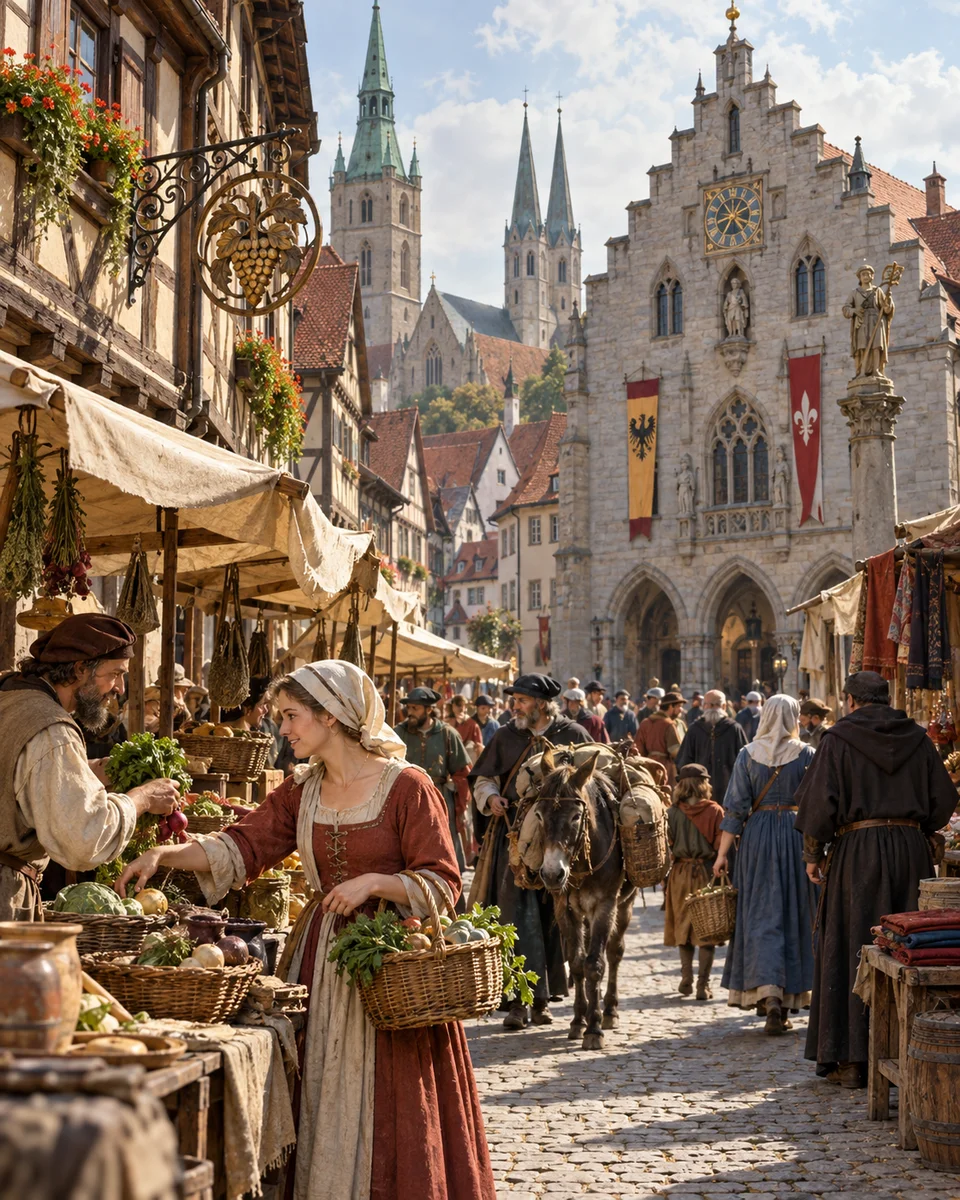
myAudience · AI-generated original illustration · Original generated artwork; not documentary evidence or a grant of landmark/cultural rights. No third-party image reproduced.
The Holy Roman Empire was a changing association of territories and jurisdictions, not the ancient Roman Empire reborn with identical institutions. Emperors shared a political landscape with princes, cities and religious authorities. Frederick Barbarossa's twelfth-century reign therefore belongs to a system of negotiated relationships rather than one uniformly administered national state.
Authority involved land, law, military support and agreements. Towns and trading connections helped sustain prosperity, while conflicts with other rulers and the papacy exposed the limits of imperial power. Imperial titles announced important claims but did not remove the autonomy or ambitions of every local political centre.
Ludwig II ruled nineteenth-century Bavaria in a different setting. His architectural patronage belongs to a period of new national structures and changing state finances, not medieval imperial government. Castles inspired by older styles are evidence of nineteenth-century imagination and construction; they must not be presented as intact buildings from Barbarossa's reign.
Compare a medieval charter with a later royal building account, identifying the authority behind each. Both can illuminate institutions, but they describe different legal worlds. Avoid equating all German-speaking communities with one empire throughout history. This overview makes the distinctions visible before studying individual rulers, so attractive architectural images do not overwhelm the chronology.
Image: speculative AI reconstruction; uncertain details.
Scene: Late-medieval-inspired central European civic town, with invented architectural composition; resemblance to later Gothic Revival buildings is not period evidence or a Neuschwanstein scene.