Ludwig II: a life in context
By German states and the Holy Roman Empire · myAudience
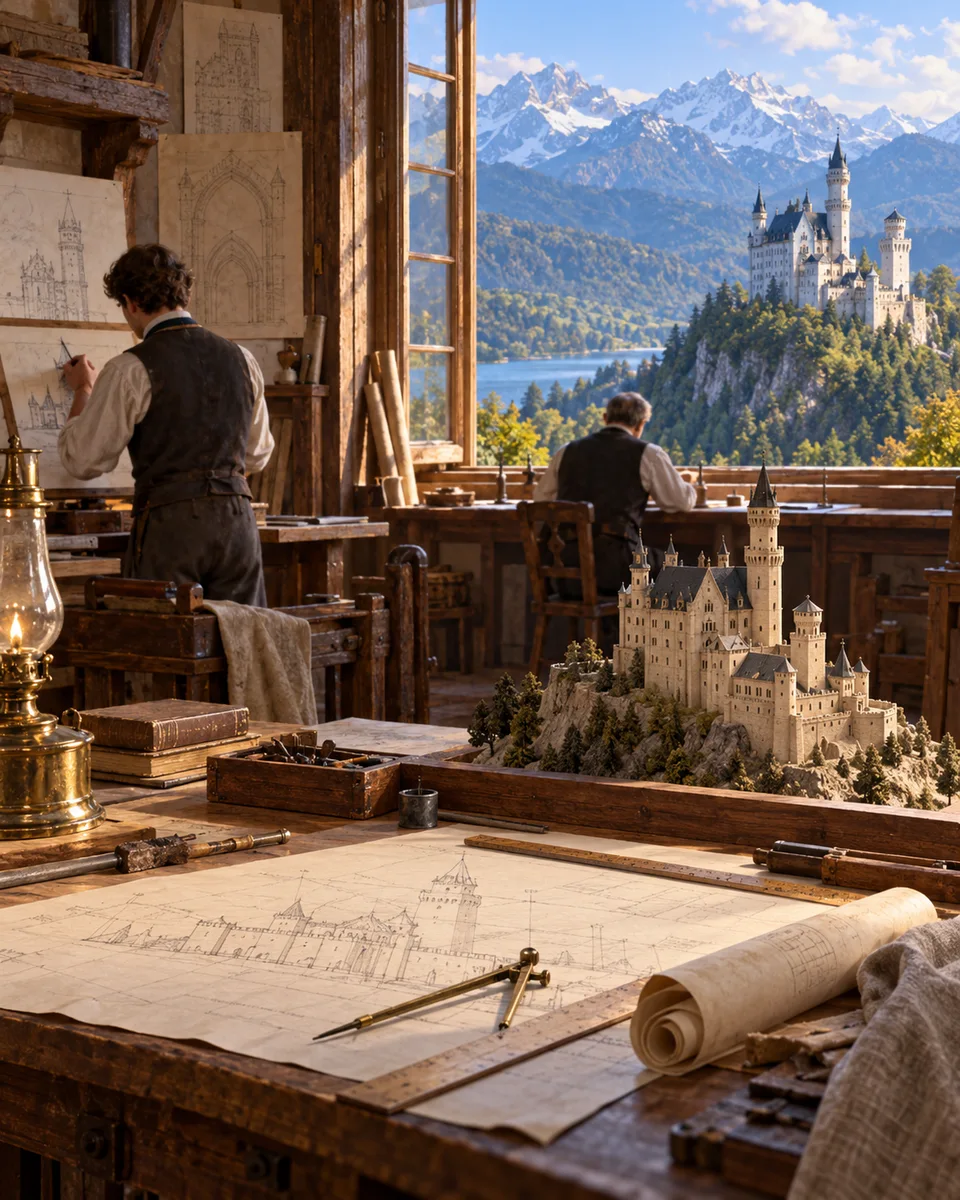
Original AI illustration generated for myAudience · AI-generated illustration; no claim of documentary evidence or authenticated likeness
Ludwig II became king of Bavaria in 1864 within a changing nineteenth-century German political landscape. His reign was not a continuation of medieval emperorship. Bavaria's relationships with the new German Empire affected the political setting in which he ruled.
He is closely associated with elaborate architectural patronage, including Neuschwanstein. These buildings used contemporary organisation and technology while imagining earlier styles. A castle inspired by medieval imagery is not therefore an intact medieval building or evidence of a knightly lifestyle continuing unchanged.
His support for Richard Wagner and other artistic interests shaped his reputation. Building costs and royal obligations also produced political conflict. Popular explanations based only on eccentric personality miss institutions, finances and the interests of those evaluating him.
Architectural imagination is a historical subject in its own right. A nineteenth-century building could draw on medieval motifs while using the materials, organisation and technical possibilities of its own period. The resulting appearance therefore tells us about the patron's representation of the past, not simply about how the Middle Ages looked. Compare an imagined scene with construction evidence to reveal that distinction. Financial and constitutional constraints then make the building part of political history as well as art. This avoids the familiar shortcut in which visual extravagance becomes proof of a personal diagnosis or explains every contested decision surrounding the king.
Neuschwanstein’s construction began in 1869, using contemporary engineering within an imagined medieval design. Bavaria joined the German Empire in 1871, placing his royal patronage within a changing constitutional world. The castle is therefore evidence of nineteenth-century imagination and organisation, not a surviving medieval seat whose appearance proves an unchanged political life.