Gran Colombia: independence and the problem of union
myAudience · AI-generated original illustration · Original generated artwork; not documentary evidence or a grant of landmark/cultural rights. No third-party image reproduced.
The republic commonly called Gran Colombia existed from 1819 to 1831 and joined territories now belonging principally to Colombia, Venezuela, Ecuador and Panama. Its official name was the Republic of Colombia. It arose amid wars against Spanish rule; its geographical scale did not guarantee that distant regions would agree on how to be governed.
Creating a republic required institutions as well as military victories. Leaders debated executive power, regional autonomy and the relationship between government and army. Long journeys and uneven resources complicated administration. The labour of soldiers and civilians sustained independence, while political participation remained unequal and slavery was not immediately eliminated.
Simón Bolívar was central to the project but did not act alone. Rivalries and disagreements with other leaders, including Francisco de Paula Santander, expose genuine competing visions rather than a simple contest between hero and villain. Military prestige could help found a government without solving questions of constitutional accountability.
The union broke apart, but calling it merely a failed empire overlooks the institutions and political arguments that continued in successor republics. Read a constitution beside a regional account and ask who could vote, hold office or claim freedom. Independence from Spain and equal citizenship were related ambitions, not identical achievements completed on the same date.
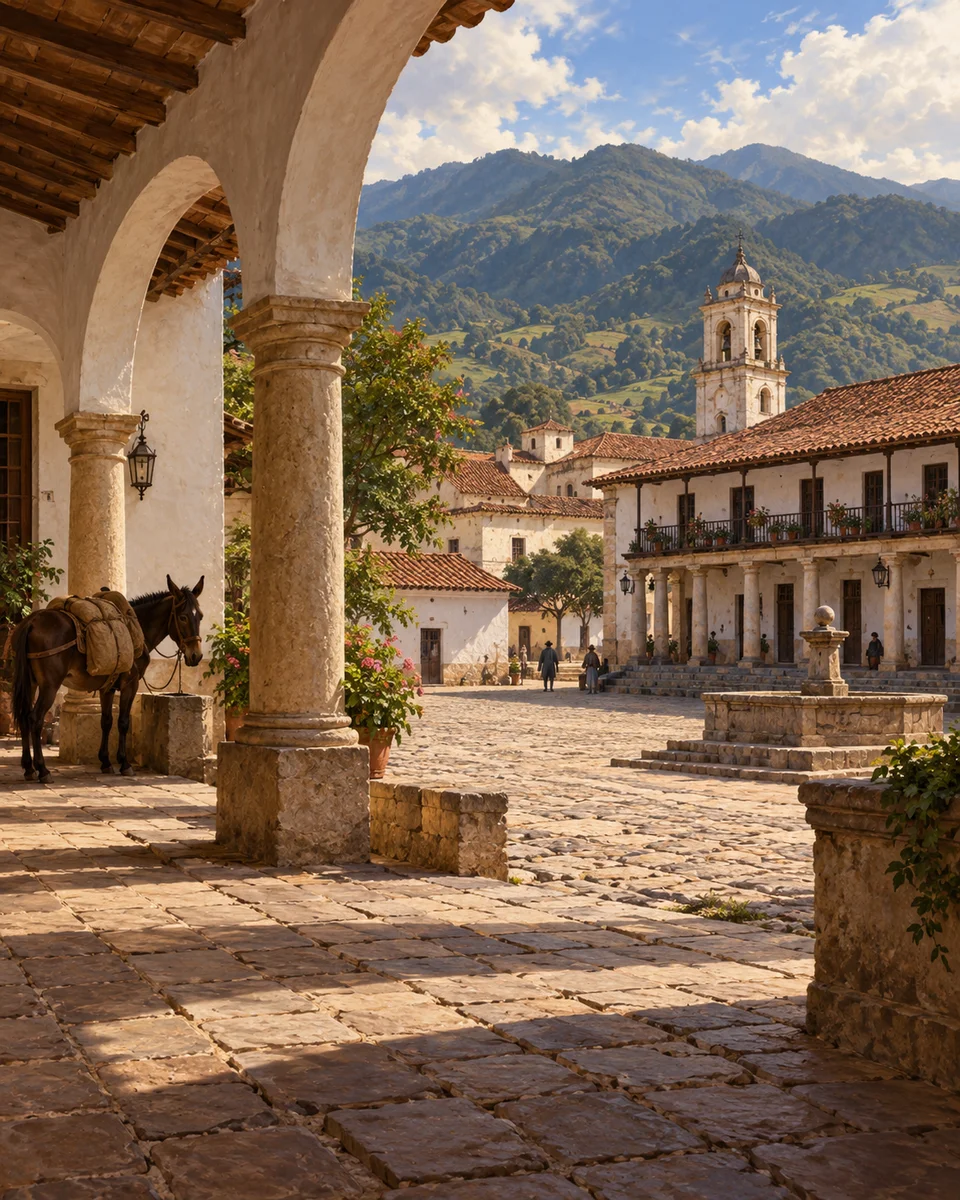
Image: speculative AI reconstruction; uncertain details.
Scene: Northern Andean town in the Gran Colombia period, circa1820s; architecture-led interpretation, without an invented foreground military hero.