Kongo: a capital and a changing religious world
By Kongo, Ndongo and Matamba · myAudience
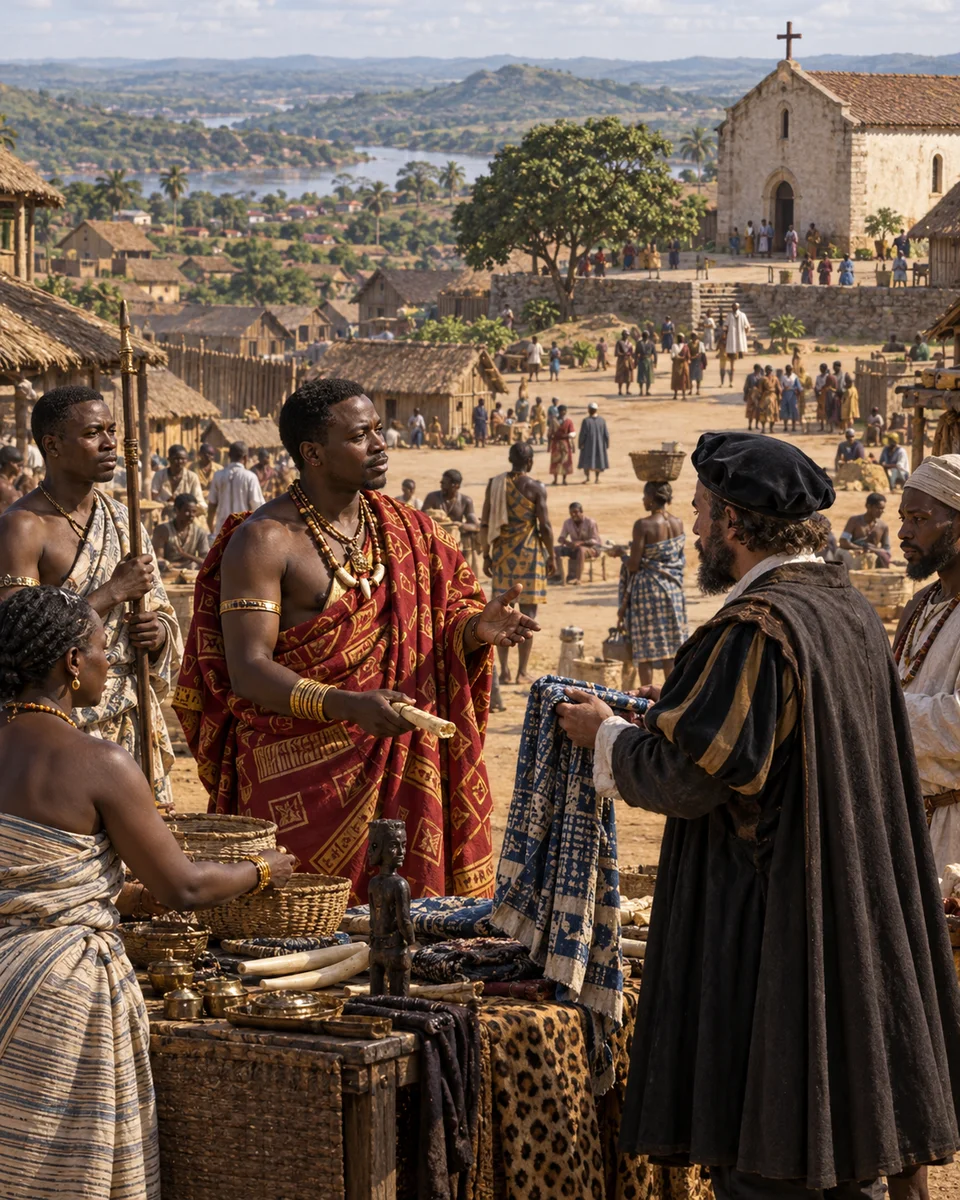
myAudience · AI-generated original illustration · Original generated artwork; not documentary evidence or a grant of landmark/cultural rights. No third-party image reproduced.
Mbanza Kongo was a political and spiritual capital before Portuguese contact. Its development cannot be explained as the creation of a European trading outpost. UNESCO describes a city whose existing buildings and institutions encountered new stone churches and other European forms, while local cultural practices continued.
Kongolese people participated in translating and reshaping Christianity. Historian Cécile Fromont describes multilingual intermediaries and Afonso I’s use of Christian authority in a contested succession. Her analysis of a brass crucifix connects Christian imagery with Central African ideas about life and death; that interpretation is attributed, not treated as an unquestionable reading of every cross.
Religious change and political agency could coexist with coercion. The Atlantic slave trade brought profound harm, while elite participation and political conflict complicated relationships with European merchants. A king’s adoption of a religion therefore cannot stand for the experience of everyone who lived under his authority, especially people exposed to enslavement.
The origins of the kingdom remain debated, and recorded oral traditions do not yield one uncontested founding date. Read the capital, written exchanges and objects as complementary evidence. Kongo is not synonymous with the modern Democratic Republic of the Congo; nearby states and later national borders require their own histories and names.
Image: speculative AI reconstruction; uncertain details.
Scene: Sixteenth-century Mbanza Kongo-inspired town, local houses and plain stone church; town plan and clothing interpreted.