Mvemba a Nzinga: a life in context
By Kongo, Ndongo and Matamba · myAudience
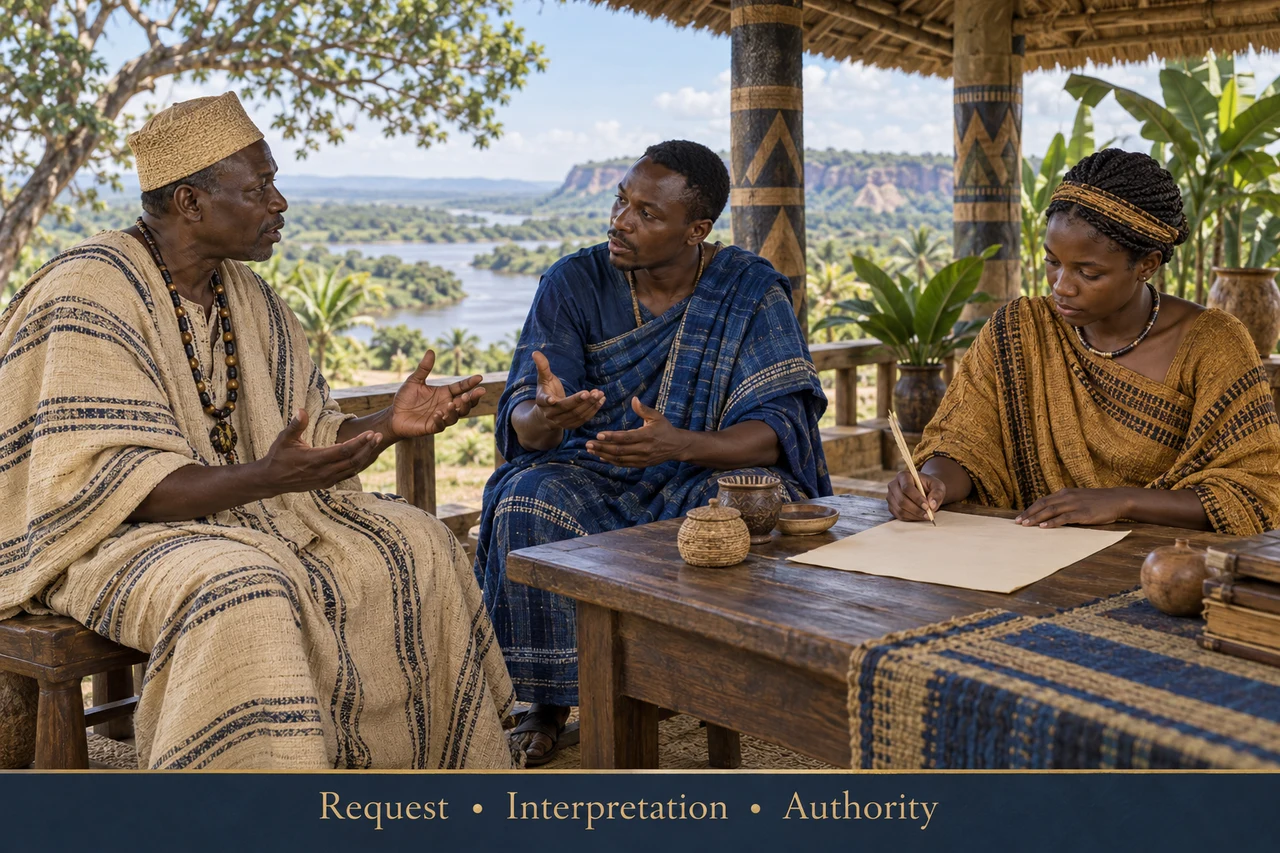
Image: illustration, not a documentary photograph. Imagined Kongo exchange scene: the people, clothing, setting and clerical roles are teaching choices, not evidence of how the 1517 request was delivered. · Original myAudience teaching illustration
Mvemba a Nzinga, known by his Christian royal name Afonso I, ruled Kongo in the early sixteenth century. His kingdom possessed political institutions before Portuguese contact. Adoption of Christianity formed part of a Kongolese strategy and cultural adaptation, not the beginning of civilisation there.
He developed diplomatic and religious connections with Portugal and sought support for education and administration. Relationships between rulers, clergy and traders were not always aligned. Royal intentions could be frustrated by people pursuing commercial or political advantage.
His letters objected to abuses associated with the slave trade, including the unlawful seizure of subjects. They reveal attempts to regulate a damaging exchange, but should not be simplified into proof that the kingdom stood outside every form of slavery.
Correspondence allows his political strategy to be examined more directly than a generic story of European arrival. A request made to another ruler can show what Afonso wanted to regulate, whom he expected to assist and where his own authority faced limits. It does not establish that the requested action occurred. The distinction is crucial when describing opposition to abuses in the slave trade: evidence of objection and evidence of effective control are different. Reading the exchange in both directions also reveals a negotiated relationship whose participants did not share identical aims.
In 1526 Afonso wrote to the Portuguese king about traders kidnapping free people, including members of noble households. He demanded intervention and sought tighter inspection of people being sold. This was an attempt to assert Kongolese jurisdiction within a trade in which the monarchy itself participated, rather than a declaration of universal abolition.
Further reading
A dated letter can make a distant political relationship concrete. The Met’s Kongo exhibition catalog lists a request from Afonso I to Manuel I of Portugal for religious materials, dated 8 June 1517. That record identifies an issuer, recipient, purpose and date. It supports a specific connection between courts, but the catalog title alone does not tell us that every requested item arrived. To investigate delivery, we would need additional records rather than fill the gap with an imagined successful shipment.
Christianity in Kongo involved people who translated and interpreted, not a one-way copying exercise. In a 2025 Met interview, art historian Cécile Fromont explains how multilingual intermediaries and locally informed understandings helped shape religious dialogue. Afonso’s political legitimacy became connected to Christianity, while Kongolese ideas continued to matter. A shared Christian object or term therefore needs a local context: similar outward forms do not prove that everyone understood them identically or that all inhabitants accepted the court’s religious choices.
The structure of government also requires dates and distinctions. Historian John Thornton’s 2025 study discusses Afonso’s 1514 request for special letters to the provincial leaders of Mbata and Mpangu. It also notes that a reference to his son in 1526 concerns revenue from a province, not simply its leadership. Holding an income entitlement, governing a territory and participating in the selection of a king are different relationships. One reference to money should not silently become proof of all three.
Thornton’s interpretation challenges the assumption that Portuguese advisers created Kongo’s central government from nothing. He compares correspondence with later descriptions of appointments and revenue shares, while warning that narratives of origins changed over time. These are arguments built from surviving sources, not an excuse to treat institutions as unchanged across centuries. Ask which date and province a claim concerns, whether the account is contemporary or retrospective, and whether a right to income has been confused with modern private ownership of land.
Use an invented revenue exercise to keep shares distinct from office titles. Suppose a district receives 120 accounting units, of which 36 are forwarded to a central authority and 84 remain locally. The forwarded share is 36 ÷ 120 = 30%. These are invented units and allocations, not measured Kongolese receipts or a valuation of people. The exercise shows why a title alone cannot tell us how much income its holder receives: both the total and the rule governing the share matter.
Now reduce total receipts to 90 units. If the forwarded amount remains fixed at 36, the local remainder is 54 and the forwarded fraction becomes 40%. If instead the rule preserves a 30% share, 27 are forwarded and 63 remain. Those two arrangements produce different results. Can an unchanged list of officials establish which rule operated? No. We would need the relevant entitlement and collection records. This changed example separates an absolute amount, a percentage and an institution without inventing a historical tax schedule.
Political and religious connections did not remove the violence of enslavement. Fromont explains that the expansion of Atlantic slavery interacted with Kongo’s political conflicts; Christian status did not reliably prevent people from being captured in practice. This is not evidence that the court represented everyone equally, nor that its religious alliances amounted to a modern abolition programme. Studying diplomacy and creative religious interpretation should retain the people harmed by those systems, while avoiding a single cause offered as the explanation for every later crisis.
The key learning task is to distinguish a request, a received object, an income entitlement and actual governing authority. The selected teaching illustration makes exchange and interpretation visible, but it does not show Afonso’s authenticated face, the exact 1517 letter or a documented delivery. Evidence can give Kongolese actors agency without making their institutions timeless or treating European involvement as either the sole creator or the sole explanation of their history. The selected documents support bounded questions rather than a complete biography.
An object can illuminate a cultural setting without belonging to the ruler whose life we are studying. The Met dates the brass Kongo crucifix discussed by Cécile Fromont to the sixteenth or seventeenth century. That broad range does not establish that Afonso commissioned, handled or even saw this particular object. Keep three questions separate: when the object was made, what its features may communicate, and whether a specific person's connection to it is documented. An attractive illustration cannot supply the missing provenance.
Fromont interprets the crucifix through a conversation between Christian imagery and Kongolese understandings of life and death. Her explanation makes local interpretation central, rather than treating outward resemblance as proof of passive imitation. But an attributed interpretation is different from a survey showing what every person believed. A careful reader can explain the proposed meaning, identify the features on which the argument rests, and leave disagreement or alternative readings open. Our imagined diplomatic scene illustrates communication; it does not reproduce that museum object or prove anyone's beliefs.
Letters and objects also travel through different evidential chains. A cataloged request records a sender's intention; a surviving item records an object's existence. To connect the two, look for evidence such as a matching date, described contents, destination or acknowledgement. Mere coexistence in an exhibition is insufficient. A later document from another ruler may demonstrate a longer diplomatic relationship, but it cannot retroactively prove that Afonso's earlier request was fulfilled. Build a timeline first, then test each connection instead of merging several centuries into one encounter.
Use a fresh invented example to see why the order of allocations matters. A district receives 200 accounting units. If 25% is forwarded first, 50 leave and 150 remain. A local reserve of 10% of that remainder is 15, leaving 135 for other uses. The reserve is therefore 7.5% of the original receipts, not 10%. If receipts become 160 and the same sequential rules apply, 40 leave, 12 enter the reserve and 108 remain. These invented quantities describe no historical tax or valuation of people; they train us to ask which total each percentage uses before interpreting an income entitlement.
Original worked exercise — Question: In the invented district model, what share of 120 units is forwarded when the central allocation is 36, and what remains locally?
Original worked exercise — Full answer: 36 ÷ 120 = 0.30, so 30% is forwarded; 120 − 36 = 84 units remain. The accounting units are invented, and the result establishes no historical tax rate, land ownership or measure of political freedom.
Original worked exercise — Changed question: Receipts fall to 90 units. Compare a fixed 36-unit allocation with an unchanged 30% rule. Can unchanged office titles decide between them?
Original worked exercise — Changed full answer: Fixed 36 leaves 54 and represents 36/90 = 40%. A 30% rule forwards 0.30 × 90 = 27 and leaves 63. Titles do not determine the applicable rule; entitlement and collection evidence are needed. Both alternatives conserve the 90-unit total.
Original worked exercise — Worked rationale: Divide the forwarded amount by total receipts because the question asks for a share of the whole. Subtraction finds the conserved local remainder. An office title is not an accounting rule or proof of private ownership. The invented units represent an exercise, not historical receipts or enslaved people.
Original worked exercise — Changed rationale: A fixed amount remains 36 even when the total changes, while a 30% rule changes the forwarded amount with total receipts. Compare both the numerator and denominator, then check that central and local amounts still sum to 90. Treating identical titles as proof of identical entitlements would skip the source evidence that decides which rule applied.
Additional worked exercise — Question: In the invented 200-unit district, forward 25% of receipts, then reserve 10% of the remainder. Find all allocations and the reserve's percentage of original receipts.
Additional worked exercise — Full answer: Forwarded = 0.25 × 200 = 50. Remaining = 200 − 50 = 150. Reserve = 0.10 × 150 = 15. Other uses = 150 − 15 = 135. Conservation: 50 + 15 + 135 = 200. Reserve/original = 15/200 = 0.075 = 7.5%. These are invented accounting rules, not a historical revenue schedule.
Additional worked exercise — Changed question: Receipts fall to 160 under the same rules. Compare the correct reserve with reserving 10% of original receipts after forwarding 25%. Why does the result change?
Additional worked exercise — Changed full answer: Under the sequential rule: forward 40, leaving 120; reserve 12, leaving 108. Conservation: 40 + 12 + 108 = 160. Using original receipts as the reserve denominator instead gives 16 and leaves 104; 40 + 16 + 104 = 160, but this is a different rule. The latter reserve is four units larger because it uses 160 rather than 120 as its base. A balanced total alone cannot establish that the correct entitlement was applied.
Additional worked exercise — Method and error rationale: Identify the base before multiplying each percentage. The second percentage applies to the first remainder, so multiplying 0.75 × 0.10 gives a 0.075 share of the original. Conservation catches missing units but does not distinguish two different balanced allocation rules; documentary evidence must decide the actual rule.
Image: illustration, not a documentary photograph. Imagined Kongo exchange scene: the people, clothing, setting and clerical roles are teaching choices, not evidence of how the 1517 request was delivered.