Timbuktu: learning, trade and images of Mali
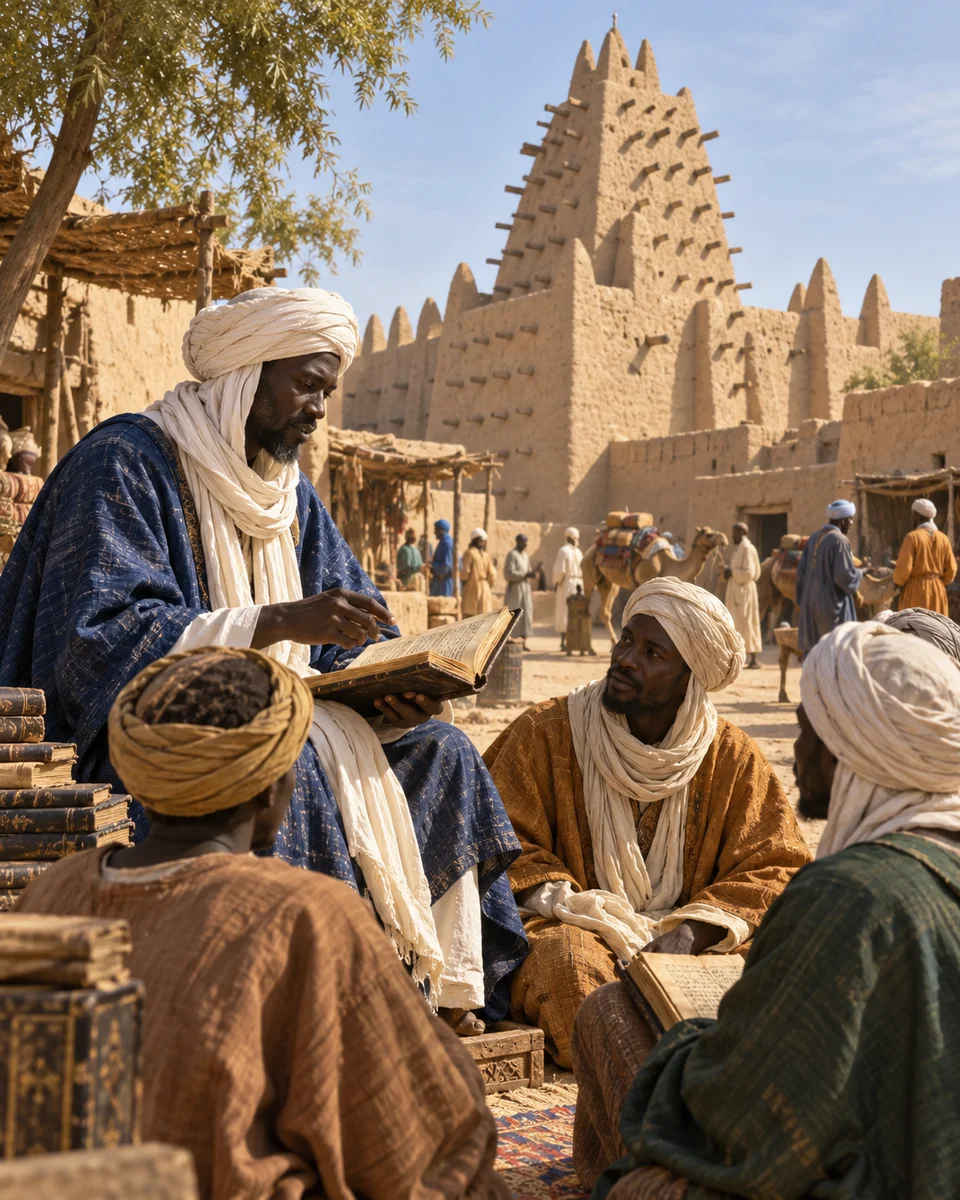
myAudience · AI-generated original illustration · Original generated artwork; not documentary evidence or a grant of landmark/cultural rights. No third-party image reproduced.
Mansa Musa’s pilgrimage brought attention to Mali beyond West Africa. The Met discusses how later European maps represented him through European conventions of monarchy. A famous portrait on a map is therefore evidence of how its makers pictured a ruler, not an authenticated image of his face or a neutral description of Sahelian political life.
Timbuktu developed as a centre of trade and Islamic learning. UNESCO identifies markets for manuscripts and goods including salt, gold, grain and livestock, alongside major mosques. Its account links the initial Djingareyber construction with Musa and records substantial later rebuilding. The surviving building is consequently not an unchanged object from one patron’s lifetime.
A manuscript market joins economic and intellectual history: texts were objects to produce, exchange, read and preserve. This observation opens useful questions without inventing a single curriculum shared by all students. Comparing an institution with a royal portrait also keeps knowledge and work visible beside the image of extraordinary wealth.
Timbuktu’s history extends across different political regimes. This focused account does not repeat UNESCO’s problematic early foundation date or precise medieval student totals. The Met’s discussion likewise warns against forcing all Sahelian leadership into imported visual and political categories. Read a dated building phase and an external representation for the different questions each can actually answer.
Image: speculative AI reconstruction; uncertain details.
Scene: Fourteenth- to fifteenth-century Timbuktu-inspired earthen architecture and exchange; writing marks are not transcribed manuscripts, figures and details interpreted.