Dutch worlds: republic, trade and colonial power
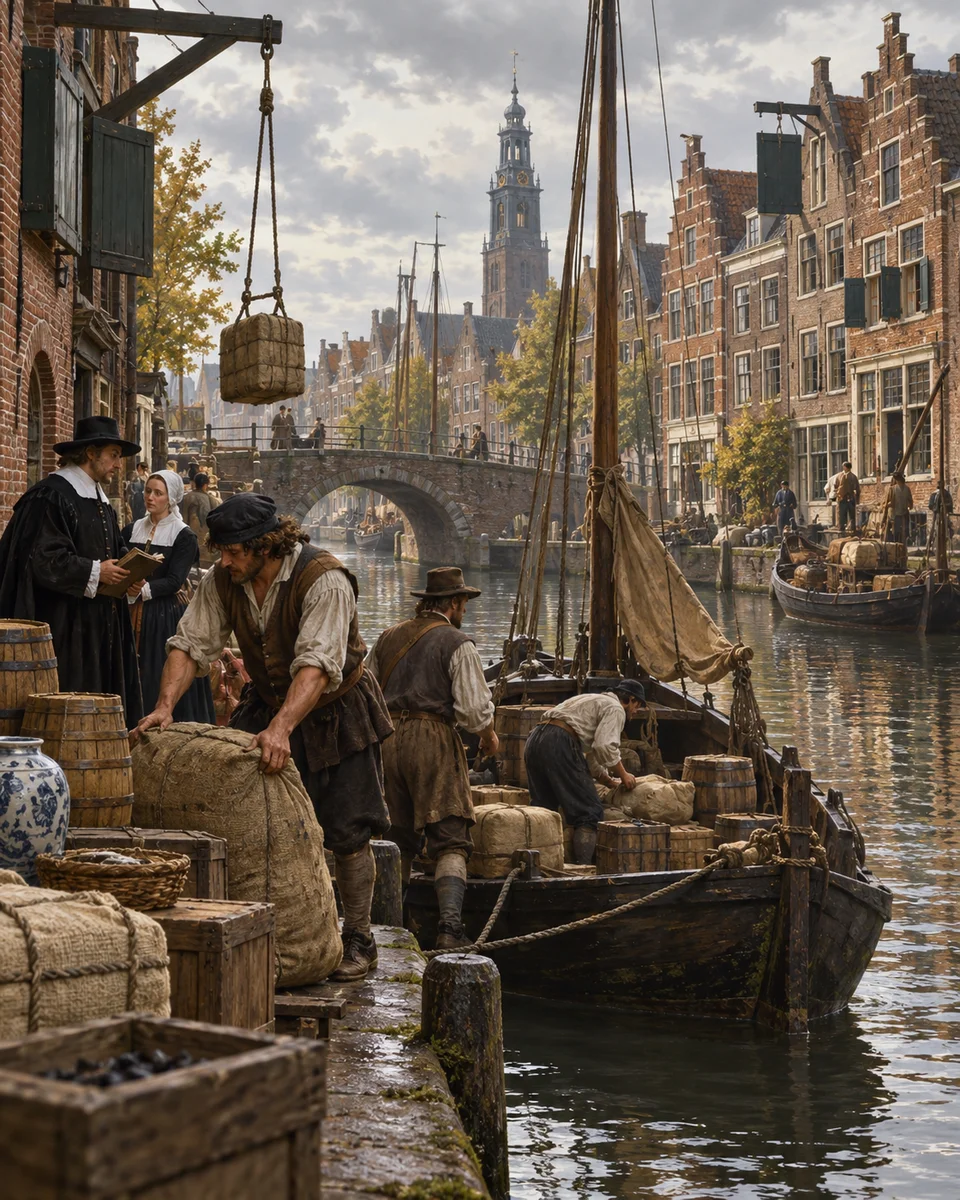
myAudience · AI-generated original illustration · Original generated artwork; not documentary evidence or a grant of landmark/cultural rights. No third-party image reproduced.
The Dutch Republic developed amid revolt against Habsburg rule and became influential through its provinces, towns and commercial networks. It was not governed in the same way as the later Kingdom of the Netherlands. Wilhelmina belongs to the late nineteenth- and twentieth-century monarchy, so her story should not be placed inside the republic's seventeenth-century government.
Ports, shipping, finance and skilled production helped sustain economic power. Canals and water-management works required continuing investment and cooperation. Paintings and urban buildings reflect particular patrons and markets, not a complete picture of social equality. Prosperity rested on workers and resources whose experiences are less visible in elite collections.
Chartered companies operated overseas with commercial and coercive powers. The Dutch East India Company combined trade with armed force and territorial influence. Its activity cannot be described simply as peaceful global exchange; exploitation and colonial violence were central in many settings, alongside relationships shaped by local actors.
The VOC was founded in 1602 by consolidating earlier trading companies. Its charter and corporate organisation joined investors’ interests with overseas political power. In Japan, a controlled trading presence at Dejima offered a very different relationship from military intervention elsewhere. Looking at the company place by place reveals why a single label such as trade cannot explain all its activities.
Image: speculative AI reconstruction; uncertain details.
Scene: Seventeenth-century Dutch canal and cargo working scene; composite buildings and figures.