Suleiman I: a life in context
By Ottoman Empire · myAudience
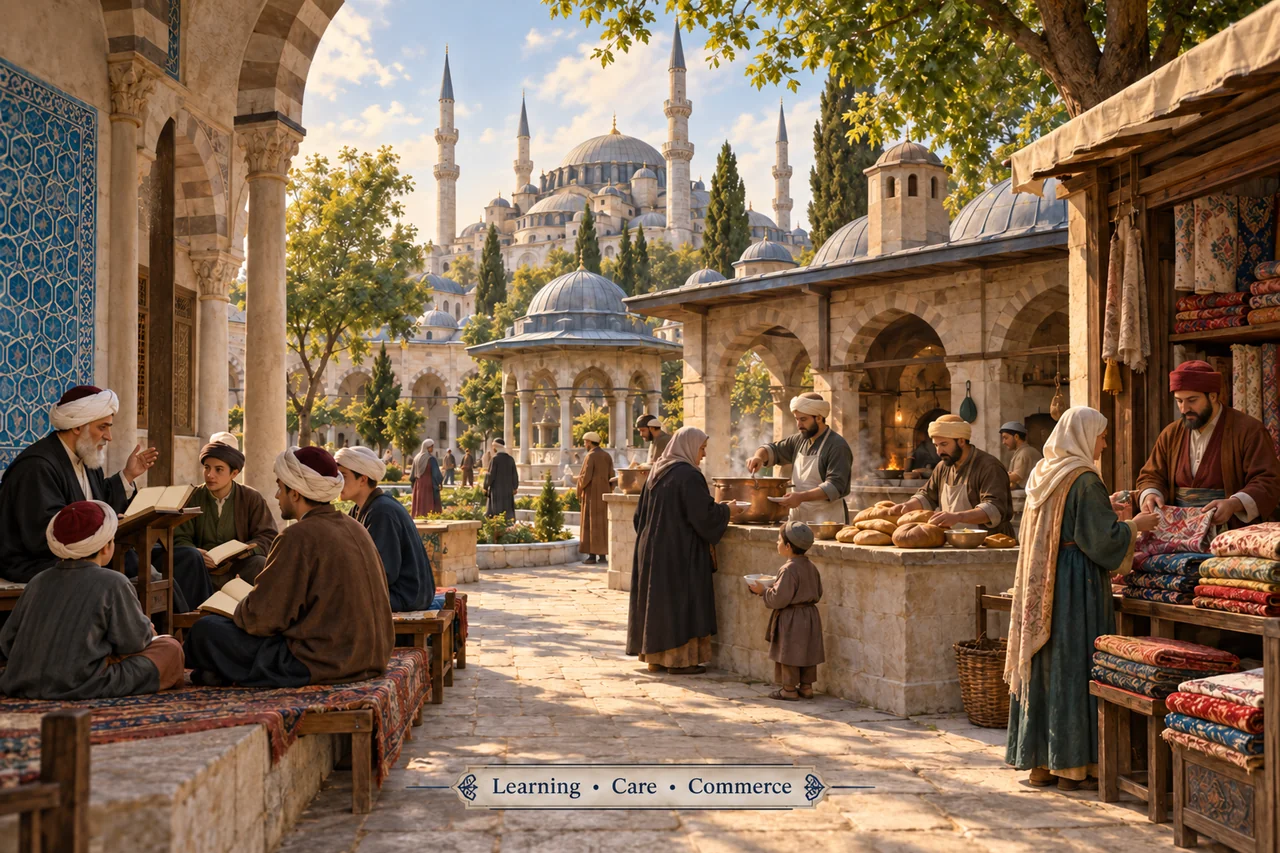
Image: illustration, not a documentary photograph. Imagined courtyard; the arrangement illustrates linked functions, not a measured site plan. · Original myAudience teaching illustration
Suleiman I ruled the Ottoman Empire from 1520 to 1566. His reign combined military campaigns, legal authority and cultural patronage within a complex imperial system. Different communities and regions experienced that system through varied and unequal arrangements.
Warfare and diplomacy extended influence while creating financial and administrative demands. Councils, officials and local relationships shaped implementation. Calling him magnificent or lawgiver identifies important reputations, not a universal verdict from everyone governed.
Architectural patronage, including work associated with Sinan, transformed urban landscapes. Buildings depended on craftspeople, materials and institutions maintaining their wider functions. Religious and royal display therefore belongs beside practical organisation and labour.
Legal reputation and practical justice should be examined separately. A ruler can be associated with a body of regulation while subjects encounter authority through officials and local institutions whose decisions vary. Ask what a particular rule covered, which groups it affected and what evidence exists for enforcement. The same distinction applies to a monumental foundation: proclaimed generosity and the experience of users are related, but not interchangeable. This offers a concrete way to evaluate Suleiman's celebrated titles without either accepting them as universal truth or dismissing the institutions they describe.
Sinan’s Süleymaniye complex in Istanbul was built in the 1550 s during his reign. The architect’s later Selimiye mosque belongs to the period after Suleiman’s death and should not be assigned to the same commission. Dates turn spectacular architecture into a history of continuing institutions and craft, rather than a collection credited wholesale to one famous patron.
Further reading
A monumental mosque can be read as part of an urban system. The Süleymaniye complex in Istanbul was designed by Sinan under Süleyman I; UNESCO dates the major complex to 1550–1557. Its significance is broader than the main dome. Schools, accommodation, care, bathing and commerce place religious architecture within the practical life of a city. An impressive skyline is the beginning of the explanation, not its conclusion.
The word külliye describes a linked complex rather than just a large prayer hall. UNESCO’s account includes a madrasa, medical school, bath building, hospice and other associated structures. Different functions require different kinds of space: teaching needs rooms where people can gather, accommodation needs places to stay, and bathing needs water and working arrangements. This comparison explains functional diversity; it is not a measured plan or a claim that every building now present had its present use in 1557.
Institutions also need a continuing way to pay for their work. The Met explains how pious foundations, including schools, hospices and soup kitchens, were supported by commercial properties such as shops, markets, baths and caravanserais. A foundation can connect income-producing activity with services that do not depend entirely on charging each recipient. That is a useful organisational principle to study, although the costs, rules and beneficiaries of any particular foundation must be established from its own records.
A building and an institution can change at different speeds. Stone walls may survive while the activities, staffing or collections inside them change. Calling a structure a library today does not automatically date the present collection or institutional arrangement to the first construction campaign. Likewise, a current visitor route is not proof of a sixteenth-century route. Treat architectural fabric, dated documents and present use as related evidence with separate chronologies.
Here is an invented budget model, expressed in account units rather than historical Ottoman prices. Suppose a foundation receives 120 units and spends 45 on food, 35 on wages and 20 on maintenance. Total spending is 45 + 35 + 20 = 100 units, leaving 120 − 100 = 20. The arithmetic shows why an attractive building is not enough: a continuing service also depends on recurring income and costs. It does not establish the real foundation’s accounts, quality of care or who was admitted.
Change the model so income falls by 25% while those three costs stay the same. Income becomes 120 × 0.75 = 90 units; spending remains 100, producing a shortfall of 10. Would a 20-unit reserve solve the problem indefinitely? No. It covers two identical 10-unit shortfalls, assuming no other changes, then is exhausted. The model distinguishes a reserve from a sustainable income stream without pretending that this simplified scenario describes a recorded Ottoman crisis.
Documentation helps test claims about buildings as well as budgets. A 2019 ISPRS case study describes laser scanning, photographic material and three-dimensional modelling of the Süleymaniye complex. Such a record can support comparison of observed surfaces and later change; a generated illustration cannot substitute for measured evidence. Even a scan needs a known date, scale, coverage and interpretation. A detailed digital view is a record with limits, not direct access to every phase of the past.
The drawing places learning, public service and commerce beside an imagined Ottoman courtyard, so that the linked functions are easy to notice. It does not reproduce a surveyed site plan, a historical admission policy or an authenticated likeness of Süleyman or Sinan. The project’s splendour and imperial patronage should be studied alongside the people who funded, built and used it. Explaining how a foundation worked does not make military expansion benign or prove that its benefits reached everyone equally.