Phoenician cities: networks, craft and writing
By Phoenician and Carthaginian worlds · myAudience
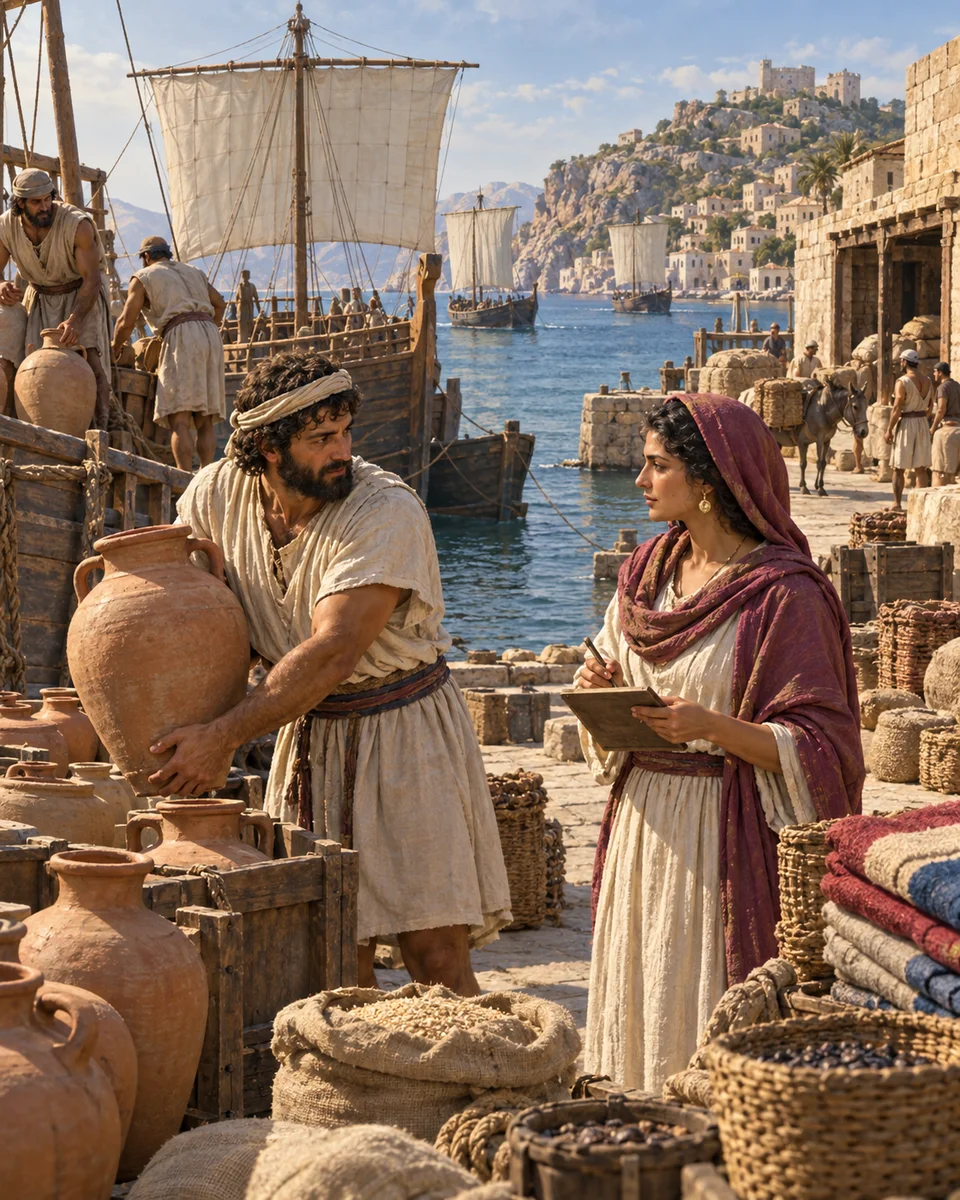
myAudience · AI-generated original illustration · Original generated artwork; not documentary evidence or a grant of landmark/cultural rights. No third-party image reproduced.
Tyre, Sidon, Byblos and Arwad were distinct coastal centres rather than provinces of one permanently unified Phoenician empire. The Met describes rival cities linked with maritime exchange. Phoenician is itself a name inherited from Greek accounts, so a modern label should not automatically be treated as everyone’s own contemporary identity.
Artisans worked wood, ivory, metal and textiles, and trade linked the coast with settlements around the Mediterranean. Byblos preserves building phases extending far beyond the period usually called Phoenician. Its inscriptions also help document alphabetic writing, whose wider influence depended on adoption and adaptation by other communities.
A trading network is not the same as direct territorial rule. An imported object demonstrates movement, but does not by itself reveal whether it arrived through a purchase, a gift or coercion. These distinctions make a port or excavated object a useful starting point for inquiry without turning every connection into a peaceful or equal relationship.
Much surviving narrative evidence comes from outside writers, alongside archaeology and inscriptions. The Met presents stories of distant voyages as reports by ancient authors, not modern eyewitness verification. This overview keeps that distinction and does not supply a secure biography for Dido from a foundation tradition. Carthage’s later political history needs its own scope.
Image: speculative AI reconstruction; uncertain details.
Scene: First-millennium BCE eastern Mediterranean merchant port interpretation; not a single unified Phoenician capital.